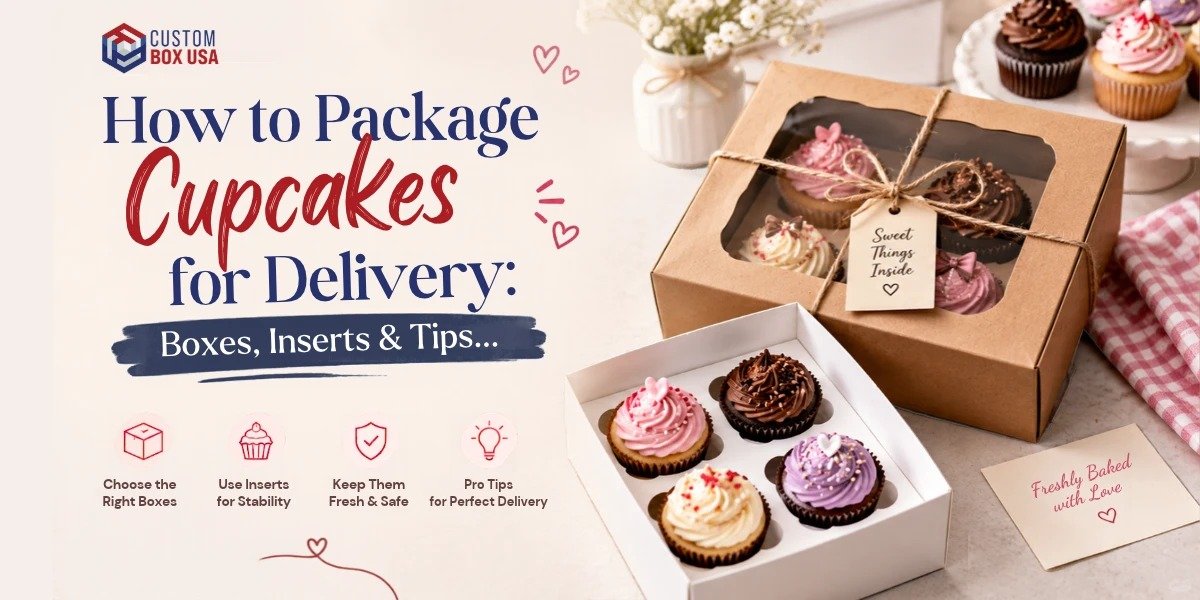
Most bakers blame smashed cupcakes on rough drivers. Usually, though, the damage starts at the packing table. To package cupcakes for delivery, set each chilled cupcake in a snug insert, use a box tall enough to leave space above the frosting, and close it tight. For shipping, put that box inside a sturdy outer box with padding and, when needed, a wrapped cold pack.
How to package cupcakes for delivery: the quick answer
Five parts work together here. For a local trip, the first two often do the job.
- Insert: a cardboard tray with round holes. Each cupcake sits in its own hole, like eggs in a carton.
- Cupcake box: tall enough that the frosting never touches the lid.
- Outer box: for shipping only. It takes the bumps so the inner box doesn't.
- Cooling: chilled cupcakes hold their shape. Cold packs help on hot days and long routes.
- Label: "Perishable," "Fragile" and "This Side Up" stickers warn the people handling the box.
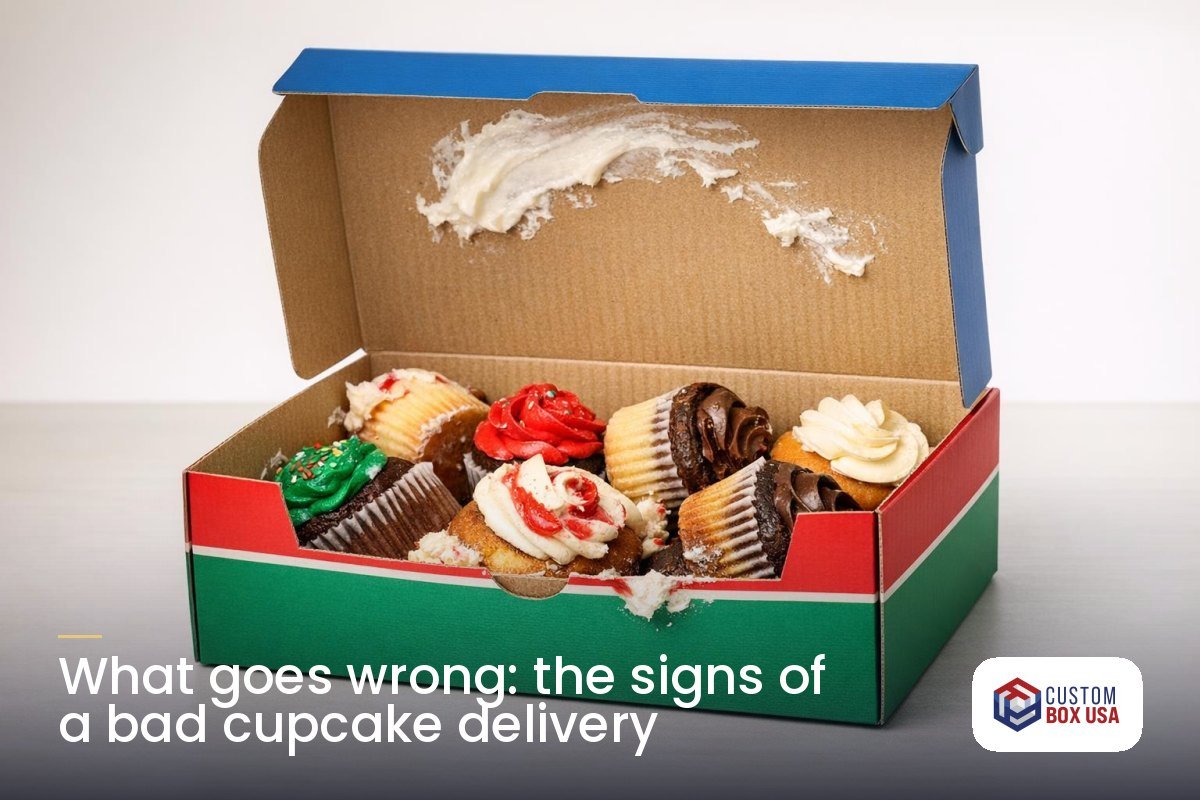
What goes wrong: the signs of a bad cupcake delivery
Failed deliveries tend to look alike. Each sign is a clue that points to one cause:
- Frosting on the lid: the box was too short, or the cupcakes moved upward.
- Cupcakes lying on their side: nothing held them in place.
- Drooping frosting or sliding toppers: the cupcakes got warm.
- A crushed corner: the outer box was too weak for the trip.
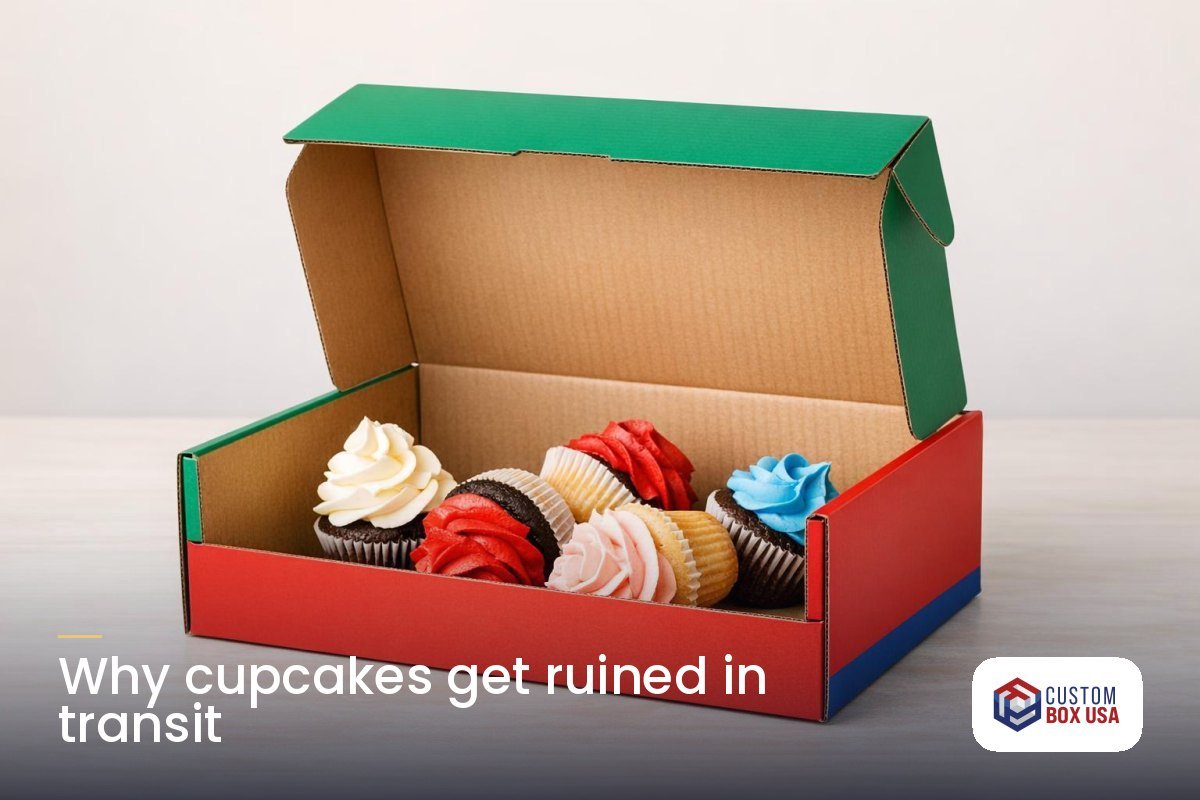
Why cupcakes get ruined in transit
Almost every ruined cupcake comes down to one of six causes. Fix the cause, and the problem goes away.
The box is too big and has no insert
A cupcake is top-heavy, with a narrow base and a heavy swirl on top. In a roomy box, one tap of the brakes sends it sliding into its neighbor. Then the rest fall like dominoes.
The frosting sits too close to the lid
Boxes flex and bounce on the road. If the tallest swirl sits just under the lid, a small bump presses the two together. The result is the smeared lid that customers complain about most.
The insert holes don't match the liner size
A hole that's too big lets the cupcake wobble. One that's too small pushes the cupcake up toward the lid and can crack the liner. Mini, standard and jumbo cupcakes each need their own hole size.
The frosting is too soft for the trip
Whipped toppings and warm buttercream lose their shape fast. Firm, butter-rich buttercream and ganache (a mix of chocolate and cream) hold up much better on the road.
The outer box lets things shift
A thin outer box, or empty space inside it, lets the cupcake box slam around. Every drop then travels straight to your frosting.
The route is too slow or too warm
A box that sits in a hot car or a closed warehouse can hurt both the look and the safety of your cupcakes. Carriers call this waiting time "dwell time," and weekends add a lot of it.
Cause and fix at a glance
Match the problem you see with the change that fixes it.
| What you see | Likely cause | Fix |
|---|---|---|
| Cupcakes tipped over | No insert, or box too big | Use cupcake boxes with inserts sized to your liners |
| Frosting stuck to the lid | Box too short | Choose a taller box and leave at least 1 inch of clearance |
| Cupcakes wobble in their holes | Insert holes too wide | Order inserts for your exact liner size |
| Droopy frosting, sliding toppers | Heat or soft frosting | Chill before packing; use firmer frosting for long trips |
| Crushed or dented box | Weak outer box, no padding | Double box with corrugated cardboard and void fill |
| Box arrives warm | Slow service or weekend delay | Ship fast, early in the week, with a wrapped gel pack |
Local delivery or shipping? Pick your route first
Your route decides your packaging. A short drive across town and a cross-country parcel need very different setups, so choose the route before you choose the box.
Decision table: car trip vs. courier vs. mail
| Route | Box setup | Cooling | Risk level |
|---|---|---|---|
| Your own car, same day | Cupcake box with insert | Chill before packing; cool car | Low, because you control the ride |
| Local courier or delivery app | Cupcake box with insert, sealed with a sticker | Chill first; insulated bag on hot days | Medium, because you can't control handling |
| Mail or parcel carrier | Cupcake box with insert inside a corrugated outer box with padding | Chill or freeze first; wrapped gel pack and insulated liner | High, because of drops, stacking and delays |
Which cupcakes travel well and which don't
Some cupcakes are simply better travelers. Here's our honest view, based on frosting type and fillings.
| Cupcake type | Travel risk | Best route |
|---|---|---|
| Firm, butter-rich buttercream | Lower | Local or shipping |
| Ganache topping | Lower | Local or shipping |
| Unfrosted, with frosting sent separately | Lowest | Shipping |
| Whipped cream topping | High | Local only |
| Cream cheese frosting or cream fillings | High | Local only, kept cold |
| Fresh fruit toppings | High | Local only |
We wouldn't ship cream-filled or cream cheese cupcakes. They're what food-service workers call TCS foods, which need time and temperature control to stay safe. If you sell them, ask your local health department about cottage food rules (state rules for selling food made at home) before you ship anything.
What is the best box for cupcake delivery?
The best box fits your cupcakes closely, holds an insert, and leaves room above your frosting. The style and material depend on your route and your brand.
Window, tall, single and multi-count boxes
- Window boxes have a clear panel, so customers see the cupcakes without lifting the lid. They work well on counters and for gift orders.
- Tall boxes suit high swirls and toppers.
- Single boxes fit favors, samples and premium cupcakes.
- Multi-count boxes cover most bakery orders. Pick the count that matches how you sell, such as by the half dozen or dozen.
Kraft or white for a bakery
Kraft is the brown, natural-looking board. It feels rustic and hides small scuffs. White board makes colors pop and looks clean and bright. Neither one wins outright: kraft suits farmhouse and organic brands, while white suits bold, colorful designs. Compare options on our custom kraft boxes page.
Paperboard for local trips vs. corrugated for shipping
Paperboard is thin, flat cardboard, like a cereal box. It's light and prints beautifully, so it's a good fit for the inner cupcake box and local delivery. Corrugated cardboard has a wavy layer inside that makes it stiff, a bit like a car's bumper. That's what you want for the outer shipping box. Most regular bakery boxes can't survive a parcel network alone, which is why double boxing is the safer choice.
Custom printed cupcake boxes with your logo
A plain box gets the cupcakes there. A printed box also tells everyone who made them. Put your logo, colors and social handle on the lid, and your box becomes a silent salesman at every office party and birthday table.
Cupcake box inserts: which type and size fit?
Cupcake boxes with inserts are the biggest single fix for tipped and smeared cupcakes. The insert locks each cupcake in place, so it can't slide or bump its neighbor.
Cardboard, die-cut and removable inserts
A die-cut insert is cut by a metal blade into an exact shape, such as round holes that match your liner. Some inserts are glued into the box, and others lift out so you can swap sizes. For example, some retail cupcake carriers come with two inserts, one for standard and one for mini cupcakes, because a single tray can't hold both well.
| Insert type | Best for | Watch out for |
|---|---|---|
| Fixed cardboard insert | One cupcake size you sell every day | Can't switch sizes |
| Removable die-cut insert | Bakeries selling mini, standard and jumbo | Must order the right hole size for each |
| Deep insert with tall walls | Tall frosting and toppers | Needs a taller box |
| Flat tray with shallow holes | Low frosting, local trips | Less grip for shipping |
Matching holes to mini, standard and jumbo liners
Measure before you order:
- Measure the liner's width at its base. That sets the hole size.
- Measure the full height, from the bottom of the liner to the top of the frosting.
- Add at least 1 inch to that height to get the inside height of the box.
- Order one sample box and test it with real cupcakes.
For a refresher on box sizes, our guide on how to measure box dimensions walks through length, width and height.
Step-by-step: how to pack cupcakes for delivery
Follow these seven steps in order. Each one fixes a cause from the list above.
1. Cool and chill first
Let cupcakes cool fully, then chill them so the frosting firms up. Cold frosting acts like a hard shell instead of soft cream. For shipping, some bakers freeze frosted cupcakes unwrapped until firm, then wrap each one. Wrapping them earlier would flatten the swirl.
2. Place them in the insert and check clearance
Set each cupcake in its hole, then check from the side. Packaging guides suggest at least 1 inch of space above the tallest frosting. With less room, one bounce can push the lid into your swirls.
3. Anchor with candy sticks if needed
For long trips, push a candy stick or toothpick into the center of each cupcake. Trim it so it just touches the lid. It works like a tent pole, holding the lid up and the cupcake down. Remind the customer to remove the sticks before eating.
4. Close and seal the cupcake box
Close the lid and add a tamper-evident seal, a sticker that shows if someone opened the box. For shipping, you can also wrap the box in food-safe plastic to keep moisture out.
5. Put it in a snug outer box with void fill
Pick a corrugated outer box only a little bigger than the cupcake box. Fill the gaps with void fill, meaning paper, bubble wrap or packing peanuts. Shake the box: nothing should move.
6. Add a wrapped gel pack when needed
A gel pack is a frozen pack that keeps the box cool, like the ice pack in a lunchbox. Wrap it and place it beside or on top of the cupcake box, never touching the cupcakes. An insulated liner, a foam or thermal layer, slows down the heat coming in.
7. Label and tape all seams
Tape every seam, not just the middle one. Add "Perishable," "Fragile" and "This Side Up" labels, though they can't promise gentle handling. Put the customer's name and address on the outer box only, not on your printed cupcake box.
Keep cupcakes safe: temperature and time
Looks matter, but safety matters more. Perishable cupcakes need to stay cold, and the clock starts the moment they leave your fridge.
The USDA 2-hour rule and the 1-hour limit above 90°F
The USDA says bacteria grow fast between 40°F and 140°F, a range it calls the Danger Zone. It advises refrigerating perishable food within 2 hours, or within 1 hour when the air is above 90°F. See USDA's 2-hour rule for delivered food for details.
The same rules apply to food mailed from home. Per USDA mail order food safety guidance, perishable food that arrives above 40°F shouldn't be eaten, even if it looks and smells fine. FoodSafety.gov delivery tips add that shipped perishables should arrive frozen, partly frozen, or at 40°F or below.
Warm-weather checklist
- Schedule deliveries for the cooler part of the day.
- Pack cupcakes straight from the fridge, not after they've sat on the counter.
- Run the car's air conditioning before loading.
- Use an insulated bag and a wrapped gel pack for courier trips.
- Choose sturdier frostings in summer, or keep cream-based flavors for pickup only.
What to tell your customer on arrival
Slip a small card inside the box. Write "Refrigerate on arrival," explain how to open the box, mention any candy sticks, and add a "best by" time. It takes seconds and protects both your customer and your reputation.
How do you transport cupcakes in a car?
Put the boxes on a flat surface, such as the floor or the trunk, and drive gently. Car seats slope backward, so boxes on them tilt and slide on every turn.
Flat floor or trunk, not seats
The floor behind the front seats is often the best spot. A non-skid shelf liner under the boxes stops them from sliding. Keep them out of direct sun from the windows.
Drive tips and an emergency repair kit
Brake early and take corners slowly. Pack a small kit with a piping bag of spare frosting, a small spatula and extra toppers. If one cupcake gets bumped, you can fix it at the door.
Stacking and securing boxes
Only stack boxes strong enough to take the weight, with the heaviest on the bottom. Wedge them against each other or the seat back so they can't slide as a group.
How to ship cupcakes: carrier and timing tips
Once the box leaves your hands, speed matters more than almost anything else.
Fast service and early-week shipping
Choose overnight or 1 to 2 day service. Ship early in the week so your box doesn't sit in a warehouse over the weekend.
Tracking, insurance limits and recipient notice
Always use tracking, and share the link with your customer. Many shipping insurance policies don't cover baked goods, so read your carrier's terms before counting on a claim. Tell the recipient when the box will arrive, so it doesn't sit on a warm porch.
Check USPS Publication 52 for mailing perishables
USPS Publication 52 is the postal service's rulebook for what can be mailed. Its USPS Publication 52, Perishable Matter section covers items that can spoil in the mail, cause a health risk, or create odors. Read it before you mail cupcakes through USPS, and check other carriers' rules before your first shipment.
Shipping other baked goods too? Our post on how to ship cookies without breaking applies the same double-box idea to cookies.
Prevent it next time: test pack before you scale
A test run costs one box and one batch of cupcakes. A failed order can cost you a customer.
Shake test and a trial run
Pack a full box with real cupcakes and shake it gently side to side. If anything moves, add void fill or check the insert. Then drive the real route, or mail it to a friend, and open the box at the end. Look for smears, tilting and warmth.
Common mistakes to check before every order
- Box too big for the number of cupcakes
- No insert, or insert holes the wrong size for the liner
- Frosting touching the lid
- Gel pack touching the cupcakes
- Shipping right before a weekend
- Thin outer box with no padding
- Taping only the middle seam
Cupcake packaging for bakeries from Custom Box USA
Custom Box USA makes custom printed cupcake boxes with inserts in the size, style and material you choose. You can order one sample box first, then move to a bulk run once it passes your test.
- Sizes and inserts: boxes built around your cupcake height, with die-cut cardboard inserts for mini, standard or jumbo liners.
- Styles: window boxes, tuck-end boxes and two-piece boxes.
- Materials: paperboard for inner boxes, corrugated cardboard for shipping, and kraft or recyclable stock. Ask our team which materials suit your cupcakes and frostings.
- Printing and finishes: print outside, inside or both. Choose gloss or matte, spot UV (a shiny coating on chosen areas), foiling (a metallic layer) or embossing (a raised design).
Our team offers free design support, so you can upload finished artwork or just share your logo. Shipping is free across the USA, and there are no die and plate charges. The minimum order is as low as 1 unit. Standard turnaround is 8 to 10 business days, and rush orders take 4 to 6 days, though timing may vary with order volume and location. New customers also get 20% off their first purchase.
Want greener packaging? Our eco-friendly packaging range includes recyclable kraft options. Browse styles on our custom bakery boxes page.
Frequently Asked Questions
How do you ship cupcakes without smashing them?
Chill them, set them in a snug insert, and double box them with padding. Leave space above the frosting, use candy sticks for long trips, and choose 1 to 2 day shipping early in the week.
What is the best box for shipping cupcakes?
A paperboard cupcake box with a fitted insert, placed inside a corrugated outer box. The inner box holds the cupcakes, and the outer box takes the bumps.
Do you need inserts in cupcake boxes?
Yes, for almost every delivery. Without an insert, top-heavy cupcakes slide and tip, even on a short drive.
How do you keep cupcakes from sliding in a box?
Use an insert with holes that match your liner size. For extra hold, add a candy stick trimmed to touch the lid, and put a non-skid liner under the box in the car.
Should you freeze cupcakes before shipping?
Freezing firms up the frosting and helps on longer trips. Freeze them unwrapped until firm, wrap each one, and pack them with a wrapped gel pack. For short local trips, chilling in the fridge is usually enough.
Are your cupcake boxes recyclable?
We offer kraft and recyclable stock options. Tell us how you'll use your boxes when you request a quote, and our team will suggest a material that fits.
Get a free quote
Great cupcakes deserve a box that gets them there in one piece. Start with the right insert, the right height and a cold, quick route, and your packaging will do the rest. Tell us your cupcake size, count and design idea, and we'll send back a price. Get a free quote on custom cupcake boxes today.