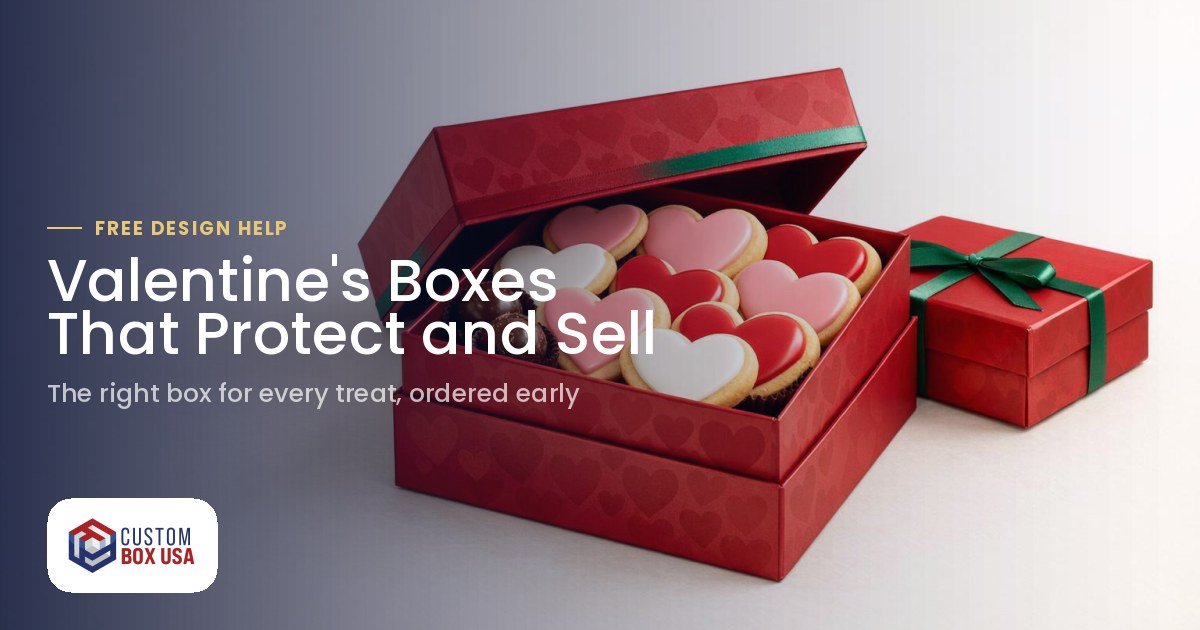
Candy was the most popular Valentine's gift in the US in 2026, ahead of flowers and greeting cards. That's a real opening for your bakery or chocolate shop. The best Valentine's Day packaging ideas for bakeries come down to five moves. Match the box to the treat, hold each piece with an insert, show off your work with a window, keep the theme easy to remove, and order early.
Below you'll find a step-by-step plan, a box-by-treat table, common mistakes with fixes, and a timeline built around February 14, 2027.
| What you need | Time | Result |
|---|---|---|
| A list of your Valentine's treats and gift sizes | One short planning session | You know which box styles to order |
| Measurements of each product | A few minutes per item | Boxes that fit, with no sliding |
| Your artwork, or just your logo | Faster with free design support | A print-ready design proof |
| One sample box | Before your main order | Fit, color and quality checked with real product |
| An approved design | 8 to 10 business days standard, 4 to 6 days rush (times may vary) | Boxes on your shelf before the rush |
Why does Valentine's Day packaging matter for bakeries and chocolate shops?
Shoppers spend more each year, and sweets sit at the top of their gift lists. A gift has to look like a gift the moment it leaves your counter.
What shoppers plan to buy
The NRF 2026 Valentine's Day spending survey forecast a record $29.1 billion in US Valentine's spending for 2026. That beat the 2025 record of $27.5 billion. Shoppers planned to spend an average of $199.78 each, up from $188.81 the year before.
Candy led the gift list at 56%. Flowers and greeting cards each came in at 41%. The treat is the star, and your box is what turns it into a present.
Gifts for friends, coworkers and family, not just partners
In the same survey, 55% of consumers planned to celebrate. Of those, 83% planned a gift for a partner and 58% planned gifts for other family members. NRF also said growth came from shoppers adding friends, coworkers and even pets to their lists.
That should shape your design. A box that says "Be Mine" works for one kind of buyer. A box that says "Sweet on You" works for a partner, a best friend, a teacher or a whole office. For team and client orders, custom corporate gift boxes with your logo make a Valentine's thank-you feel planned, not grabbed.
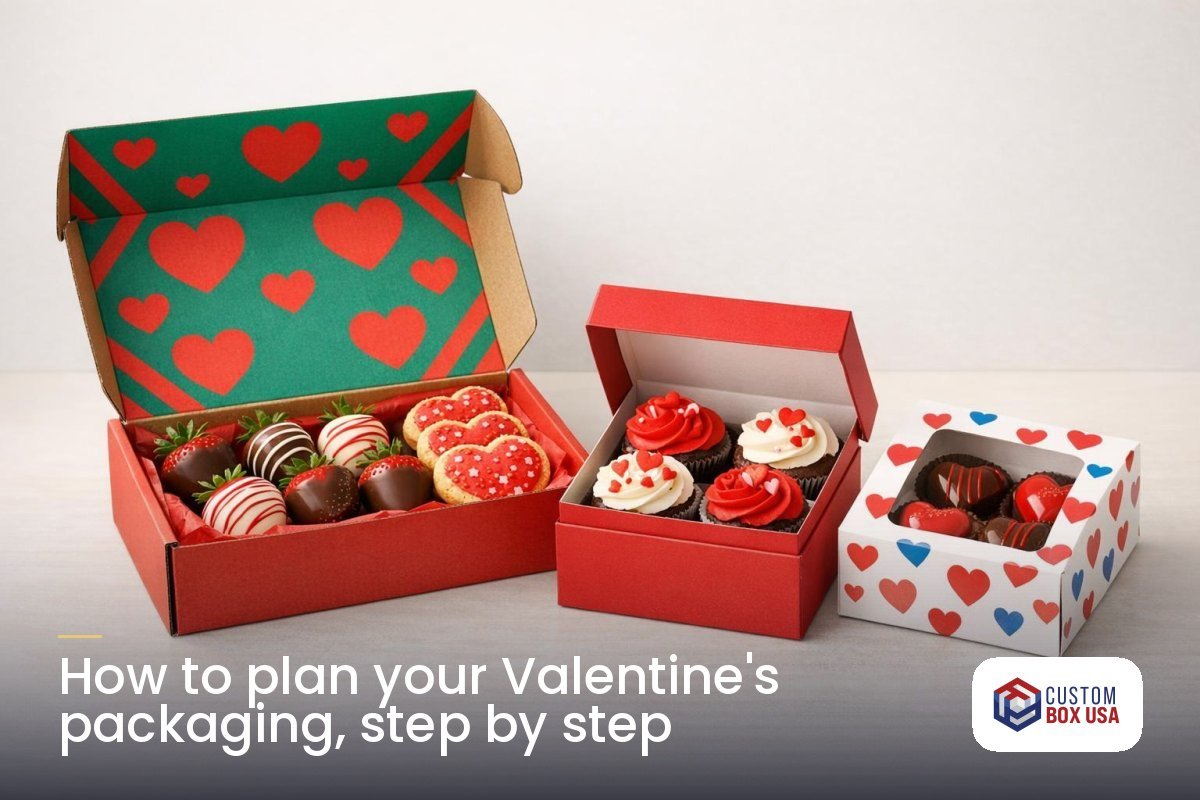
How to plan your Valentine's packaging, step by step
Work through these eight steps in order. Each one heads off a problem that's hard to fix in February.
1. Choose your treats and gift sizes
Start with what you'll actually sell. Then pick about three sizes: a small taster, a main gift and a larger box for sharing. The small size is your impulse buy, something a customer grabs at the counter without planning to. Cellophane bags, cups and mini boxes suit this role.
2. Match each treat to the right box
Every treat has a weak spot. Frosting smears, icing cracks and chocolate scuffs. Use this table as a starting point.
| Treat | Best box | Key feature | Why it works |
|---|---|---|---|
| Cupcakes and muffins | Cupcake box with insert | Cavity insert (one slot per cupcake) | Each cupcake stays upright, and frosting doesn't touch the lid |
| Cookies and brownies | Shallow box with a window | Low height plus a grease barrier | The stack stays flat and buyers see your decorating |
| Cake slices, bento cakes, pies | Window cake box or clamshell | Tall walls and a clear top | The lid clears the frosting and shows it off |
| Chocolates and truffles | Chocolate box with divider insert | One slot for each piece | Pieces don't touch, roll or scuff |
| Chocolate-covered strawberries | Clamshell or box with insert cups | A separate spot for each berry | The coating doesn't crack or smear |
| Mixed gift sets | Gift box with custom insert | Slots in different sizes | Cookies, chocolates and a card each get a place |
Two quick terms. A bakery box is a paper box, often with a lid or window, for cakes, cupcakes, cookies and pastries. A clamshell box has a hinged lid that snaps shut, like a clam. Browse custom bakery boxes to see styles you can size to your products.
3. Stop sliding with inserts
An insert, or divider, is a tray or cardboard piece inside the box that holds each item in place. A cavity is one slot in that insert, which is why cupcake boxes get described as 4-, 6- or 12-cavity.
An insert only works if the box fits. Too big, and everything shifts anyway. Measure your real product, then size the box to it. For cakes, add a cake pad, a firm board under the cake that makes it easy to lift out. Insert options include cardboard, cell dividers and die-cut trays.
4. Decide on a window
A window box has a clear cut-out, so people can see the treat without opening it. A die-cut heart window, a heart shape cut into the lid, is an easy Valentine's touch.
Our honest view: windows sell when your decorating is neat. If your icing is rustic, or treats get bumped on the drive home, a printed lid hides small flaws better.
5. Pick colors and a design that lasts past February 14
Popular Valentine's color pairs include red and pink, kraft with pink or red, burgundy and gold, and black and pink. Kraft paper is brown, natural-looking paper made from wood pulp. Its earthy, handmade look suits artisan bakeries.
Keep the heavy theme off the box itself. Use a plain or kraft box with a removable Valentine's sticker, topper or sleeve. On February 15, take the topper off and sell the same box for birthdays and Mother's Day. Sleeve boxes work well here, since the printed sleeve slides over a plain tray.
6. Add finishes and small extras
Finishes change how a box looks and feels:
- Foil stamping adds a shiny metal look, such as gold or silver.
- Spot UV adds glossy spots on top of a matte surface.
- Embossing raises part of the design. Debossing presses it in.
- Gloss or matte coating sets the overall feel.
Small extras go a long way. Try ribbon, twine, gift tags, tissue paper or a short love note card. For personalization, print your logo and add a blank tag where the buyer can write a name.
7. Check food contact and recyclable wording
Before you print, ask which materials will touch the food. Then check how you plan to describe the box as recyclable. The next section covers both.
8. Order a sample, approve the proof, then produce
A dieline is a flat outline of the box that shows where folds and cuts go, so your artwork lands in the right place. Once the art is on the dieline, order a sample box. That's a single test box to check fit, color and quality before the full run. Put a real cupcake or truffle inside and shake it gently. If it moves, adjust now.
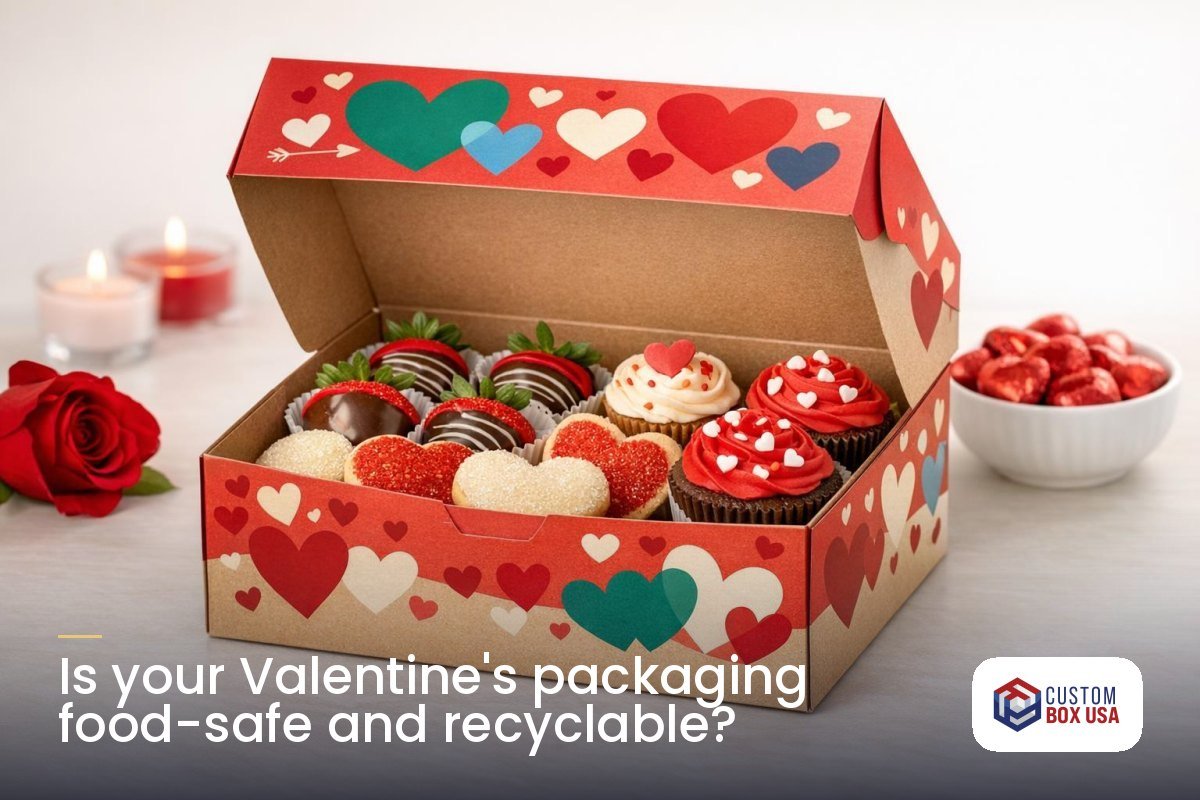
Is your Valentine's packaging food-safe and recyclable?
That depends on the materials, coatings and inks you choose, so ask your supplier directly. Keep any claims you print simple and honest.
What "food contact" means
The FDA uses the term food contact substance for any component of the materials used to make, pack or hold food. That's a broad definition, so ask about every layer: board, coating and ink. Per FDA guidance on food contact materials, packaging components used in line with a regulation in 21 CFR parts 174 to 179 need no further FDA review. The details are technical, so lean on your supplier for them.
Questions to ask your supplier
- Which material will touch the food directly?
- Is the inside printed, or plain?
- Do buttery cookies need a grease barrier? That's a coating that stops butter and oil from soaking through.
- Should I add a liner or glassine paper between the treat and the box?
Ask our team which materials suit your product, and we'll talk through options for your specific treat.
Recyclable claims: keep wording honest
The FTC Green Guides explain how US sellers can describe packaging as "recyclable" or "recycled." Under the FTC Green Guides on recyclable claims, a plain "recyclable" claim needs qualifying when recycling isn't available to at least 60% of the consumers or communities where you sell. Stick to clear phrases like "recyclable" or "made from recycled materials," and skip vague words like "green." Kraft and recyclable stock are good picks for sustainability-minded shops.
What makes good Valentine's Day chocolate box packaging?
Three things: an insert that holds every piece, a lid that closes snugly, and a size that matches your piece count. Get those right and the finish is the fun part.
Dividers and inserts that hold each piece
Truffles roll and bonbons scuff. A divider insert gives each piece its own slot, so nothing touches. If the gift gets eaten slowly over a week, the insert keeps the box tidy after the first few pieces are gone.
Choosing box size by piece count
Start with the counts you already sell. Then build a ladder: a small box for a coworker or counter treat, a medium box as your main gift, and a larger box for sharing. A few clear sizes are easier to choose from than many close ones.
Finishes and closures
Gold foil on a burgundy or black box reads as classic Valentine's. An embossed logo adds a detail customers can feel. Some shops choose a rigid box, a thick, firm box with a premium feel, or add a magnetic closure, a lid held shut by small hidden magnets. For most Valentine's runs, sturdy paperboard with a good insert does the job. See our custom chocolate boxes for sizes and insert options.
Keep chocolate cool on the way
Store boxed chocolate away from heat and sunny windows. If you ship, put the gift box inside an outer shipping box and pack it so it can't shift.
Valentine's Day cookie boxes: keep icing neat and grease hidden
The best cookie box is shallow, sized to the cookie, and has a grease barrier for buttery recipes. A window works well for decorated sugar cookies.
Shallow boxes with a window
A low box stops cookies from sliding and piling on top of each other, which is how icing chips. Size it so cookies sit snug in one or two layers. A heart-shaped window lets buyers see your piping before they pay.
Grease barriers and liners
Butter cookies and brownies can leave oil spots on plain paperboard. Ask for a grease-resistant coating, or add a sheet of glassine, a thin, smooth paper that resists grease. For example, a box of shortbread hearts still looks gift-ready days later when no oil has shown through the lid.
Common Valentine's packaging mistakes and how to fix them
| Mistake | Fix |
|---|---|
| Ordering boxes before measuring the product | Measure real treats, then test one sample box |
| Boxes that are too big | Size the box to the product and add an insert |
| Printing "Be Mine" all over every box | Use a plain box with a Valentine's sticker or sleeve |
| Oil stains on cookie boxes | Add a grease barrier or glassine liner |
| Vague eco wording like "green" | Say "recyclable" or "made from recycled materials" |
| Ordering in late January | Place your main run by early January |
Your Valentine's 2027 packaging timeline
Valentine's Day 2027 falls on a Sunday. That makes Saturday, February 13 likely your biggest pickup day, with Friday close behind. Work backward from there.
- November to early December: Pick your treats and sizes, measure them, and request a quote. Share your logo for free design support.
- December: Approve your design proof and order a sample box. Test it with real product.
- By early January: Place your main order. Standard production takes 8 to 10 business days, and rush takes 4 to 6 days. Times may vary with order volume and location.
- Early February: Fold a stock of boxes, prep stickers and tags, and plan staff for Friday and Saturday.
Keep rush as a backup, not the plan. Holiday weeks can add delays on the shipping side. See our delivery information for details.
FAQ
What are the best Valentine's Day packaging ideas for bakeries?
Match each treat to a box style, use inserts so nothing slides, and add a window if your decorating is neat. Keep the Valentine's theme on a removable sticker or sleeve so leftover boxes still sell.
Can I order just one sample box?
Yes. Our minimum order is as low as 1 unit, so you can test a single box with real product before a bulk order.
How long does production take?
Standard turnaround is 8 to 10 business days after you approve the design. Rush orders take 4 to 6 days. Timing may vary with order volume and location.
Do I have to pay for design?
No. Design support is free. Upload your artwork or just share your logo, and you'll get a design proof to approve before anything is printed. There are no die and plate charges either.
Can the boxes touch food directly?
That depends on the material, coating and ink. Tell us what you're packing, and our team will talk through options, including liners and grease barriers.
Do you ship for free?
Yes, shipping is free across the USA. Orders go out with couriers such as FedEx and DHL. More answers are on our FAQs page.
Get your Valentine's boxes ready
Tell us what you're packing and how many, and we'll help you pick the right size, material and finish. You get free design support, free shipping across the USA, and custom sizes, materials, finishes and printing. New customers get 20% off their first purchase.
Get a Free Quote and hear back within 2 hours, so your boxes are ready before the February rush.