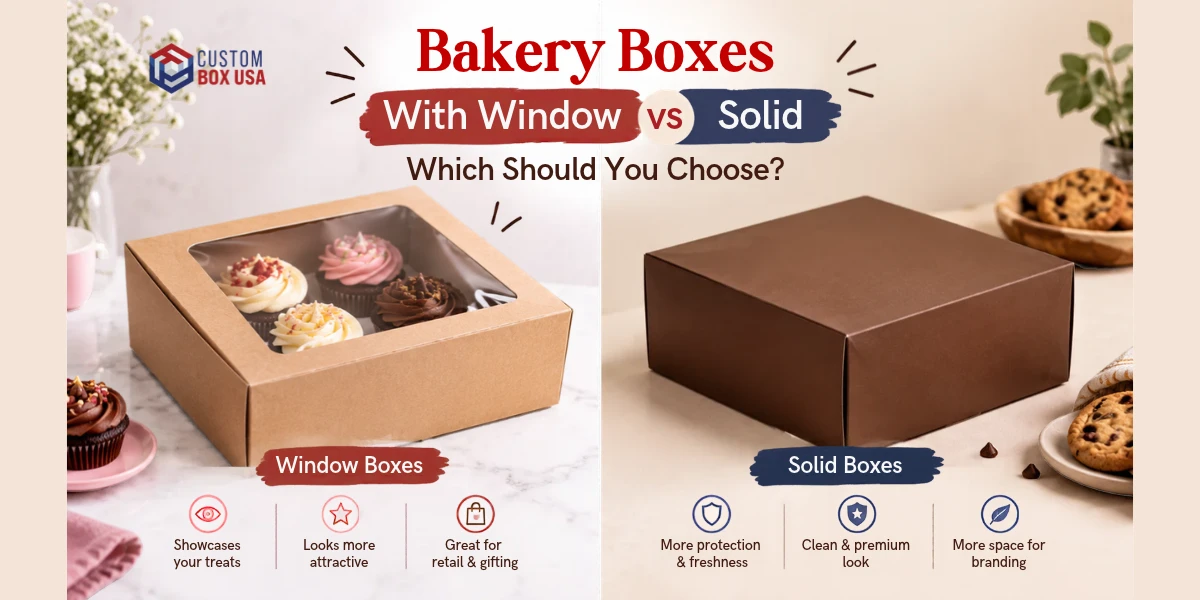
Should you buy bakery boxes with window panels or plain solid boxes? Choose a window box when your bakes sell on looks, like decorated cookies, macarons, donuts and fruit tarts. Choose a solid box when you need strength, grease control or safe delivery, like bread, warm items and tall or heavy cakes.
Most bakeries end up using both, and that's a sensible place to land. The safest approach is to match the box to each product instead of picking one style for the whole shop. The table, pick lists and common mistakes below will help you do that without wasting money on the wrong boxes.
Window vs Solid Bakery Boxes: The Short Answer
A window box shows the product and lets it sell itself. A solid box protects better, stacks better and gives you more room for your brand.
Quick pick by product
| Product | Best choice | Why |
|---|---|---|
| Decorated sugar cookies | Window | The icing work is the reason people buy. |
| Macarons | Window, with an insert | Bright colors look great in a neat row. |
| Donuts | Window | Glazes and toppings help a buyer choose fast. |
| Fruit tarts and mini pastries | Window | Shiny fruit and fine detail look appealing. |
| Assorted or gift boxes | Window | The buyer sees the variety they're paying for. |
| Bread and rolls | Solid | A window adds little when the product looks plain. |
| Plain muffins | Solid or small window | Strong printing often sells them better. |
| Warm or greasy items | Solid | Steam fogs film, and oil can mark it. |
| Tall layer cakes for delivery | Solid or partial window | A full lid is stronger and stacks better. |
Quick pick by how you sell
- Counter and display case: window boxes, so shoppers can see what's inside without opening anything.
- Delivery and online orders: solid boxes, or a sturdier box with a small window. Nobody sees the box until it arrives anyway.
- Wholesale to cafes and stores: window boxes often help on someone else's shelf, where you aren't there to explain the product.
- Gifts and corporate orders: a window for an instant first look, or a fully printed solid box if the unboxing moment matters more.
What Is a Bakery Box With Window?
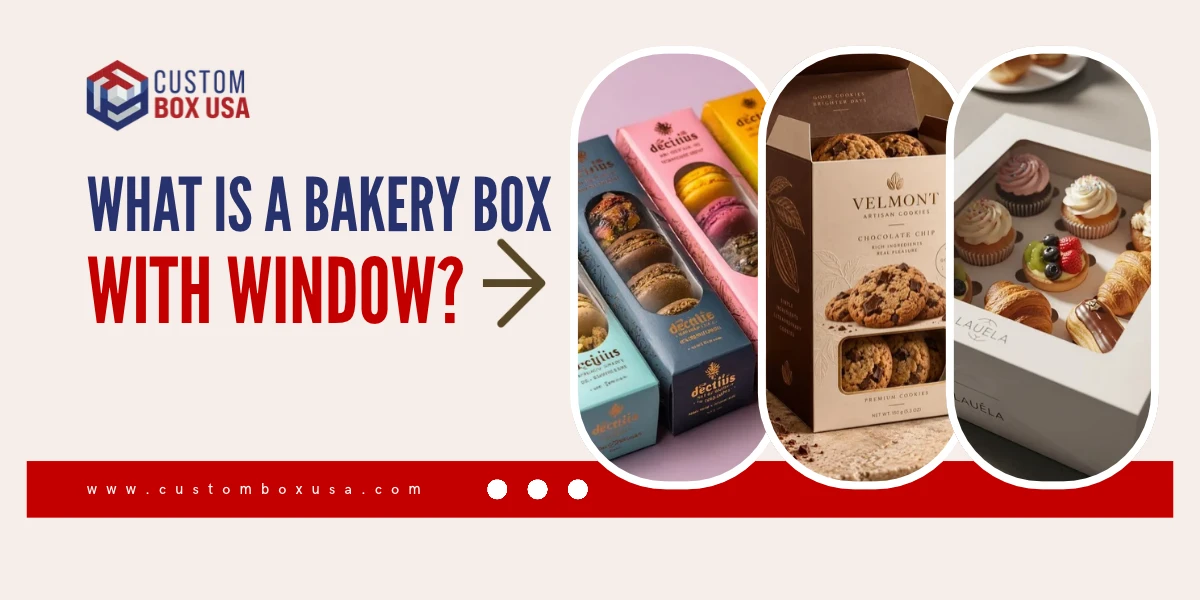
A bakery box with window is a paper box with an opening cut in the lid or front, covered by a thin clear film. The film keeps dust and fingers off the food while people look in.
How the window is made
The window starts as a die-cut, which is a shape cut out of the flat board with a metal cutting tool. A sheet of clear film is then glued behind the opening, and the trade calls this a window patch. The window's shape and position go on the dieline, the flat map of the box that shows every fold, cut and opening.
Full window, partial window and clear-lid boxes
- Full window: most of the lid is clear. It shows the most, but the lid is weaker.
- Partial window: a smaller opening, such as a strip, circle or heart. You get a peek and a stronger lid.
- Clear lid: the whole top is plastic over a paper base. It's very visual, but it uses more plastic.
Many bakeries overlook a middle option: a solid box with a printed photo of the product on the lid. You keep the strength and full branding, and shoppers still know what's inside.
Window film materials in plain words
- PET: a clear, fairly stiff plastic that's common for box windows.
- PP: another clear plastic film, a little softer than PET.
- Acetate: a clear film some sellers use for windows and lids.
- Cellulose film: a clear film made from plant fibers. Some sellers call it compostable, so ask for written proof before you repeat that claim on your own packaging.
Window vs Solid: Side-by-Side Table
Window boxes win on visibility, and solid boxes win on most other points. Your choice comes down to how much your product's looks drive the sale.
| Feature | Window box | Solid box |
|---|---|---|
| Visibility | Shows the product right away | Hidden unless you print a photo |
| Protection | Good, but the lid is weaker where it's cut | Stronger, with no cut in the lid |
| Stacking and delivery | Fine for light items; big windows can flex | Better for stacking, bags and car rides |
| Grease | Oil can smudge film and spot the board | Board can be coated to resist grease |
| Condensation | Fog shows clearly on the film | Moisture is less visible |
| Branding space | Less room; logo must avoid the window | The full lid is yours to print |
| Cost level | Usually a bit higher (extra film and gluing step) | Usually a bit lower |
| Recycling | Plastic film can limit recycling | Simpler, since it's all paperboard |
| Best for | Decorated, colorful, assorted bakes | Bread, warm items, delivery, heavy cakes |
When a Window Box Is the Better Choice
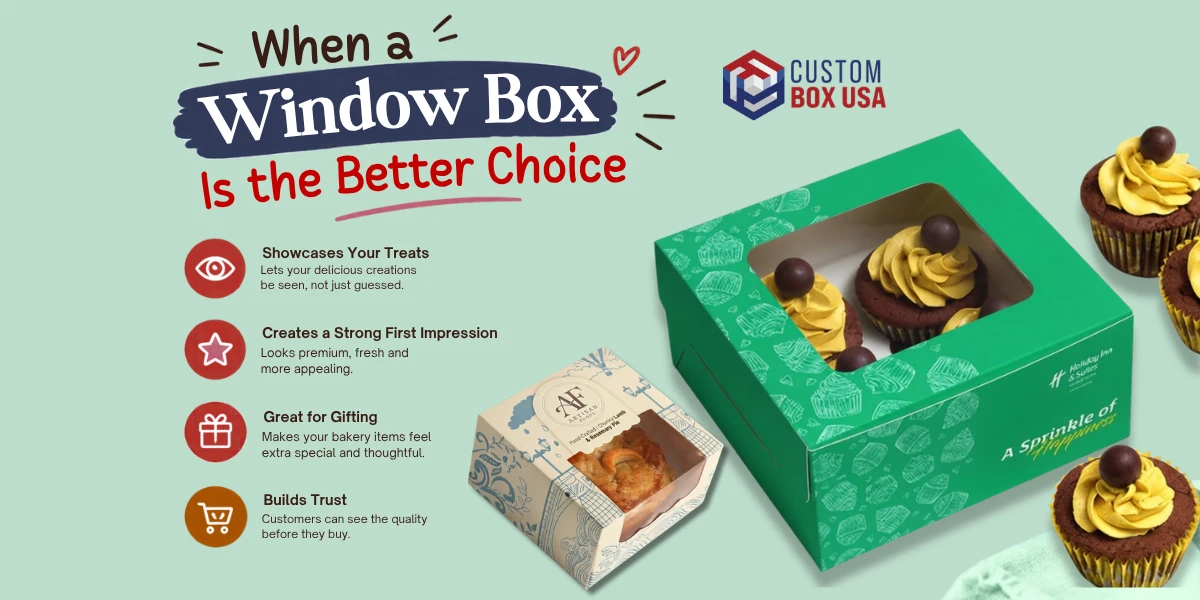
Go with a window when the product itself is your best ad. If people stop and stare at it in the case, let them see it in the box too.
Decorated cookies and cupcakes
Hand-piped cookies take real time, and a solid lid hides all that work. Window boxes for cookies and pastries let the decoration do the selling. For cupcakes, add an insert so each one stays in its own slot. Our custom cookie boxes come in sizes for singles, half dozens and larger sets.
Macarons, donuts and tarts
Macarons look best in neat rows of color, so a long, narrow window over a tray insert is a classic choice. Donuts sell fast when people can see the glaze and sprinkles, which makes a top window on custom donut boxes a natural fit. Fruit tarts work well behind a window too, as long as the film sits well above the fruit.
Assorted and gift boxes
In a mixed box, the window shows the variety the buyer is paying for. Bakery boxes with window and dividers keep each treat in its own space, so flavors and toppings don't smear into each other. This setup suits holiday season gifts, such as Christmas cookie boxes, Valentine's macaron sets and corporate thank-you boxes.
Display cases and grab-and-go shelves
On a self-serve shelf, nobody is around to explain the product. A window answers "what's in it?" at a glance. Small window boxes near the register also work well for single cookies or brownies.
When a Solid Box Wins
Pick a solid box when protection, grease or your brand message matters more than the view. It's the safer choice for anything that travels or leaves the oven warm.
Bread, plain muffins and greasy items
A loaf of sourdough or a plain bran muffin gains little from a window. Buttery croissants and fried treats can leave oil marks on film, too. A solid box made from grease-resistant board stays clean-looking for longer.
Delivery, stacking and heavy cakes
Every window weakens the lid a little, so a solid lid holds its shape better for tall cakes, stacked orders and delivery bags. For bigger or shipped orders, ask about corrugated board. That's board with a wavy layer inside, and a thin version called E-flute is common for food boxes. Our custom cake boxes come in sizes made to fit your cake boards.
Bold printing and full-box branding
A solid lid gives you the whole surface to work with. You can print your logo large, add a pattern or show a photo of the product. Your box then becomes a silent salesman on every kitchen counter it lands on.
Common Window Box Mistakes (and How to Avoid Them)
Most window box problems come from size, heat and placement. The good news is that a quick test catches nearly all of them before you pay for a big order.
Film touching icing
If the box is too short, the film presses into the frosting and leaves a smear. Measure your tallest item, toppings included, and leave a gap above it. Then match the inside size of the box to your cake board or tray.
Fogging from warm goods
Warm food gives off steam, and that steam turns into water drops on the cool film once the box is closed. The fix is simple: let everything cool fully before boxing. For anything you sell warm, use a solid box instead.
Window too big or badly placed
An oversized window makes the lid floppy and can crack at the corners. Place the window over the decorated part only, and keep wide paper borders around it so the lid stays stiff.
Hiding the logo
It's easy to put the window right where your logo should go. Plan the layout so your name sits on a solid panel. Keep a second solid area free for your ingredient and allergen label.
Too many box sizes
Each box size and style is another SKU, which means one more item to store, track and reorder. Start with a few sizes that cover most of your menu, and add more only when you truly need them.
Skipping the sample
Ordering a big run without testing is the costliest mistake on this list. For example, put a frosted cupcake in a sample box and leave it on the counter for a day. Then check for fog, smudges, grease spots and how well the lid holds up.
Are Window Bakery Boxes Food Safe? What to Ask Before You Order
Ask your supplier which board, inks, glue and film are meant for food contact, and how close the printing sits to the food. A good supplier will explain what fits your product in plain terms.
Food-safe materials, inks and glue
In the US, anything in packaging that may touch food is called a food contact substance. That covers the board, ink, glue, coating and window film. The FDA explains that packaging parts used in line with its rules in 21 CFR 174 to 179 need no further FDA review. Part 176 covers paper and paperboard, and Part 175 covers adhesives and coatings.
You can read more in the FDA guide to food contact material components. Tell our team what you're packing, and we'll help you choose materials that suit it.
Grease-resistant board and the PFAS phase-out
PFAS are man-made chemicals that were once used to help paper resist grease. On February 28, 2024, the FDA said grease-proofing substances containing PFAS are no longer being sold by manufacturers for food contact use in the US. You'll find the details in the FDA announcement on PFAS grease-proofing agents. If your bakes are buttery, ask what grease barrier the board uses. A barrier coating is a thin layer that stops oil from soaking in.
Careful "recyclable" wording
A plastic window can make a box harder to recycle in some places. The FTC Green Guides (16 CFR Part 260) say a plain "recyclable" claim can mislead if a part of the package that isn't minor can't be recycled. A claim about the paperboard part alone is fine.
A safer wording is "Paperboard box is recyclable. Remove the window film first." The Guides also say to qualify the claim when recycling isn't available to a large majority of people where you sell.
Kraft and recyclable stock options
If green packaging matters to your customers, ask about kraft or recyclable paperboard. You can also skip the film entirely and use a solid box. Browse our eco-friendly packaging for kraft and recyclable stock choices.
A quick note on labels
Packaged baked goods often need your business name and allergen details on the box. A sticker or a printed solid panel handles this well. Rules vary by product and state, so check FDA guidance and your state's food rules before you print.
Kraft or White: Which Looks Better With a Window?
White makes colors pop, while kraft looks warm and natural. Both pair well with a window, so let your brand decide.
Contrast and ink color
Kraft is brown paperboard. Light, bright inks look softer on it because the brown shows through, so dark colors, white ink and gold foil usually work best. White board, often called SBS, is smooth and bright and shows full-color printing clearly.
Printers make colors in two main ways. CMYK blends four inks to build colors, and PMS uses one exact, pre-mixed color.
Natural look vs clean look
Kraft suits rustic breads, farmhouse cafes and brands with a natural story. White suits pastel macarons, wedding favors and bright, modern brands. Still unsure? Order one sample of each, put your real product inside, and the answer usually comes quickly.
How to Order Custom Window Bakery Boxes
You choose the style, size and window, we help with the design, and you approve a digital proof before anything is printed. You can start with just one box.
Pick a style, size and window shape
Common bakery box styles include tuck-end, two-piece, gable and handle boxes. Busy counters often like auto-bottom, lock-corner or pop-up boxes, which snap or fold into shape quickly during a rush. Your window can be a rectangle, circle, heart or custom shape. Board choices include paperboard, kraft, corrugated and recyclable stock. See every option on our custom bakery boxes page.
Free design support and artwork
Upload your artwork or just send your logo, and our design team will help with the layout for free. We can frame the window with gloss or matte coating, spot UV (a shiny coat on chosen areas), foil stamping or embossing (raised shapes). We print digital, offset, screen and flexography. Digital suits small runs and samples, while offset suits bigger runs. You can print on the outside, inside or both, with no die and plate charges.
Order a sample first
Our minimum order is as low as 1 unit. That lets you test a single sample box with your real bakes before you buy window bakery boxes wholesale. Once you're happy, scale up to bulk orders for your shop or wholesale accounts.
Production and delivery
Standard turnaround is 8 to 10 business days, and rush orders take 4 to 6 days. Timing can vary with order size and location. Shipping is free across the USA, so you don't have to hunt for a box supplier near you. For orders outside the US, ask our team about options. Payment happens only after you approve your digital file.
Planning for the holidays? Order Thanksgiving pie boxes and Christmas cookie gift boxes well before the seasonal rush. That leaves time to test a sample and make changes without stress.
Frequently Asked Questions
Are bakery boxes with windows better than solid boxes?
They're better for bakes that sell on looks, but not for every product. Decorated cookies, macarons and donuts usually shine behind a window. Bread, warm items and delivery orders do better in solid boxes.
Do window bakery boxes sell more?
They can help, but nobody can promise a set sales increase. Seeing the product does help shoppers decide, especially at a counter or on a shelf. The most reliable test is your own: try a window box on one product for a few weeks and compare.
Are window bakery boxes food safe?
It depends on the board, ink, glue and film used. Tell your supplier exactly what you'll pack, and ask which materials are meant for food contact. Our team can talk you through the options for your product.
Can you recycle a bakery box with a window?
The paperboard part is often recyclable, but the plastic window can limit recycling in some areas. Ask customers to remove the film first, and word any "recyclable" claim carefully, as the FTC Green Guides describe. For an all-paper option, choose a solid kraft or recyclable box.
Why does the window on my bakery box fog up?
Warm food releases steam, and the steam turns into drops on the cool film. Let your bakes cool fully before you close the box. For items sold warm, a solid box is the better choice.
Which baked goods should not go in window boxes?
Skip windows for warm items, very greasy items and plain goods like bread. Tall, heavy cakes headed for delivery also do better with a solid or small-window lid, because a big window weakens the box.
Do window boxes cost more than solid boxes?
Yes, window boxes usually cost a bit more because they need clear film and an extra gluing step. The exact difference depends on size, quantity and finishes. Ask for a quote on both versions and compare.
Get a Free Quote for Your Bakery Boxes
Use window boxes for the bakes that look amazing, and solid boxes for anything warm, greasy or traveling. Test a sample with your real product before you order in bulk, and you'll avoid the most expensive mistakes.
Custom Box USA offers custom sizes, materials, window shapes, finishes and printing, with free design support, free USA shipping and a minimum order as low as 1 box. New customers get 20% off their first purchase, and we reply to quote requests within 2 hours.
Turn every box that leaves your counter into a branded moment. Get a free quote today, and our team will help you pick the right window or solid box for every item on your menu.