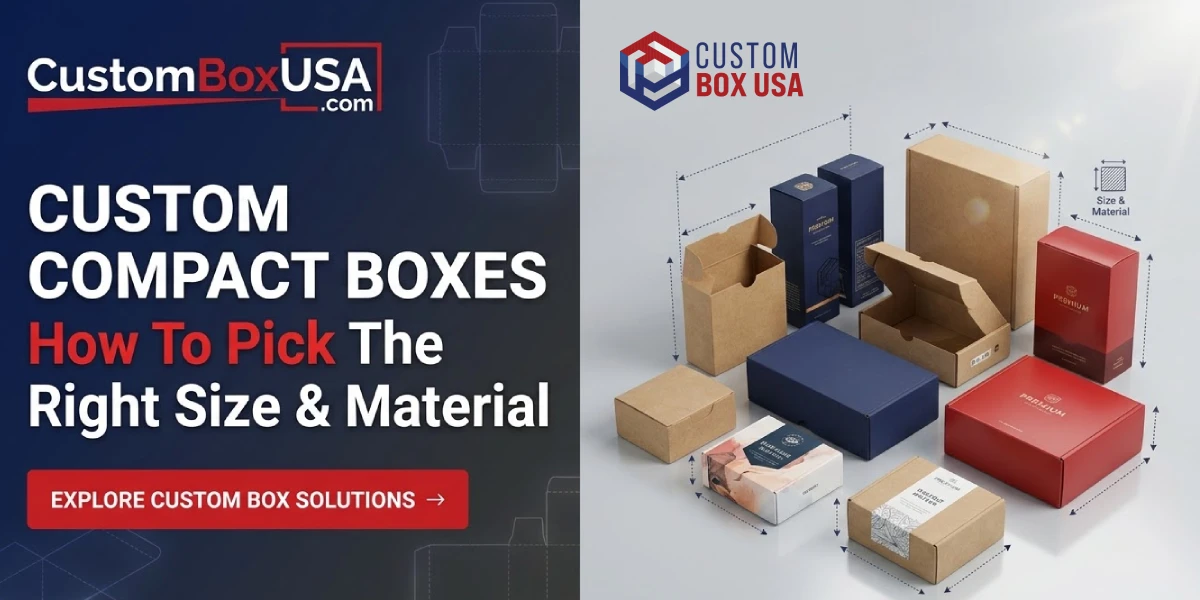
How do you pick the right size and material for custom compact boxes? Measure your compact while it's closed, including the hinge and clasp, and leave a small gap so it slides in without force. For most pressed powder and blush compacts, a printed SBS paperboard tuck end carton does the job well. Rigid board is the better pick for gift sets and premium launches.
Below, we explain the reason behind each step. Then we follow three made-up brands through their choices, so you can see how the decisions play out before you place an order.
What are custom compact boxes?
Custom compact boxes are printed cartons made to fit a makeup compact. They're the box around the case, not the case itself.
The carton, not the compact case
A compact is a small case, usually round and often metal. It's sometimes called a powder box or powder case. Inside, you'll usually find a mirror, a cake of powder and sometimes a puff.
In packaging terms, the compact is the primary packaging, because it touches the product. The printed box around it is the secondary packaging. That box carries your brand, your label details and gives the case some protection. A simple way to picture it: the compact is the phone, and the box is the phone's retail carton.
So when you order compact box packaging, you aren't ordering a new case. You're ordering a carton that has to fit a case you already have. That's why measuring comes first.
What goes inside a compact
Compacts hold pressed powder, blush, bronzer, highlighter and compact foundation. Pressed powder is makeup powder squeezed into a solid cake. That cake sits in a pan, which is a small metal or plastic dish. Pans can crack when a compact gets knocked around, so the box has a real job beyond looking good.
How do you measure a compact for a custom box?
Measure the compact closed, in inches, and note every part that sticks out. Then let your box maker add the clearance and confirm it on a sample.
Most fit problems start with one small slip. Someone measures the compact open, or forgets the hinge. Follow these steps instead:
- Close the compact. Measure it the way it will sit in the box.
- Measure the widest point. For a round case, that's the diameter. For a square or oblong case, measure length and width.
- Measure the closed depth. This is the height from the base to the top of the lid.
- Check the hinge and clasp. Many compacts have a small bump at the hinge or a clasp on the front. Measure across the case through that bump.
- Note any extras. A puff, ribbon or pouch adds size. Measure each one if it goes in the same box.
Measuring worksheet
Use this table as a checklist. The sample readings are for a made-up round compact, just to show the format. They aren't standard sizes.
| What to measure | How to measure it | Example reading (made-up compact) |
|---|---|---|
| Closed diameter (round) or length × width (square) | Widest point, case closed | 2.75 in diameter |
| Width including hinge or clasp bump | Across the case through the hinge | 2.85 in |
| Closed depth | Base to top of lid | 0.60 in |
| Extras (puff, pouch, leaflet) | Measure each one laid flat | Pouch adds about 0.10 in depth |
| Weight | Kitchen or shipping scale | Note it; heavy metal cases need stiffer board |
Why clearance should be checked on a sample
Clearance is the small gap between the compact and the inside walls of the box. Too little and the compact jams. Too much and it rattles, a bit like a marble rolling around in a shoebox.
The right gap depends on the board thickness and the box style, so we build it into the dieline for you. A dieline is the flat template of the box, showing where it gets cut, folded and printed. Board thickness also varies a little from sheet to sheet, which is one more reason to test real boxes. That's why you check the fit on a sample before the full run. It takes a few extra days, and it beats guessing.
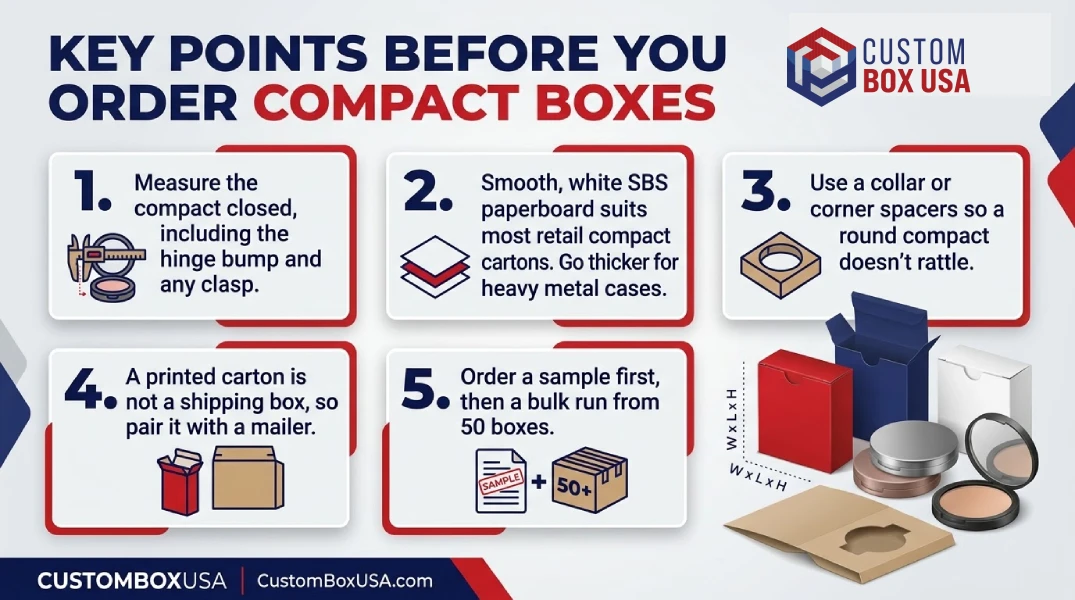
Key points before you order compact boxes
Which box style fits a pressed powder or blush compact?
A tuck end carton fits most single compacts on a store shelf. Two-piece and magnetic rigid boxes suit gift sets and launch kits.
| Box style | What it is | Best for | Watch out for |
|---|---|---|---|
| Tuck end | A folding carton with flaps that tuck in at the top and bottom | Single pressed powder boxes for retail and online | The hinge can catch on the flap if the fit is tight |
| Sleeve | A printed paper sleeve that slides over a tray or the compact | Slim compacts, limited editions | Needs a snug fit or the sleeve slides off |
| Two-piece rigid | A separate lid and base, like a classic gift box | Bronzer and highlighter sets, holiday gifts | Takes more shelf and shipping space |
| Magnetic rigid | A rigid box with a hidden magnet that holds the lid shut | Premium palettes and PR kits | More box than a single everyday compact needs |
| Window carton | A tuck end or sleeve with a die-cut opening | A blush compact box where shoppers want to see the shade | Less print area, and the window can scuff |
If you're leaning toward a lid-and-base style, our two-piece rigid boxes are a good place to compare options. They're also a popular choice for custom small boxes with lid.
How to stop a round compact rattling in a square box
Most cartons are square or rectangular, and most compacts are round. That leaves four empty corners, and the compact will slide into them. Fill that space with an insert.
A circular collar is a paperboard piece with a round hole that holds the compact in the center, much like the cup in an egg carton holds an egg. Corner spacers are small folded pieces that fill each corner. Both stop the slide-and-tap sound shoppers notice when they pick up the box.
What material is best for compact box packaging?
SBS paperboard is the best fit for most compact cartons, because it's smooth, white and prints sharp color. Rigid board is for luxury and gift boxes, kraft is for a natural look, and corrugated board is for shipping.
What "pt" means
In the US, board thickness is given in points (pt). One point equals 0.001 inch, so 18pt board is 0.018 inch thick. You may also hear a thousandth of an inch called a "mil." It's the same measure.
Boards aren't perfectly even, either. The usual industry tolerance is about ±5%, so a 20pt board can measure anywhere from 0.019 to 0.021 inch. On a snug compact carton, that small swing can change how the fit feels.
Some suppliers quote GSM instead of pt. GSM stands for grams per square meter, and it measures weight, not thickness. The two don't convert directly. A 300 GSM board can be 18pt if it's a dense SBS, or 24pt if it's a bulky kraft. It's like comparing a brick and a pillow of the same weight. So compare boards in pt when fit matters.
Thicker doesn't always mean stronger. A small 18pt carton can hold its shape well, while a much larger carton made from the same board can flex. There's no single best thickness. It depends on the board grade, the box size, the product weight and the closure.
For compacts, the box is small, so the real question is how heavy the case is. A light plastic compact can sit in thinner board. A heavy metal compact needs thicker board so the panels don't bow. Tell our team the weight, and we'll suggest a thickness to test on your sample.
| Material | What it is | Use it for | Shelf or shipping? |
|---|---|---|---|
| SBS paperboard | Smooth, white, solid board | Tuck end, sleeve and window cartons | Shelf and inside a mailer |
| Rigid board | Thick, stiff board wrapped in printed paper | Gift sets, palettes, PR kits | Shelf and gifting |
| Kraft board | Brown, natural-looking board | Clean beauty and eco-minded brands | Shelf and inside a mailer |
| Corrugated E flute | Thin board with a wavy inner layer (the "flute") for cushion | Mailer boxes for one or a few compacts | Shipping |
| Corrugated B flute | Thicker wavy layer with more cushion | Outer shipping boxes for bulk orders | Shipping |
For sustainability-minded brands, our kraft boxes and other recyclable stocks give you a natural look. Kraft and cardboard are recyclable, and a simple design with one or two ink colors suits the brown surface well.
When does a compact box with window make sense?
A window makes sense when the shade sells the product, as with blush or highlighter. It's less useful for pressed powder in neutral shades, where a printed swatch can do the same job.
A die-cut window is a shape cut out of the box so shoppers can see inside. You can leave it open or cover it with a clear plastic film glued behind the opening. Each choice has trade-offs:
- Open window: no plastic, so it's simpler to recycle. But dust and fingers can reach the compact.
- Film-covered window: keeps the compact clean while still showing it. The film can scuff in transit, though.
- Less print space: every square inch you cut out is space you can't use for branding or labels.
- Light: a window lets light in. If your formula or case finish reacts to light, ask your product team before you add one.
One practical tip: place the window over the part shoppers care about. If the compact sits closed in the box, a window shows the lid, not the shade. Some brands print the shade on the lid or add a shade sticker, so the window still shows the color.
How do inserts keep a compact from moving or cracking?
Inserts hold the compact in one place, so it can't slide or bang against the box walls. That lowers the chance of a cracked pan, though no box can promise zero damage.
Think of an insert as a seat belt for the compact. We offer cardboard, die-cut, cell divider, punch partition and foam inserts. Here's how they match up with compact types:
- Single round compact: a paperboard collar or corner spacers. Light, low cost and recyclable with the box.
- Square compact: often needs no insert if the clearance is right. A thin card base can lift it for a neater look.
- Multi-pan palette: a die-cut insert shaped to the palette, so it doesn't flex.
- Gift set with several compacts: cell dividers or a foam insert with cut-outs for each piece.
Foam gives more cushion, while paperboard is easier to recycle. For a single compact on a shelf, paperboard is usually enough. For a heavy metal case that ships a long way, foam is worth a look.
Which finishes and printing suit cosmetic compact packaging?
Matte or soft-touch lamination with one accent finish, such as foil or spot UV, suits most cosmetic compact packaging. Use PMS ink when a brand or shade color must match exactly.
Lamination is a thin film laid over the print to protect it. Gloss looks shiny, matte looks calm, and soft-touch feels a bit like velvet. On top of that, you can add accent finishes. Spot UV adds shiny spots on chosen areas. Foil stamping adds gold, silver or holographic metal color. Embossing raises your logo, and debossing presses it in.
For color, you'll choose between two systems. CMYK mixes four inks to print full-color photos. PMS is one premixed ink in an exact color, like buying paint already mixed instead of blending it yourself. A shade photo printed in CMYK may look slightly off from the real blush. That's why the free digital proof matters, and why PMS is the safer choice for a signature brand color.
Browse our cosmetic boxes to see the finishes side by side. Related pages like eye shadow boxes are handy if your line includes palettes.
How much label space does a compact box need?
Plan label space before you design, because compact cartons have small panels. The front needs the product name and net quantity, and the outer box needs the ingredient list.
The front of the box is called the principal display panel. It's the side shoppers see first. Under general US cosmetic labeling rules, it shows the product name, what the product is, and the net quantity, meaning how much product is inside. On an outer box, the net quantity usually sits in the bottom 30% of that front panel, running parallel to the base. Very small front panels, 5 square inches or less, have some exceptions. The ingredient list goes on the outer box too, often on a side or back panel.
Leave room on the side and back panels for a batch number and a barcode. Your brand supplies the approved wording and checks the current rules. Our job is to give that wording enough room and keep it inside the safe zone, the area that keeps text away from cut edges. Art that runs past the cut line is called bleed. It stops thin white slivers from showing at the edges after trimming.
Three scenarios: which compact box would you pick?
The right box depends on where the compact is sold and how it travels. These three brands are made up, but their choices are ones many beauty brands face.
Scenario 1: A new online brand with one pressed powder
Say you're launching one round pressed powder in three shades on your own web store. You want a clean branded unboxing on a startup budget.
You could pick a tuck end carton, a sleeve or a rigid box. The tuck end in SBS paperboard wins here. It's light, prints sharp color, and works well for custom small boxes with logo in a short run. Add a paperboard collar so the round case doesn't rattle.
Then ship each carton inside a mailer box. A printed carton is made to look good, not to survive a delivery truck. Our mailer boxes in E flute corrugated pair well with small cartons.
Scenario 2: A blush line headed for store shelves
Now say you sell five blush shades to boutique shops. Shoppers pick by color, so each shade has to be easy to spot.
A window carton makes sense. Choose a film-covered die-cut window, because store handling would otherwise leave dust and fingerprints on the compact. Print the shade name in PMS ink on the front panel, and keep the window clear of the net quantity area. If the compact sits closed, add a shade sticker on the lid so the window shows color, not plain plastic.
Scenario 3: A holiday gift set for the season
Last one: you want a bronzer and highlighter duo as a holiday gift set. The goal is a premium feel that people keep after opening.
A two-piece rigid box with a die-cut insert is the right call. Rigid board feels solid in the hand, and the insert keeps the two compacts apart so they don't knock together. Add foil stamping for the logo. Plan holiday orders early, since production runs 8–12 business days after artwork approval, plus shipping.
Decision table
| Situation | Box style | Material | Insert | Extra |
|---|---|---|---|---|
| Single compact sold online | Tuck end | SBS paperboard | Collar or corner spacers | Ship inside a mailer box |
| Shade-led retail shelf | Window carton | SBS paperboard | Collar | Film-covered window, PMS shade color |
| Holiday or PR gift set | Two-piece or magnetic rigid | Rigid board | Die-cut or foam | Foil stamping or embossing |
| Eco-minded brand | Tuck end or sleeve | Kraft board | Paperboard collar | Open window or no window |
| Heavy metal compact | Tuck end | Thicker SBS paperboard | Snug collar | Test fit on a sample |
What mistakes should you avoid with compact boxes?
Most compact box problems come from measuring wrong or skipping the sample. Each one is easy to avoid once you know to look for it.
- Measuring the case open. An open compact is much deeper. Always measure it closed.
- Ignoring the hinge. That small bump can catch on the tuck flap and make the box hard to close.
- Board too thin for a heavy case. A metal compact can bow the panels of a thin carton.
- Printing shade photos without checking the proof. CMYK can shift colors, so hold the proof next to the real product.
- Too little label space. Small panels fill fast once you add the ingredients, batch number and barcode.
- Skipping the sample. A sample costs far less than a full run that doesn't fit.
How do you order custom compact boxes from Custom Box USA?
Request a quote, share your measurements, approve a free digital proof, and we print and ship your boxes free anywhere in the USA. Orders start from 50 boxes, and you can order a sample first.
Custom Box USA is based in Anaheim, California, and every order follows the same six steps:
- Configure and get a quote. Send your compact size, box style, material and finish. Our team replies within 1 hour.
- Design. Upload your artwork or just share a logo. Our design team helps for free.
- Approve the digital proof. You check the layout, colors and label space before anything prints.
- Payment. You pay once you're happy with the approved proof.
- Production. Standard turnaround is 8–12 business days after artwork approval. Rush production can often be arranged.
- Free delivery. Shipping is free anywhere in the USA.
Cost per box depends on the style, size, material, printing, finish, insert and quantity. Larger runs bring the cost per box down, which is why many brands move to wholesale runs once the sample fit is right. There are no die or plate charges, and you save 20% on your first order. That applies to custom compact boxes and to other custom printed boxes, from small cartons to custom corrugated boxes for shipping.
Frequently Asked Questions
What size box do I need for a makeup compact?
You need a box sized to the closed compact plus a small clearance. Measure the closed diameter or length and width, the closed depth and the hinge bump. Our team adds the clearance on the dieline, and you confirm the fit on a sample.
What material is best for compact powder boxes?
SBS paperboard is the best material for most compact powder boxes. It's smooth and white, so colors print sharp. Choose rigid board for gift sets and kraft for a natural, recyclable look.
What board thickness is best for a pressed powder box?
There's no single best thickness, because it depends on the box size, the board grade and the weight of the compact. Light plastic compacts work in thinner SBS paperboard. Heavy metal compacts need thicker board so the panels don't bow, and a sample shows you which feels right.
Should a compact box have a window?
Add a window if the shade is what sells the product, as with blush or highlighter. Keep in mind that a window reduces print space, lets in light and can scuff. A film-covered window keeps the compact cleaner than an open one.
How do I stop a round compact from rattling in a square box?
Use a circular collar or corner spacers inside the box. Both fill the empty corners and hold the compact in the center. They're made from paperboard, so they stay light and recyclable.
Can I order a sample before a bulk order?
Yes, you can order a sample first. It's the best way to test the fit, the closure and the colors. Once you're happy, production orders start from 50 boxes.
How long does it take to make custom compact boxes?
Standard production takes 8–12 business days after artwork approval, plus shipping. Rush production can often be arranged. For holiday launches, order early so your boxes arrive with time to spare.
Ready to box your compacts?
Your compact box is your silent salesman, and it's the first thing a shopper holds. Measure the case closed, pick a board that matches its weight, add an insert, and test it all on a sample. After that, the bulk order holds no surprises.
Ready to create your custom boxes? Get a free quote within the hour, from 50 boxes, with free design support, a free digital proof and free shipping across the USA.