
How Many Cigarettes in a Pack: The Complete Answer & Everything Connected to It
Cigarette pack sizes differ in different countries & markets but in the US the standard pack contains 20 cigarettes. While this has established itself as the global benchmark, the pack quantities, regulations & packaging standards differ from one region to another.
The answer goes beyond simply counting cigarettes. Different markets have unique legal requirements, manufacturers offer different pack sizes or packaging plays a main role in product protection as well as brand recognition. That is why businesses trust Custom Box USA for premium custom cigarette packaging designed to meet industry standards while boosting shelf value & strengthening the brand identity.
How Many Cigarettes Come in a Standard Pack: Country by Country
The answer changes based on where you are buying.
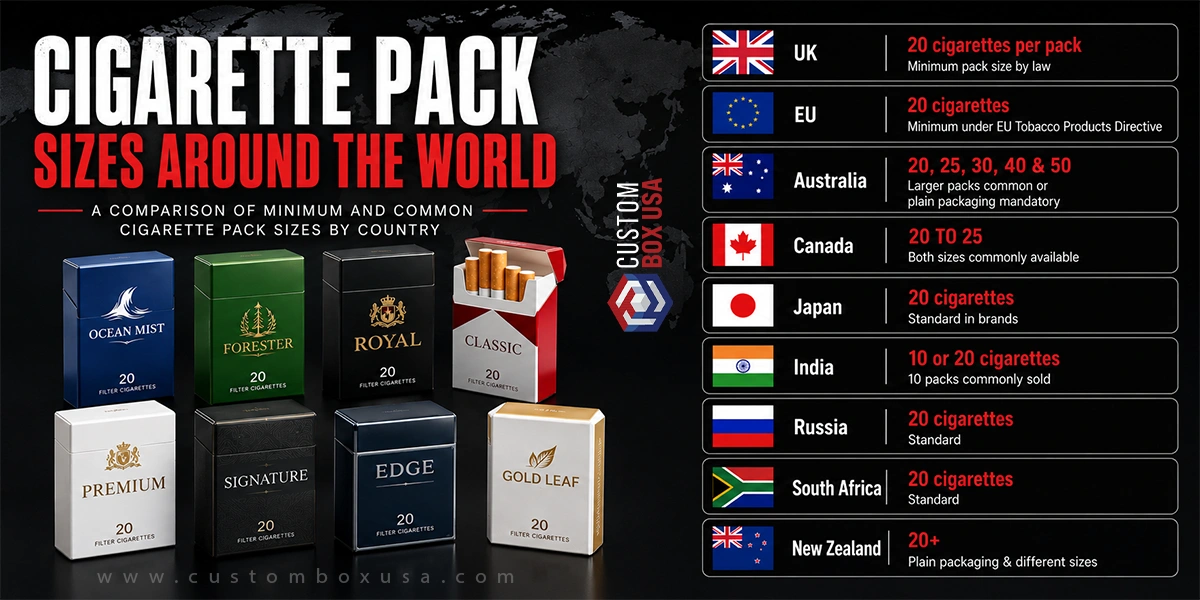
The 20 cigarette standard is not universal. While it dominates the US, European Union or most of Asia other markets have established different norms based on taxation policy, regulatory decisions or consumer behavior.
|
Country / Region |
Standard Pack Size |
Notes |
|
US |
20 pack of cigarettes |
Federal standard as of 2009 |
|
UK |
20 cigarettes per pack |
Minimum pack size by law |
|
EU |
20 cigarettes |
Minimum under EU Tobacco Products Directive |
|
Australia |
20, 25, 30, 40 & 50 |
Larger packs common or plain packaging mandatory |
|
Canada |
20 TO 25 |
Both sizes commonly available |
|
Japan |
20 cigarettes |
Standard in brands |
|
India |
10 or 20 cigarettes |
10 packs commonly sold |
|
Russia |
20 cigarettes |
Standard |
|
South Africa |
20 cigarettes |
Standard |
|
New Zealand |
20+ |
Plain packaging & different sizes |
The 10 pack format is banned in the UK & EU specifically because regulators determined that small & therefore less expensive packs made cigarettes genuinely accessible to young buyers. Australia's larger pack sizes exist partly because taxation is applied per stick because bulky packs reduce the relative cost per cigarette which paradoxically can reduce consumption of multiple compact packs.
Why 20 Cigarettes? The History Behind These Numbers
The 20 cigarette standard was not a health decision. It was a manufacturing & marketing one.
In the early 20th century cigarette manufacturers observed that 20 cigarettes fit perfectly in a pack that was comfortable to carry in a standard shirt pocket. The dimensions of a 20 cigarette hard pack approximately 85 mm tall, 55 mm wide & 22 mm deep were the result of fitting the maximum number of cigarettes in the most portable rectangular form.
American tobacco companies standardized on 20 in the 1920s & 1930s as mass production scaled up. The number suited production line productivity, retail pricing psychology & consumer habit formation. Smokers who finished a pack each day became a marketing concept: the pack a day smoker that influenced advertising for many years.
By the time health regulation started seriously restricting cigarette marketing in the latter half of the 20th century the 20 cigarette standard was so deeply embedded in production infrastructure, retail pricing & consumer expectation that changing it would have required industry wide coordination that never materialized.
In 2009 the US Family Smoking Prevention & Tobacco Control Act codified what had been a market convention in law packs of less than 20 cigarettes were made illegal in the US primarily to prevent the sale of cheap as well as small packs to price sensitive young buyers.
How Many Cigarettes Are in a Carton?
A standard cigarette carton includes 200 cigarettes which means 10 packs of 20.
The carton is the wholesale unit that retailers purchase from distributors & that bulk buyers use for cost savings. The 10 pack carton is the standard in the US & most global markets but variations exist.
|
Carton Type |
Number of Packs |
Total Cigarettes |
|
Standard US carton |
10 packs of 20 |
200 cigarettes |
|
Mini carton |
5 packs of 20 |
100 cigarettes |
|
Australian large carton |
10 packs of 25 |
250 cigarettes |
|
Cigarettes in bulk wholesale carton |
Varies |
400 500+ cigarettes |
Mini cartons that hold 5 packs are produced for small retailers, travel retail environments & markets where consumers prefer shorter supply purchases. These are not universally available but are common in duty free retail as well as specific Asian markets.
For retailers the carton price per cigarette is always less than purchasing individual packs. For consumers who smoke regularly the carton purchase offers advantages like cost savings & supply security which is why bulk purchasing behavior tends to increase when cigarette prices rise significantly via taxation.
Dimensions of Cigarette Packs from Different Major Cigarette Brands
A pack of 20 cigarettes may be found in almost any leading brand however the box itself differs by brand. Based on the manufacturer, the height, breadth & depth vary somewhat; these little variations are usually caused by the length of the filter as well as the degree of tobacco packing.
This is a comparison of three popular brands
- Marlboro measures 85 x 55 x 22 mm
- Dunhill's dimensions are 85 x 55 x 23 mm
- The camel measures 84 x 54 x 22 mm
On paper the changes look insignificant—meaning a millimeter here and there but they are seldom coincidental. For a thick tobacco fill a somewhat deep pack can be constructed. A long filter can fit in a high pack. These are minor engineering considerations included in the design, not haphazard choices.
For those who work in packaging this is very important. If these specifications are incorrect, issues can arise quickly like cigarettes moving about in the box, improperly fitting foil liners or a flip top lid that won't seal flush. Because each brand still needs its unique box constructed around its unique product; seasoned packaging manufacturers utilize these brand dimensions as a reference point instead of a template to duplicate exactly.
Cigarette Quantity Per Pack: Why It Matters
It is tempting to dismiss 20 per pack as a random fact. In actuality it is one of the most useful figures in the whole retail and supply chain as well as understanding it correctly saves firms valuable time.
-
Ordering gets fast or clean
When everyone understands that a pack includes 20 cigarettes then there is no need to discuss specific units. Retailers & suppliers can simply say 10 packs or 2 cartons & each of these parties understand what they mean. Less back and forth means less mistakes.
Errors in shipping are reduced
Managing individual cigarettes in large quantities is challenging. In fulfillment packs & cartons are simple to count, stack & check off. That is actually what stops warehouse workers from miscounting shipments or shorting orders.
Inventory becomes easy to manage
In a stock check nobody likes to count lost smokes. Inventory evaluations do not take long when everything is tracked in entire packs & it is much simple to identify any missing items.
Therefore smokers should not consider this to be merely interesting information. From the individuals designing the box to the shop owner checking stock on a busy Friday night it is a tiny bit of information that subtly maintains the full chain of tobacco stores operating smoothly.
What Are the Different Cigarette Sizes & How Do They Affect Pack Height?
E Cigarette boxes length influences pack dimensions meaning longer cigarettes need taller boxes.
Understanding the relationship in cigarette format & pack size is necessary for packaging decisions. Here is the complete breakdown
|
Cigarette Type |
Cigarette Length |
Pack Height |
Common Pack Quantities |
|
Regular / Standard |
70mm (2.75 inches) |
~75mm |
10, 20 |
|
King Size |
84mm (3.3 inches) |
~88mm |
20 |
|
100s |
100mm (3.9 inches) |
~105mm |
20, 25 |
|
120s |
120mm (4.7 inches) |
~125mm |
20 (less common) |
|
Slim / Super Slim |
84 100mm & narrower diameter |
~88 105mm, slimmer width |
20 |
|
Large Capacity Packs |
84 100mm |
Vary |
25, 30, 40 & 50 |
Regular cigarettes at 70 mm are the oldest format & are less common in contemporary markets where filtered cigarettes dominate. They are sometimes called unfiltered cigarettes & historically were sold without the filter tip that was a standard from the 1950s onward.
King size at 84 mm was the dominant format globally in the 1960s & 1970s as filtered cigarettes grew to represent the majority of the market. The king size filter cigarette is still the most commonly produced format globally.
100s & 120s are lengthy cigarettes designed for smokers who prefer a long smoking duration per cigarette. The 100mm format is popular in the US particularly. The 120mm format, sometimes called a "cigarillo," sits in a standard cigarette or a small cigar in format.
Slim cigarettes maintain a similar length to king size but with a narrower diameter. The slim format was significantly popular from the 1990s onward & now represents a substantial market segment particularly for young adult smokers.
Regulation of Custom Cigarette Box Sizes
Pack size has been a significant regulatory concern & continues to rise. Here are a couple of things that are important to comprehend.
- Price OR pack size are directly related. To increase profit many brands reduce packaging while increasing pricing. This has a direct impact on customers' access to & affordability of cigarettes.
- Smoking rates are generally less in small compartments. People end up making cuts after the expense exceeds what they can afford.
- Companies have long used eco friendly packaging as a tool for branding. However the majority of nations now impose stringent restrictions on the appearance & content of cigarette cartons.
- In 2011 Australia emerged as the first nation to enact rules pertaining to simple packaging. In the years that followed, the UK, Canada & France adopted comparable regulations.
Popular Types Of Cigarette Boxes
Cigarette packaging uses many distinct structural formats each with specific functional advantages.
-
Hard Flip top Cigarette Boxes (hinged lid)
The most commonly used format globally. A rigid cardboard box with a hinged lid that flips open. Offers strong protection for the cigarettes, easy one handed opening or a flat stable surface for branding. The flip top was largely dominant in the 1960s & remains the standard for most premium brands.
The inner foil liners & the inner frame (also called the structural collar) are equally important parts of a cigarette pack. The foil liner helps preserve freshness by protecting cigarettes from moisture or air while the inner frame reinforces the box, prevents crushing as well as maintaining the flip top lid securely closed in daily use.
Soft Cigarette Boxes
A foil lined paper sleeve with a foil tear strip. The soft pack was historically the most common format before the flip top became dominant. It is still commonly used for value tier brands and is still standard in some markets. The soft pack is light & cheap to produce but provides less physical protection to the cigarettes in handling.
Slide & shell (drawer box)
An inner tray that slides out of an outer sleeve. Creates a unique premium opening experience & is used by brands positioning at the high end of the market. The slide format provides excellent protection & has a tactile quality that differentiates the brand at the point of use.
Round edged box
A variation on the standard hard pack with rounded corners. The rounded edge creates a soft visual profile that some brands use to suggest a premium or distinctive positioning.
Neck/shoulder pack
A structural variant where the box narrows at the top creating a shoulder like shape. Used by specific brands as a distinctive structural identifier.
Soft cup pack
A hybrid that combines hard & soft formats with a semi rigid cup at the top & a soft body. Less common but used in specific markets.
Flip-Top Containers
The most common type on shelves is this one. A hinged lid may be opened or closed with a single flip. It typically includes 20 sticks as well as has a stiff construction that prevents cigarettes from being crushed.
Slide and Shell Containers
In this case the pack functions as a little drawer. It feels really sophisticated because an inner tray slips out from the outer sleeve. Because it sticks out at the point of sale & premium companies frequently select this design.
Tuck End Containers
To retain everything in place this design incorporates flaps that tuck in at the top & bottom. It is a simple uncomplicated construction that secures cigarettes with out the need for additional hardware.
Pack Slim Boxes
These cigarette boxes have a slightly streamlined & slimmer form and are designed especially for thinner cigarettes. The pack's small size makes it comfortable to carry while providing adequate protection for the smokes.

How Does Pack Size Affect Smoking Behavior? The Research
Pack size genuinely changes how much people smoke. This is backed by real research not just opinion.
The National Library of Medicine found that pack size & cigarette price each affect how much people smoke. The findings point in two clear directions.
-
Bigger packs lead to more smoking
When smokers have extra cigarettes in front of them they tend to smoke more. A 30 or 40 pack makes it easy to light up without thinking twice. Australian regulators noticed this problem. They started questioning if large packs were quietly cancelling out the benefit of higher prices.
Smaller packs and higher prices reduce smoking
When cigarettes become hard to afford, people smoke less. This is especially true for young and low income smokers. The UK and EU made packs smaller than 20 illegal for exactly this reason. Very small packs at very low prices were making cigarettes too easy to access for young people.
The 10 pack was a real issue. In markets where 10 packs were sold many younger smokers preferred them. A small pack was cheaper upfront so it fit a tight weekly budget. Banning the 10 pack did not stop smoking entirely. But it did make cigarettes noticeably hard to afford for that group.
Cigarette Tax & How It Relates to Pack Quantities
Tax rules have a big impact on pack sizes than most people realize.
In the United States cigarette taxes work on two levels. There is a federal tax as well as a state tax on top of that. The federal excise tax is $1.0066 per pack of 20 cigarettes. State taxes vary a lot. New York State and New York City together add $4.35 to each pack. New Jersey adds $1.25 per pack.
How the tax is calculated matters for pack size.
In the US tax is charged per pack. This means a 25 cigarette pack carries the same tax as a 20-cigarette pack. That makes the 25 pack better value each cigarette for the buyer. It is one reason some markets see larger packs getting popular. Manufacturers can fit more cigarettes in one taxable unit.
Australia works differently. Tax there is charged per cigarette not per pack. So a large pack does not reduce the tax burden at all. What it does reduce is the cost of luxury packaging per cigarette. That saving gets passed on via competitive retail pricing.
Two different tax systems. Two different reasons why pack sizes look the way they do.
Unknown But Interesting Facts About Cigarette Boxes
The quantity of cigarettes in a pack is only one aspect of cigarette packaging. These are some fascinating facts that you should be aware of.
The Origin of the Flip Top Hard Pack
The flip top hard pack was developed in 1955 by a designer working for Philip Morris. The soft pack was the norm prior to this. The flip top was initially regarded as a premium innovation; it protected cigarettes superiorly & felt really substantial in the hand & gradually turned in the standard as manufacturing costs fell.
Why Cellophane Wrappers Matter?
The cellophane wrapper on hard packs is not just cosmetic. It offers moisture management that maintains appropriate cigarette humidity, protects the pack from denting in pockets and handbags as well as traditionally offering a clean surface for the tax stamp to cling to without contaminating the printed surface.
Matching Carton & Pack Designs
Some brands produce matching carton & pack designs; the carton carries design elements that align with the pack's visual identity, though most consumers never see the carton. This is brand consistency taken to its logical extreme.
Duty Free Cigarette Boxes Differences
Duty free cigarettes are typically sold in formats slightly different from domestic retail packs in the same brand. To differentiate them from domestically taxed products the duty free format may have different language requirements, health warning requirements as well as sometimes different pack quantities.
Advantages of Purchasing Cartons of Cigarettes in Bulk
Purchasing in bulk has some obvious advantages worth noting.
- Cartons are less expensive per cigarette than buying individual packs
- You always have supplies on hand & never run out
- Stocking up early protects you from future price rises
- Retailers frequently give discounts on carton orders
- Less time wasted on repeat journeys to the shop
- Buying goods all at once makes it less difficult to track or manage
- Reduces the likelihood of running out during trips or busy periods
- Storage is straightforward because boxes are small as well as stack neatly
Where to Buy Best Cigarette Packaging Boxes?
Custom Box USA is the obvious option if you are searching for a trustworthy cigarette box packaging partner in the US. We build to your exact specifications if you need a standard flip top hard pack, king size, slim format, soft pack or large capacity carton. Full customization of dimensions, materials & print finishes like matte lamination, gloss coating, foil stamping & embossing is all handled in house. Free shipping across the country, no strict minimum requirements & a compliance review against FDA and FTC regulations prior to printing are all included in each order.
Modern cigarette packaging is also evolving toward sustainability. That’s why Custom Box USA offers custom cigarette boxes wholesale with recyclable paperboard, eco friendly coatings & other packaging solutions that help brands meet changing environmental expectations without compromising quality or shelf appeal.
Conclusion
So how many cigarettes come in a pack? For most of the world the answer is 20 & that number shapes everything from pricing to regulation to the box design itself. This blog covered more than just a number though. It walked by pack sizes, carton counts, dimensions, packaging types & the rules that shape all of it in different markets.
If you are in the tobacco business or simply curious about packaging standards, understanding these details matters. And if you are looking to get your personal cigarette packaging boxes designed & produced Custom Box USA can help. Reach out today & get your first order set up the right way.
FAQs
Do legal cigarette packets that have less than 20 cigarettes exist?
Yes in some countries but not all. The US banned packs under 20 cigarettes back in 2009. The UK and EU do not allow them either. But in India as well as parts of Asia 10 cigarette packs or packing are still sold legally. It just based on where you are.
How many smokes are in one carton?
A regular carton contains 200 cigarettes which are made up of 10 packs of 20.
In markets where 20 packs are the norm why do some brands offer 25 packs?
The 25 pack works out less costly per cigarette regardless though the total price is a bit pricey. Retailers still make more per sale so it works for each sides. Regular smokers who watch cost per cigarette tend to prefer it over the standard 20 pack.
What is the difference between a hard pack and a soft pack beyond appearance?
A hard pack has a flip top lid or a sturdy cardboard shell. It protects cigarettes superiorly & stops them from getting crushed in a pocket or bag. A soft pack is just a foil lined paper sleeve. It is cheaper to make but offers much less protection and does not reseal once opened. That is why hard packs dominate premium brands while soft packs stick to value tier options.
Can cigarette pack sizes differ across brands in the same country?
Yes while 20 packs are the industry norm & many manufacturers offer 25 or 30 packs where local rules allow.
Why do some countries prohibit compact cigarette packs?
Small packs are less expensive upfront making cigarettes readily accessible to young or price sensitive consumers. Many governments have banned them in order to minimize their accessibility.