Picture a busy Friday night. Your fried chicken leaves the kitchen golden and crunchy, but twenty minutes later the customer opens a box of soft, steamy skin.
Knowing how to package food for takeout comes down to a few habits. Match the box to the food, keep hot and cold items apart, and let steam escape from anything fried. Seal lids tight, put heavy items on the bottom, and test one real order before you buy boxes in bulk. Each question below gets a short answer first, then the reason it works.
How do you package food for takeout? The short answer
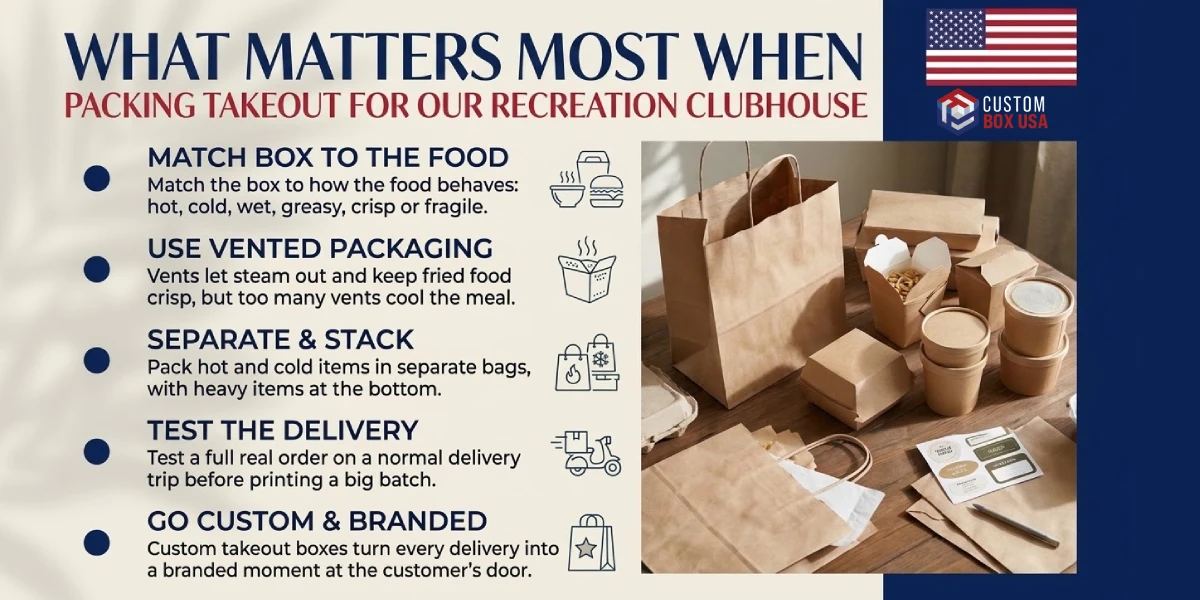
Pick a container that fits how the food behaves. Then protect its heat, texture and shape until it reaches the door. These six steps cover most orders:
- Match the box to the food. Crispy, saucy and fragile foods each need a different box.
- Keep hot and cold apart. Ice cream next to soup helps neither one.
- Let steam out. Trapped steam is what turns fries and fried chicken soft.
- Seal and label. Tight lids stop leaks, and labels stop mix-ups.
- Bag it right. Heavy items go at the bottom, and containers stay upright.
- Test one real order. Pack it, take it on a normal trip, then open it like a customer would.
Here are the quick answers in one place:
| Question | Short answer |
|---|---|
| How do I keep fried food crisp? | Let steam out with vents or an open carton, and add a napkin or paper liner. |
| How do I stop soup leaks? | Use a tight lid, leave room below the rim, seal it and keep it upright. |
| Vents or insulation? | It depends on trip time. Long trips need more insulation; crisp food needs some venting. |
| Hot and cold in one bag? | Better not. Use separate bags, or at least keep them on opposite sides. |
| How long can food sit out? | No more than 2 hours between 40°F and 140°F, or 1 hour above 90°F outside. |
| Do I need tamper-evident seals? | California requires them for third-party delivery. Elsewhere they still build trust. |
| Should I test before printing? | Yes. Use your heaviest, wettest menu item and a real delivery trip. |
Start with how your food behaves
The food decides the box, not the other way around. Before you look at styles or colors, write down what each dish does during a typical ride.
What should you check about your food before choosing a box?
Ask six questions: is it hot, cold, wet, greasy, crisp or fragile?
Most dishes are two or three of these at once. A burger is hot, greasy and a little wet, while pho is hot and very wet. Each trait points to a fix. Wet food needs a tight lid. Greasy food needs a grease-resistant liner, which is paper or a coating that stops oil from soaking through. Fragile food needs a snug fit so it can't slide.
Does trip time and weather change the packaging?
Yes. A quick walk-up pickup and a long winter delivery need different setups.
One packaging industry guide sums up the trade-off well: too much insulation without vents makes crisp food soft, and too much airflow cools hot meals fast. Short pickups can lean toward vents, while long cold-weather trips need more insulation. Hot summer days also affect food safety, which we cover further down.
Why should you test with a full portion, not an empty box?
An empty box can't show you leaks, sagging or steam.
A box that looks great on the counter can act very differently after half an hour on the road with real food inside. Test with your heaviest and wettest dish, because that's where problems show up first.
What Matters Most When Packing Takeout
Takeout packaging tips by food type
Each food has one main risk, and the right box is the one that fixes it. Use this table as a starting point.
| Food | Main risk | Box style | Simple fix |
|---|---|---|---|
| Fries | Steam makes them soft | Open fry carton or vented clamshell | Napkin liner; pack apart from the burger |
| Fried chicken | Steam and grease | Vented paperboard or corrugated box | Liner on the bottom; don't pile pieces tightly |
| Burgers and sandwiches | Soggy bun, grease stains | Clamshell burger box | Wrap in foil or paper; wet toppings on the side |
| Pizza | Steam, cheese sticking to the lid | Corrugated pizza box with vents | Small vents; keep the lid off the cheese |
| Soups and noodles | Leaks, soggy noodles | Tight-lid container | Leave room below the rim; noodles and broth apart |
| Chinese takeout and rice dishes | Sauce leaks | Folded paper takeout pail | Keep upright; don't fill to the top |
| Salads and cold items | Wilting from heat | Cold container with a clear lid | Dressing on the side; separate bag from hot food |
| Cakes, donuts, pastries | Crushing and sliding | Bakery box with an insert | Snug insert; carry flat |
How do you keep fries and fried chicken crispy in a takeout box?
Let the steam out and give the grease somewhere to go.
Fries leave the fryer full of hot moisture. In a closed box, that moisture becomes condensation: water drops that form when steam hits a cooler surface. It's the same reason a lid on a pot of boiling pasta drips water back into the pot. A fry carton (an open paper holder) lets steam leave instead. For fried chicken, use a box with vent holes and a paper liner on the bottom, and pack fries in their own container rather than on top of a hot burger.
How do you stop a burger bun from getting soggy in a box?
Wrap the burger and keep wet toppings away from the bread.
A sheet of foil or greaseproof paper holds heat and catches juice. Pickles, tomatoes and sauces can ride in a small side cup so the bun stays dry. A clamshell (a box with a hinged lid that opens like a clam) keeps the burger from getting squashed. Want your logo on it? Our custom burger boxes come in your size, material and print.
How do you pack pizza so the cheese doesn't stick to the lid?
Keep the lid up and let some steam escape.
Cheese sticks when the lid sags or when steam softens the cardboard. Corrugated board helps here. It's cardboard with a wavy layer inside, a bit like a tiny row of arches, which makes it stiff and adds some insulation. Small vents let steam out, and a plastic pizza "saver" in the middle holds the lid off the cheese. Our custom pizza boxes can be sized to your pies.
What is a Chinese food takeout box good for?
Rice, noodles and saucy stir-fries that travel upright.
The classic chinese food takeout box is called an oyster pail. It's a folded paper box you'll find at American Chinese restaurants across the country. Its folded design lets some steam escape, so rice is less likely to turn mushy. Don't fill it to the very top, and keep it standing in the bag. Our custom Chinese takeout boxes can carry your logo too.
How should you pack salads, cakes and donuts?
Keep salads cold and away from hot food, and give baked goods a snug fit.
Put dressing in a side cup so the greens don't wilt on the way. For cakes and donuts, use a bakery box with an insert, which is a piece of board cut to hold each item in its own spot, like an egg carton. A window box lets customers see the treats without lifting the lid.
How to keep takeout food hot and crispy
Insulation keeps food hot, and venting keeps it crisp. The goal is the right balance for your trip time.
Should you choose vents or insulation?
Use both, in the right amount for the food and the distance.
A sealed box works like a sauna: heat stays in, but the steam has nowhere to go. A box full of holes is like an open window, with no steam but fast heat loss. For a short pickup, more venting is fine. For a long delivery, add insulation and keep a few small vents. Stews and curries don't mind steam, so seal those tight.
What is the best material for hot takeout containers?
Thick paperboard or corrugated board with a grease-resistant liner suits most hot, dry or fried foods.
Double-wall paperboard has two layers with an air gap between them, so it holds heat a little better than one layer. Corrugated board is stronger and also insulates. Very wet dishes like soup need a sealed, leak-resistant container instead. Every menu is different, so ask our team which materials suit your food before you order.
Do foil, napkins and fry sleeves really help?
Yes. Each one is a cheap fix for one specific problem.
Foil around a burger keeps heat close, a napkin under fried food soaks up grease, and a fry sleeve lets steam escape. Our advice: add these only where they solve a real problem. Extra layers on every item add cost and waste without making the food better.
Should you preheat delivery bags?
If you use your own insulated bags, warming them before service helps.
A cold bag pulls heat out of the food at first, much like pouring coffee into a cold mug. A warm bag doesn't. Keep your bags near the pass (the counter where finished orders wait), not in a chilly back room.
Why put sauce on the side?
Sauce poured over crisp food turns it soft within minutes.
Gravy, dressing and dips belong in small lidded cups. Pack each sauce next to the dish it goes with, so customers aren't left guessing.
How do you stop leaks, crushed food and mixed-up orders?
Most of these problems come from loose lids, poor bag stacking and missing labels. All three are easy to fix on the pass.
How do you pack soup for takeout without leaks?
Use a tight lid, leave room below the rim and keep the container upright.
A container filled to the brim spills the moment it tilts, while a little headspace gives the liquid room to move. Press the lid down all the way around, then add a sticker or tape across it. For pho or ramen, pack noodles apart from the broth so they don't swell into mush.
What goes at the bottom of the bag?
Heavy, flat, sealed containers go at the bottom. Light or fragile items go on top.
It's the same logic as a grocery bag, where the eggs never go under the milk. Soup and rice dishes make a stable base, and fries and desserts sit on top. Bags with handles are easier for drivers to carry level, and cold drinks should stay apart from hot food. That matches the delivery packaging tips one delivery platform gives its restaurants.
How should you label orders?
Label every container with the item and any changes, like "no onions."
Labels speed up checks and help families split a big order. Put customer names on a small removable order label, not written large on the box, so the whole street doesn't see who ordered what.
Which extras belong in every bag?
Napkins, the right utensils and the matching sauces.
Ask customers whether they want utensils, since many people eat at home. A quick check against the ticket before the bag closes catches most missing items.
Food safety basics for takeout and delivery
Hot food should stay hot, and cold food should stay cold. That keeps food out of the range where germs grow fastest.
What is the temperature danger zone?
It's the range from 40°F to 140°F, where bacteria multiply quickly.
According to the USDA Food Safety and Inspection Service, perishable food shouldn't sit in that range for more than 2 hours. If takeout arrives early, keep it at 140°F or above, or put it in the fridge. The FDA guidance on the Danger Zone cuts that limit to 1 hour when it's above 90°F outside. This matters most for perishable foods such as cooked meat and dairy.
Are restaurant rules different from home rules?
Yes. Restaurant rules use slightly different numbers, and they depend on where you are.
The FDA Food Code is a model rulebook for restaurants, and states and local health departments adopt it in their own way. Its limits for hot holding and cold holding (keeping cooked food hot, or cold food cold, until it's served) differ a little from the consumer numbers above. Check your local health department's rules for your exact limits.
What is tamper-evident packaging, and do you need it?
It's a seal or sticker that shows if someone opened the order. California requires it for third-party delivery.
Think of the foil seal under a new jar lid: it doesn't stop anyone from opening the jar, it just makes it obvious. California's tamper-evident delivery law, AB-3336, took effect in 2021 for restaurant orders delivered by third parties. Stickers, sealed bags and containers with built-in tamper features are common ways to comply. New York lawmakers have proposed a similar bill, but it isn't law. Even where it's not required, a sealed bag tells customers nobody touched their food.
Common takeout packaging mistakes
Most takeout complaints trace back to a handful of habits.
What mistakes ruin takeout orders most often?
Testing empty boxes and sealing hot, crisp food airtight top the list.
- Testing an empty box. It hides leaks, sagging and steam problems.
- Sealing fried food airtight. The steam has nowhere to go but back into the food.
- Packing salad next to fries. The salad wilts and the fries cool down.
- Skipping sauce cups. Sauce poured on top soaks everything.
- No labels. Orders get mixed up, and special requests get missed.
- Careless bag stacking. Heavy items on top crush cake and fries.
- Too many box sizes. Fewer sizes mean simpler storage and faster packing.
- Printing before testing. A big print run of the wrong box is an expensive lesson.
Custom takeout boxes: what should you decide before you order?
Settle on sizes, material, print and extras, then test a sample. Your box is a silent salesman at every door, so it has to look good and work well. That's especially true for food delivery packaging for restaurants, where the box is the first thing customers see.
Which size, style and material should you pick?
Pick the fewest sizes that fit your best-selling dishes, in a material that suits the food.
Group your top sellers by size. For example, if your burger and your chicken sandwich fit the same clamshell, you only need one box for both. Gable boxes, which have a handle-style top shaped like a small house roof, work well for full meals. Kraft boxes are made from strong brown paper and suit sustainability-minded brands. Our kraft boxes and other recyclable stock come in custom sizes.
How should you print your logo on restaurant to-go packaging?
Keep the design simple and bold so it still looks good after steam and a little grease.
Your box shows up at the door and often in customer photos, so it can turn every delivery into a branded moment. A clear logo, your web address and one or two colors usually beat busy artwork. You can print outside, inside or both, using digital, screen, flexography or offset printing, with a gloss or matte finish. White boxes make colors pop, while kraft hides small marks a little better.
Do you need windows, vents, inserts or handles?
Add them only where your food needs them.
Vent holes are cut at the die-cut stage, when a press with sharp blades stamps out the box shape, like a cookie cutter. Plan them before printing. Check the dieline, the flat outline of the box that shows every fold and cut, so your logo doesn't land on a vent. Windows suit baked goods, inserts keep items apart, and handles help with heavy meals.
Can you test a sample first?
Yes. Our minimum order is as low as 1 unit, so you can test a single sample before a bulk order.
Pack it with real food, take it on a normal trip and open it like a customer would. Fix any leaks or soggy spots, then order in bulk. There are no die and plate charges, design support is free, and shipping is free across the USA.
How long does a custom order take?
Standard turnaround is 8 to 10 business days, and rush orders take 4 to 6 days.
Timing may vary with order volume and location, so order seasonal boxes early before a busy holiday week. Our food and beverage packaging range covers takeout, bakery and snack boxes in one place.
Is there a checklist you can copy?
Yes. Use one list before ordering and one during service.
Before ordering:
- List your top dishes and group them into as few sizes as possible.
- Choose kraft or white, and inside, outside or both-side printing.
- Place your logo away from vents and fold lines on the dieline.
- Decide on windows, vents, inserts and handles.
- Order a sample and test it with your heaviest, wettest dish.
On the pass during service:
- Hot and cold items go in separate bags.
- Lids are pressed down and sealed.
- Sauces sit in cups next to their dish.
- Heavy items are at the bottom, and containers are upright.
- Labels and the tamper-evident seal are on, and the order matches the ticket.
Frequently Asked Questions
Should takeout containers have vent holes?
Yes for fried and crispy foods, but not for soups and saucy dishes. Vents let steam out so fries, fried chicken and pizza stay crisp, while wet foods need a sealed lid so they don't leak.
How do you keep takeout food hot during delivery?
Use an insulated container, a warm delivery bag and the shortest path from pass to driver. Foil wraps and double-wall paperboard help hold heat. Pack the food right before pickup so it doesn't cool on the counter.
Can hot and cold food go in the same bag?
It's better to use separate bags. Cold drinks and salads pull heat from hot food, and hot food warms cold items. If they must share a bag, keep them on opposite sides with a divider.
Is kraft paper good for hot or greasy food?
Kraft works well for hot food, and a grease-resistant liner or coating helps with oily dishes. Plain kraft can show oil spots over time, so ask our team which kraft options suit your menu.
Can I print my logo on takeout and pizza boxes?
Yes, on takeout, pizza, burger and other food boxes. Share your logo or upload your artwork, and our free design support team will help place it on the box.
How long can delivery food sit before it is unsafe?
No more than 2 hours between 40°F and 140°F, or 1 hour if it's above 90°F outside. These are USDA and FDA consumer guidelines. Restaurants should also follow their local health department's rules.
Ready to package your takeout? Get a free quote
Good takeout packaging keeps food hot, crisp and safe, and it puts your brand in your customer's hands. Start with how each dish behaves, test a real order, then print the box that passes.
Custom Box USA has spent 10 years making custom packaging and has delivered 1500+ orders. You choose the size, material, finish and print, with free design support and free shipping across the USA. First-time customers also get 20% off their first purchase. Get a free quote, and our team will reply within 2 hours.