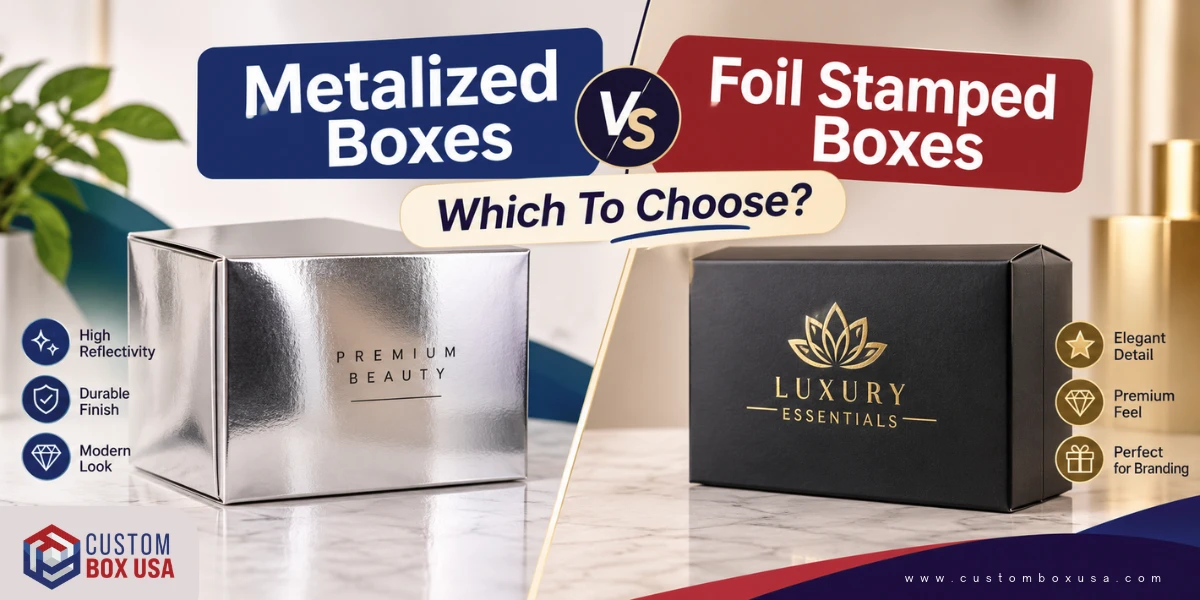
Many first-time buyers use "metalized" and "foil stamped" as if they mean the same thing. In fact, they're two different ways to make a box shine. Custom metalized boxes shine across the whole surface, because the board itself carries a thin metal layer. Foil stamped boxes start as plain board, and shiny foil is pressed on only where you choose, like your logo or a border.
So start with one question: should the whole box glow, or just one bright detail? Your answer settles most of the other choices.
Quick answer: metalized vs foil stamped boxes
Pick metalized when the shine is the main design. Pick foil stamping when your logo or a few details should catch the light against a printed or plain background.
The one-line difference
Metalized is the material. Foil stamping is a finish added on top of a material. Since one is the base and the other is a decoration, you can use both on the same box.
The 30-second light test
Hold a sample box under a lamp or near a window and tilt it slowly. If the whole surface flashes back at you, it's metalized. If only the logo or edges shine while the rest stays matte or printed, it's foil stamped. This test is handy when you compare samples or study a box you liked in a store.
What are metalized boxes?
Metalized boxes are made from board with a very thin layer of metal, usually aluminum, on the surface. Most use paperboard, which is a thick, firm paper used for folding cartons. The metal layer makes the whole box shine.
How the metal layer is added
There are two common methods. In vacuum metallizing, aluminum is heated in a sealed chamber until it turns into vapor. That vapor settles on the paper as a coat about 20 to 30 nanometers thick, according to one maker's explanation of how vacuum metallizing works. That's hundreds of times thinner than kitchen foil.
The second method is lamination. Here, a plastic film that already has a metal coating is glued onto the board. Both boxes look shiny, but they're built differently. That difference matters a lot when you get to recycling.
Gold, silver and other looks
Silver is the classic metalized look, because it's the natural color of aluminum. Other tones, like gold, usually come from tinted coatings or colored inks printed over that silver base. You can also choose a gloss or matte finish. Gloss gives a mirror-like flash, while matte feels softer and shows fingerprints less. Ask our team which shades work for your box style.
Metalized vs aluminum foil
Aluminum foil is a solid sheet of metal, like the roll in your kitchen drawer. Metalized board or film only has a tiny metal coating on top of another material. So when a supplier says "foil," ask which one they mean. The answer changes how the box feels, how it's printed and how it's recycled.
Want to see the styles and finishes we make? Browse our custom metalized boxes page.
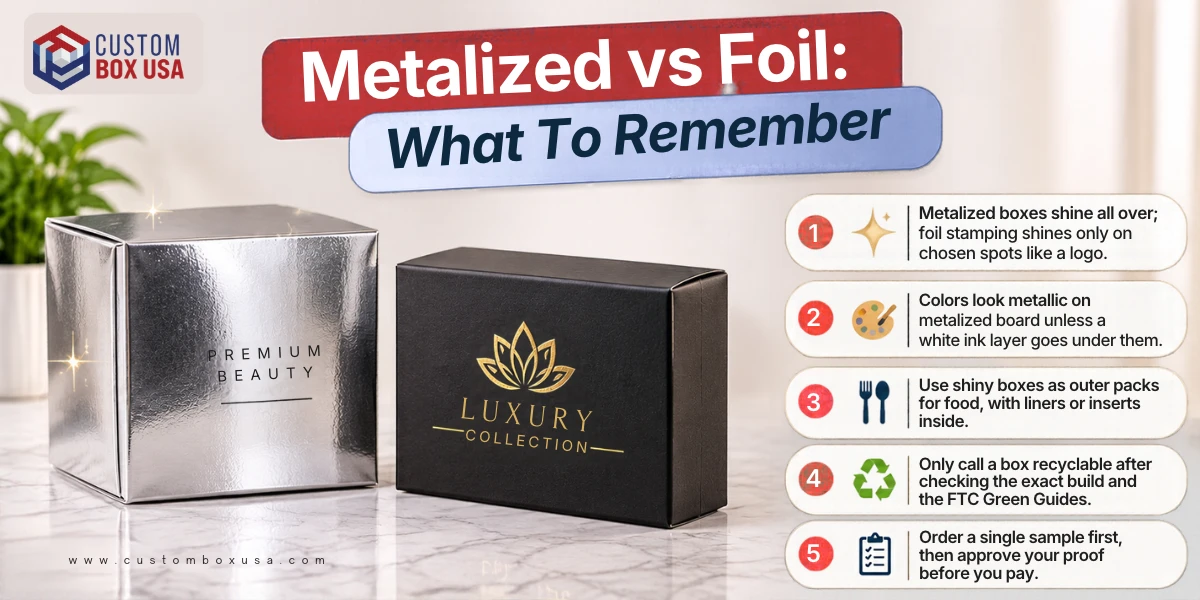
Metalized vs foil: what to remember
What is foil stamping?
Foil stamping puts a thin layer of metallic foil onto chosen parts of a box, such as a logo, a name or a pattern. The rest of the box stays exactly as it was printed.
Hot foil in plain words
Hot foil stamping uses a die, which is a metal tool shaped like your design. The die is heated and pressed onto a roll of foil that sits over the box. Heat and pressure make the foil stick only where the die touches. It works much like a rubber stamp, except the "ink" is a sheet of shiny foil. It's also a dry process, so there's no wet ink to wait for.
Cold foil in one paragraph
Cold foil skips the heated die. A press prints glue in the shape of your design, and then foil is laid over it. The foil sticks only to the glue, and the extra foil peels away. Because cold foil uses printing plates instead of a stamping die, it fits inside a normal print run.
Why logos and borders suit it
Foil pulls the eye to one spot. For example, a gold logo on a deep green box, or a silver border on a white lid, shows the customer exactly where to look. If the whole box shone, your logo would have a harder time standing out.
Metalized vs foil stamped: side-by-side table
The biggest differences are coverage, color printing and fine detail.
| Feature | Metalized box | Foil stamped box |
|---|---|---|
| Look | Whole surface shines | Only chosen spots shine |
| Coverage | Full box, inside or outside | Logos, text, borders, patterns |
| Color printing | Inks take a metallic tone; true colors need a white base layer | Normal full-color printing around the foil |
| Fine detail | Printed detail works well | Very thin lines and tiny text can fill in |
| Feel | Smooth, glossy or matte | Foil areas feel different from the board around them |
| Scuffing | Large shiny areas can show scratches | Small foil areas are less exposed |
| Recycling note | Depends on how the board is built | Studies found foil-decorated paper recyclable |
| Best for | Holiday sets, premium gifts, standout shelf boxes | Logo accents, bakery and everyday gift boxes |
What drives the cost
We don't list prices here, because cost depends on your exact box. The main drivers are how much of the box shines, the box size, the board type, the quantity and how many finishes you stack. For a small logo accent, foil stamping is usually the simpler job. For full-surface shine, metalized board makes more sense, because the shine is already built into the board. The fairest way to compare is to ask for two quotes side by side.
Which should you choose? Three example scenarios
The right pick depends on what's inside the box, who gets it and what the shine needs to say. These three situations are made-up examples, but they reflect questions buyers often ask.
Scenario 1: A small bakery's holiday cookie box
Say you run a small bakery and want festive cookie boxes for December gift orders. You want a box that feels like a present but still says "fresh from our oven."
You could choose a full gold metalized box, or a white or kraft box with a gold foil logo. The full gold box looks dramatic, but it can feel more like a jewelry box than a bakery box. A gold foil logo on warm kraft or crisp white keeps the homemade feel and still adds holiday sparkle.
Best pick: white or kraft board with a gold foil logo, plus a liner inside for the cookies. It's festive without hiding who you are. See our holiday gift boxes for styles that fit this kind of order.
Scenario 2: Year-end gifts for company clients
Now say you're ordering custom gift boxes for your company's top clients. You want a strong first impression and a logo people remember.
Here, the shine is the message. A silver or gold metalized box makes the unboxing feel special from the first second. You can add your logo with foil in a contrasting tone, or emboss it so people can feel it. Embossing raises the design so it stands up from the surface, a bit like Braille.
Best pick: metalized board with an embossed or foil logo. Order one sample first, because a premium gift box is worth checking in your own hands. Our corporate gift boxes page shows styles that work for client and employee gifts.
Scenario 3: A chocolate shop's Valentine's box
Finally, say you run a chocolate shop, and your Valentine's design uses bright red and soft pink. You also love the idea of a rose gold shine.
This is where many buyers get a surprise. On metalized board, red and pink take on a metallic tint unless a white ink layer goes under them first. Why? The silver shows through thin ink, the same way old paint shows through one coat of new paint. The white layer works like primer on a wall. If exact colors matter most, a white board with a rose gold foil heart is the safer pick. If the shine matters most, choose metalized board with white printed under your key colors.
Best pick: it depends on your priority, so ask for a sample of both and order early. Browse our custom chocolate boxes for shapes and insert options.
Decision table: match your situation to a finish
| Your situation | Best choice | Why |
|---|---|---|
| Holiday gift set with a "wow" moment | Metalized gold or silver | The whole box feels like a present |
| Corporate client or employee gift | Metalized + foil or embossed logo | Premium shine with a logo people remember |
| Chocolate or cookie gift box | Foil logo on white, or metalized with white base | Keeps colors true while adding shine |
| Everyday bakery box | Kraft or white with a foil logo | Fresh, honest look with a branded touch |
| Subscription or retail box | Foil logo, or metalized for limited editions | Foil for repeat runs, full shine for special drops |
Can you combine metalized board and foil stamping?
Yes, and the mix often looks best. Combining finishes lets you decide where the eye goes first.
Metalized or white board with a foil logo
A silver metalized box with a gold foil logo gives you two tones of shine. A white box with a silver foil logo looks clean and modern. Both put your logo in charge.
Kraft with gold foil
Kraft is brown paper stock made from wood pulp. Gold foil on kraft is popular with bakeries and gift shops, because it feels natural and a little fancy at the same time. Our gold foil boxes show how this pairing looks. Foil logos can also go on plain custom cardboard boxes and custom corrugated boxes used for shipping, so ask our team what suits your box style.
Add embossing or spot UV
Spot UV is a shiny clear coat added only to chosen areas. On a matte box, it makes a pattern pop without adding any color. Debossing presses a design into the board, the opposite of embossing. One or two extra finishes usually look classy, but five at once can look busy. Pick the one that fits your brand best.
Can you use metalized boxes for food or chocolates?
Yes, as the outer box. For food that touches the packaging, use a liner, insert or inner tray made for that job.
Outer box vs direct food contact
Most shiny gift boxes act as an outer shell. Chocolates sit in a tray or cup, and cookies sit on a liner or in a bag. This keeps the decorated surface away from the food and helps the box stay clean.
Inserts, liners and windows
Inserts are cut pieces of board that hold items in place, like slots for truffles or cupcakes. Windows let customers see the treats inside. Both work with foil stamped boxes. On a metalized box, a window works like a shiny picture frame around your food.
Ask our team about food-contact materials
Every food product is different. Moist, oily or warm items need different materials than wrapped candy does. Tell our team what you're packing, and ask which materials and liners suit your product before you order.
Are metalized and foil stamped boxes recyclable?
Studies have found foil-decorated paper recyclable, and some metalized paper builds are recyclable too. The real answer for your box depends on how it's made and where it's sold.
What studies say about foil-decorated paper
A study by Pira International, commissioned by the Foil & Specialty Effects Association (FSEA), found that paper and board decorated with hot or cold foil were recyclable and repulpable. Repulping means breaking used paper down in water so it can become new paper. The FSEA foil recyclability study tested material with 25% to 100% post-consumer waste content. A separate study from Georgia Tech's Renewable Bioproducts Institute found that foil-decorated paper didn't cause problems in a common repulping process.
For metalized paper, a 2025 peer-reviewed study on vacuum metallized paper says some directly metallized paper with thin coatings can go in the standard paper stream. That finding covers only the builds tested. Boards with a glued-on plastic film are built differently, so ask us which version your box uses.
What the FTC 60% rule means for your label
The FTC's Green Guides set rules for eco claims on US packaging. A plain "recyclable" label is fair only if recycling is available to a "substantial majority" of the people or communities where you sell. The FTC defines that as 60%. Below that, you should qualify the claim, for example by noting that recycling may not be available in all areas. You can read the details in the FTC Green Guides (Federal Register).
Safe wording to use
Use "recyclable" or "made from recycled materials" only where it's true for your exact box. Avoid vague words like "green" on a shiny box. If sustainability is a big part of your brand, plain kraft with a small foil logo is often the easiest box to talk about honestly.
Common mistakes to avoid
Most problems come from design choices, not from the materials themselves.
- Foil text that's too small. Very fine text and thin lines can fill in and look blurry. Keep foil text bold and simple.
- Foil on folds or glue flaps. Foil can crack on a fold, and glue may not hold well on top of it. Keep foil a little away from fold lines.
- Expecting bright colors on silver. Colors look metallic on metalized board unless white ink goes underneath.
- Forgetting about scuffs. Large glossy surfaces can show scratches in shipping. A matte finish or an outer mailer box helps.
- Skipping the sample. Shine is hard to judge on a screen. A real sample shows how the light hits.
- Printing "recyclable" without checking. Confirm the board build first, then use honest wording.
How to order custom metalized boxes from Custom Box USA
You pick the box, we help with the design, you approve a proof, and then we make and ship it.
1. Pick size, style, material and finish
Choose your box style, size and board. Then add metalized board, foil stamping, embossing, debossing, spot UV, or a gloss or matte coating. Custom sizes, materials, finishes and printing are all available, so the box fits your product.
2. Share your logo or artwork
If you have a vector logo file, such as AI, EPS or PDF, send it. Vector files stay sharp at any size, because they're built from lines and shapes instead of pixels. Only have a basic logo? That's fine. Our free design support can build the layout for you.
3. Approve your proof, then pay
A proof is a digital preview of your box. You check it, ask for changes and approve it. Payment comes after you approve the digital file.
4. Production and delivery
Standard turnaround is 8 to 10 business days, and rush orders take 4 to 6 days. Timing may vary with order volume and location. Shipping is free across the USA, and there are no die and plate charges. You can order a single box as a sample, then move on to custom boxes wholesale quantities.
It's mid-November, so holiday and Christmas orders don't have much spare time. Leave room for design and proof approval before production starts. Our team works from Anaheim, so if you've searched "custom boxes Los Angeles," we're close by. We also ship custom printed boxes to brands all over the country.
Frequently Asked Questions
What are metalized boxes?
Metalized boxes are made from board with a very thin metal layer, usually aluminum, that makes the whole surface shine. Silver is the classic look, and other tones come from tinted coatings or inks.
Is metalized packaging the same as aluminum foil?
No. Aluminum foil is a solid metal sheet, while metalized packaging has only a tiny metal coating on paper or plastic.
Are metalized boxes recyclable?
Some are, depending on how the board is built. Research has found certain directly metallized paper builds recyclable in the paper stream, while film-laminated boards can differ. Ask our team about your exact board.
Is foil-stamped packaging recyclable?
Industry studies found foil-decorated paper and board recyclable and repulpable. Still, check local recycling access and the FTC Green Guides before you print a "recyclable" label.
Which is cheaper, metalized or foil stamping?
It depends on your design. A small foil logo on plain board is usually the simpler job, while full shine calls for metalized board. Quantity, size and extra finishes also change the cost, so compare quotes for both.
Can you print on metalized board?
Yes. Inks take on a metallic tone, so printers add a white base layer under areas where you want true, solid colors.
Can I order a single sample before a bulk order?
Yes. Custom Box USA has a minimum order as low as one unit, so you can check the shine, colors and fit before a full run.
Get a free quote
Go metalized when you want the whole box to shine. Choose foil stamping when one bright logo should lead, and combine both when you want a bit of each. Still not sure? Send us your idea, and our team will suggest a build that fits your product and budget.
You'll get free design support and free shipping across the USA, plus 20% off your first purchase. Quote requests get a reply within 2 hours. Get a free quote today and turn every delivery into a branded moment.