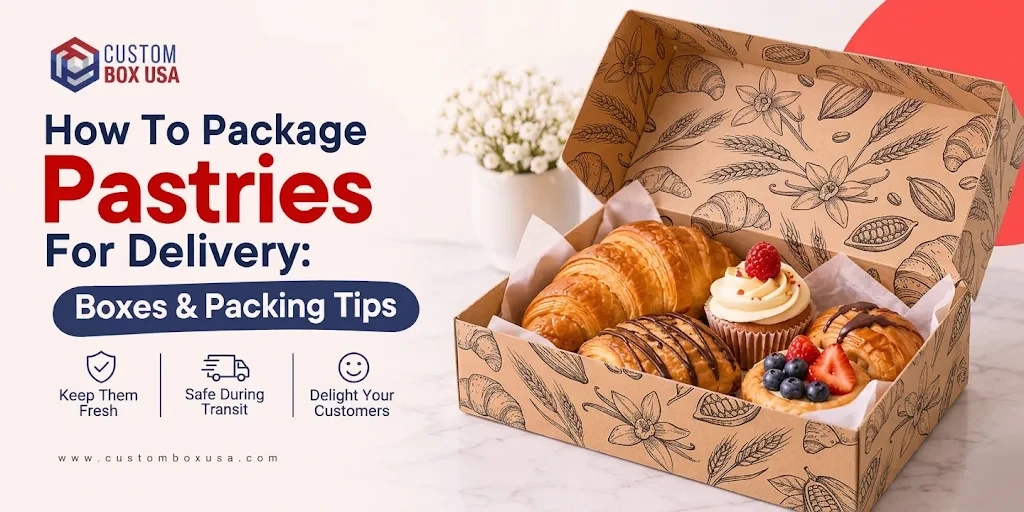
A croissant that leaves your counter looking perfect can arrive flat, soggy or smeared. Bumpy roads usually get the blame. Most of the damage starts earlier, though: warm pastry sealed in a box, too much empty space, or a cream filling left out too long. The good news is that each of these problems has a simple fix.
So here's how to package pastries for delivery without costly surprises. Cool them fully, give each one its own spot, cushion the box without squeezing it, and label it clearly. The details change a little between a short drive across town and shipping across the country, so we cover both below. You'll also find a table showing which pastries travel well and which are better kept local.
How to package pastries for delivery: the short answer
Cool, separate, cushion, box, label. Those five steps cover most orders. If you're learning how to ship pastries by courier, add two more: a strong outer carton and a fast shipping service.
Quick answer table
| What you need | Time it takes | Result |
|---|---|---|
| Cooling rack and patience | Until pastries are fully at room temperature | No steam, no soggy bottoms |
| Parchment, wax paper or food liners | A few minutes per box | Pastries don't stick together |
| A bakery box with dividers or an insert | Order ahead of time | Nothing slides or bumps |
| Corrugated outer carton and void fill (shipping only) | A few extra minutes | The inner box survives the courier |
| Labels and a handling card | One minute | Handlers and customers know what to do |
Local delivery vs. shipping at a glance
Local delivery is a short trip, often in your own car or with a local courier. A good bakery box with an insert is usually enough. Shipping is a much longer trip through sorting centers, trucks and planes, so your pastry box needs to sit inside a stronger box with padding around it.
- Local delivery: bakery box, dividers, a flat spot in the car, and a cooler bag for cream fillings.
- Shipping: everything above, plus an outer carton, void fill, cold packs if needed, labels and a fast service.
Which pastries travel well (and which need extra care)?
Firm, dry pastries travel best. Soft, cream-filled or very delicate ones carry the most risk. It pays to be honest here, because not every pastry is a good fit for the mail.
Decision table by pastry type
| Pastry | Risk in transit | Best box or insert | Speed |
|---|---|---|---|
| Turnovers, baked hand pies | Low | Tuck-end or window box with a tray insert | Standard is usually fine for short trips |
| Croissants | Medium (flaky layers crush easily) | Roomy box with cell dividers, no tight packing | Fast, so they stay crisp |
| Danishes | Medium (icing can smear) | Divided tray, parchment between pieces | Fast |
| Fruit tarts | Medium to high (glaze and fruit shift) | Snug insert that holds the tart base | Local or overnight |
| Macarons | High (shells crack) | Fitted tray insert, tight rows | Fast |
| Éclairs, cream puffs, custard pastries | High (perishable filling) | Insert plus insulation and a cold source | Think twice before shipping; local same-day is safer |
When to skip shipping and deliver locally
If the filling is cream, custard or dairy, pause before you mail it. These fillings are perishable, which means they can spoil if they aren't kept cold. Our honest view is that local same-day delivery is the safer choice for éclairs and cream puffs. Shipping them can work, but you'll need insulation, cold packs and the fastest service, and there's very little room for a delay.
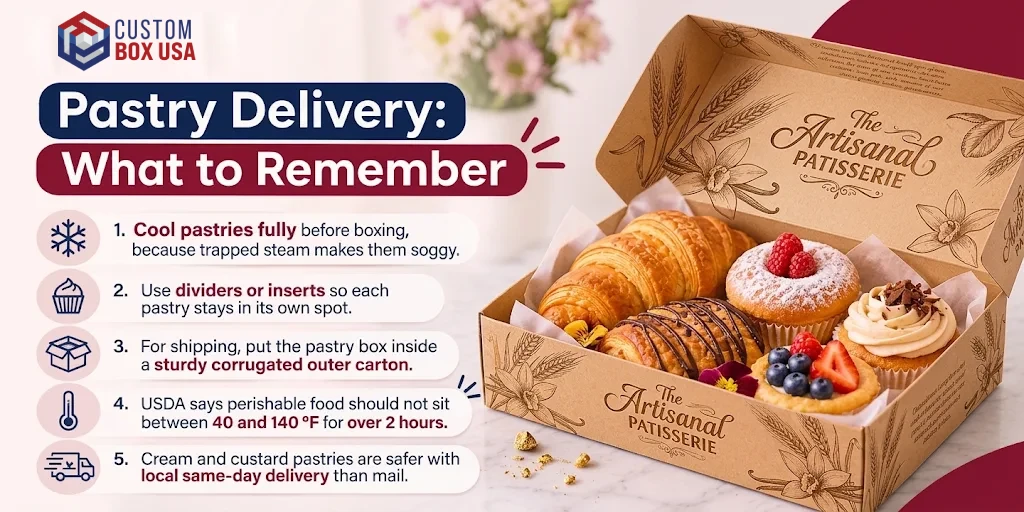
Pastry Delivery: What to Remember
Step-by-step: how to pack pastries for shipping
Follow these seven steps in order. Steps 1 to 3 also apply to local delivery, while steps 4 to 7 matter most once a courier is involved.
Step 1: Cool completely
Let pastries reach room temperature before the lid goes on. Warm pastry gives off steam, and inside a closed box that steam turns into condensation: small water drops on the lid and walls. Those drops soften crisp layers and leave you with soggy bottoms.
Step 2: Wrap or separate with parchment or food liners
Parchment, wax paper and food liners are thin sheets made for food. They stop pastries from sticking to each other or to the box. Slip a sheet under anything sticky or glazed, such as a danish with icing. For shipping, you can wrap each pastry on its own, but keep croissants loosely wrapped so their layers don't get pressed flat.
Step 3: Use pastry boxes with dividers
Dividers are card walls or trays inside the box that give each pastry its own spot. They're the single best way to stop pastries from bumping into each other. Our custom bakery boxes can be made with inserts sized to your exact pastries.
Step 4: Put the box inside a sturdy outer carton
This is called box-in-box packing. You place the pastry box inside a bigger, stronger box with padding between the two. The outer box should be corrugated cardboard, which is strong board with a wavy layer sandwiched inside. A plain bakery box isn't built for a sorting center, so sturdy corrugated shipping boxes take the knocks instead.
Step 5: Fill gaps without squeezing
Void fill is paper, bubble wrap or air pillows that fill empty space so nothing slides. Add a layer on the bottom, around the sides and on top, then gently shake the box. If you hear movement, add more. If you have to push hard to close the lid, you've gone too far and will crush the layers.
Step 6: Seal and label
Tape every seam of the outer carton. Mark it "Fragile," "Perishable" and "This Side Up." For cold items, the USDA advises labeling the box "Keep Refrigerated." A small card inside with storage and reheating tips is a kind touch for your customer.
Step 7: Pick speed and ship early in the week
Choose the fastest service you can afford. For perishable food, the USDA suggests overnight delivery where possible. Try to ship on a Monday, Tuesday or Wednesday, because a box sent on Friday may sit in a warehouse over the weekend.
How it works, in plain words
Pastries fail in four ways: steam, movement, pressure and heat. Cooling stops steam, and dividers stop movement. The outer carton and gentle void fill handle pressure, while speed and cold packs fight heat. Cover all four, and most pastries arrive looking the way they left your counter.
Pastry boxes with dividers: how to choose
Match the insert to the shape of your pastry. Round or tall items need cells, while flat or long items sit better in a tray. Here's a simple comparison.
Cell dividers vs. tray inserts vs. clamshells vs. window boxes
| Option | What it is | Best for |
|---|---|---|
| Cell dividers | Card walls that form a grid of small spaces | Croissants, cream puffs, round pastries |
| Tray insert | A card tray with cut-outs that hold each item | Macarons, mini tarts, danishes |
| Clamshell container | A box with a hinged lid that snaps shut, like a shell | Single items for quick local orders |
| Window box | A box with a clear cut-out so people see the pastry | Gifts and retail shelves; pair with an insert |
How to measure pastries for the right fit
Measure your largest pastry at its longest, widest and tallest point. Use the tallest point, not the average, because icing and fillings add height. Leave a little room so flaky edges don't rub the walls. Then share these sizes with your box maker, who will build a dieline: a flat drawing of the box that shows every fold and cut.
Kraft or white? Recyclable options
Kraft is brown, natural-looking board that suits rustic, artisan and eco-minded brands. White board makes bright colors and fine details stand out. Both work well, so pick the one that matches your brand. For greener packaging, look at our kraft boxes and recyclable packaging options.
Buttery pastries need one more check: grease resistance, meaning how well a box stops butter from soaking through. A liner or coating can help, so ask our team which option suits your product.
How do you keep pastries fresh during delivery?
Keep air, moisture and heat out, and keep the trip short. Cream fillings also need to stay cold and within USDA time limits.
Moisture and condensation
Never seal warm pastry. On humid days, pack in a cool, dry room if you can. Keep crisp and moist items in separate boxes, because a juicy fruit tart can soften the croissant sitting next to it.
Cream fillings and the USDA 40–140 °F / 2-hour rule
The USDA calls 40 to 140 °F the "Danger Zone," the range where bacteria can grow on perishable food. According to USDA Mail Order Food Safety, perishable food should not stay in that range for more than 2 hours. Bacteria can grow without changing how the food looks, smells or tastes, so you can't judge safety by eye. The USDA also says mailed perishable food that arrives above 40 °F should not be eaten.
Hot and cold weather tips
Summer is harder. USDA guidance on take-out and delivered foods cuts the safe window to 1 hour when the air is above 90 °F. On hot days, use an insulated liner and gel packs for cream items, and plan the shortest route. Winter cold is usually on your side, but keep boxes away from car heaters, which can melt icing.
Mailing perishable food: what USPS Publication 52 says
Yes, you can mail food. USPS Publication 52, the postal rulebook for restricted and perishable mail, says perishable items may be mailed at the sender's own risk. They must be packed properly and delivered fast enough to prevent spoilage. In practice, that means the packing steps above plus the quickest service you can book.
Custom pastry boxes: make the delivery a branded moment
A plain box keeps pastry safe. Custom pastry boxes do that too, and they also work as a silent salesman for your bakery. Every delivery becomes a small ad your customer opens at home.
Custom sizes, materials, finishes and printing
At Custom Box USA, you choose the size, style, material and finish. Materials include corrugated cardboard, paperboard (thin, smooth card often used for bakery boxes), kraft and recyclable stock. Finishes include gloss or matte, spot UV (a shiny coating on chosen areas) and foil.
Logo, window and inside printing ideas
- Your logo on the lid, so people recognize the box from across a room.
- A window that shows off your best-looking pastry.
- Printing inside the lid, such as a thank-you note or a short message.
- A QR code that links to reheating tips for croissants.
- A handling card that explains how to store each pastry.
Free design support, free USA shipping and a sample first
You don't need finished artwork. Share your logo, and our design team will help for free. Shipping is free across the USA, and there are no die and plate charges. The minimum order is as low as 1 unit, which makes the safest first move easy: order one sample box and pack it with your real pastries before a bulk order. If the size is off, you find out with one box instead of a whole run.
Turnaround and holiday planning
Standard production is 8 to 10 business days, and rush orders take 4 to 6 days. Timing can vary with order volume and location, so check our free quote page for details on your order. With Christmas less than six weeks away, ask about the rush option if you're starting now. For Valentine's Day 2027, starting in December leaves calm room for a sample and a design proof.
Common mistakes and how to prevent them
Most damaged pastry orders trace back to a short list of mistakes. Each one is easy to avoid once you know it.
| Mistake | What happens | How to prevent it |
|---|---|---|
| Sealing warm pastry | Steam turns to water and makes pastry soggy | Cool fully before closing the lid |
| Packing flaky pastries tight | Croissant layers get crushed flat | Use cell dividers and leave a little room |
| No outer carton when shipping | The bakery box gets crushed in transit | Use box-in-box packing with corrugated board |
| Wrong box size | Pastries slide or get squeezed | Measure the tallest point and test a sample |
| Shipping on a Friday | Box sits in a warehouse over the weekend | Ship early in the week |
| No handling note | Box gets stacked or tipped | Label "Fragile," "Perishable" and "This Side Up" |
| Butter soaking through plain board | Grease stains on the box | Ask about liners or grease-resistant options |
Pro tips
- Bake as close to dispatch time as you can.
- Pack one test box, drop it gently onto a table, then open it and check every pastry.
- Keep a few spare inserts on hand for odd-shaped specials.
Pastry delivery checklist
Screenshot this list and keep it near your packing table.
Before packing
- Pastries are fully cooled.
- Cream and custard items are cold and packed last.
- Parchment or liners are cut and ready.
- Box and inserts fit your largest pastry.
- Crisp and moist items go in separate boxes.
Before handing to the courier
- The inner box sits in a corrugated outer carton (shipping only).
- Void fill is in place, and nothing moves when you shake the box.
- Cold packs are added for perishable fillings.
- Labels and a handling card are on the box.
- It's early in the week, and the fastest service is booked.
Frequently Asked Questions
Can you ship pastries in the mail?
Yes, as long as they're packed well and arrive before they spoil. USPS allows perishable food at the sender's own risk. Firm pastries ship best, while cream-filled ones are safer with local delivery.
How do you keep pastries from getting crushed in a box?
Use dividers or a tray insert and a box that fits your tallest pastry. For shipping, place that box inside a corrugated carton with gentle padding on every side.
Do you need ice packs for pastries?
Only for perishable fillings like cream, custard or dairy. Plain croissants, turnovers and danishes don't need them. For cold items, the USDA advises a cold source and the fastest shipping you can get.
What day is best to ship baked goods?
Monday through Wednesday is best. Shipping early in the week helps keep your box from sitting in a warehouse over the weekend.
How do you package a cake for delivery?
Use a sturdy cake box with a base board, keep it level and cold if needed, and pad it inside an outer carton for shipping. Our guide on how to ship a cake walks through every step.
Are kraft boxes good for pastries?
Yes. Kraft boxes work well, and many are recyclable. For buttery pastries, ask about a liner so grease doesn't soak through.
What is the minimum order for custom pastry boxes?
At Custom Box USA, the minimum order is as low as 1 unit. You can test a sample box with your real pastries before you commit to a bulk order.
Next step: get a free quote
Safe pastry delivery comes down to a few calm habits: cool first, give each pastry its own spot, protect the box and move fast. The right box makes every one of those easier. Custom Box USA has spent 10 years in custom packaging and delivered 1500+ orders across the USA. Tell us your pastry sizes, and our team will help you pick the box, insert and finish. You'll get free design support, free USA shipping and 20% off your first purchase.
Get a Free Quote and hear back within 2 hours.