A customer leaves your shop with a dozen glazed donuts for a Monday office meeting. When they lift the lid, half the glaze is stuck to the cardboard and two donuts have slid into a sticky pile. The donuts were fine when they left your counter. The box, or the way it was packed, let them down.
Learning how to package donuts well comes down to a few habits. Let the glaze set, pick a box with room above the toppings, and add an insert so nothing slides. Then choose a box with small vents and a grease-resistant inside, and keep it flat on the trip. Each habit fixes a problem you've probably seen before, and once you know why it works, it's easy to stick with.
How to package donuts: the quick answer
Cool, fit, hold, vent, seal and carry flat. Those six steps cover most takeout and delivery orders.
The 6-step short version
- Cool the donuts until the glaze or icing feels set to a light touch.
- Pick the right size box for the count: single, half-dozen or dozen.
- Add an insert (a cardboard holder inside the box) so each donut has its own spot.
- Vent and line the box so steam can escape and oil doesn't soak through.
- Seal the box with a sticker, tape or sleeve.
- Carry it flat in a bag or carrier, never tilted on a car seat.
What changes for takeout, delivery and catering
Takeout is the easy case. The customer carries the box a short way, so a good box with an insert is usually enough. Delivery adds time, bumps and sharp turns, which makes an outer bag and a firm seal more important. Catering means many boxes at once, so stacking strength and handles become the big questions. Mail is a different job, and it gets its own section below.
Why should you let donuts cool before boxing them?
Warm donuts give off steam. Trapped in a closed box, that steam turns back into water, and water is bad news for glaze.
Why steam makes glaze sticky
When warm steam hits the cooler lid, it forms condensation, which means tiny water drops. You see the same thing under a pot lid when you boil pasta. Those drops fall back onto the glaze and melt the sugar. The top turns dull and tacky, and it sticks to the lid and to the donut next to it.
When boxing warm donuts is okay
Some customers want donuts warm, right now. For a short walk home, that's fine if the box has vent holes and the lid isn't pressed down hard. For anything longer, like a delivery order or an office drop-off, wait until the glaze has set. A few extra minutes on the cooling rack can save the whole box.
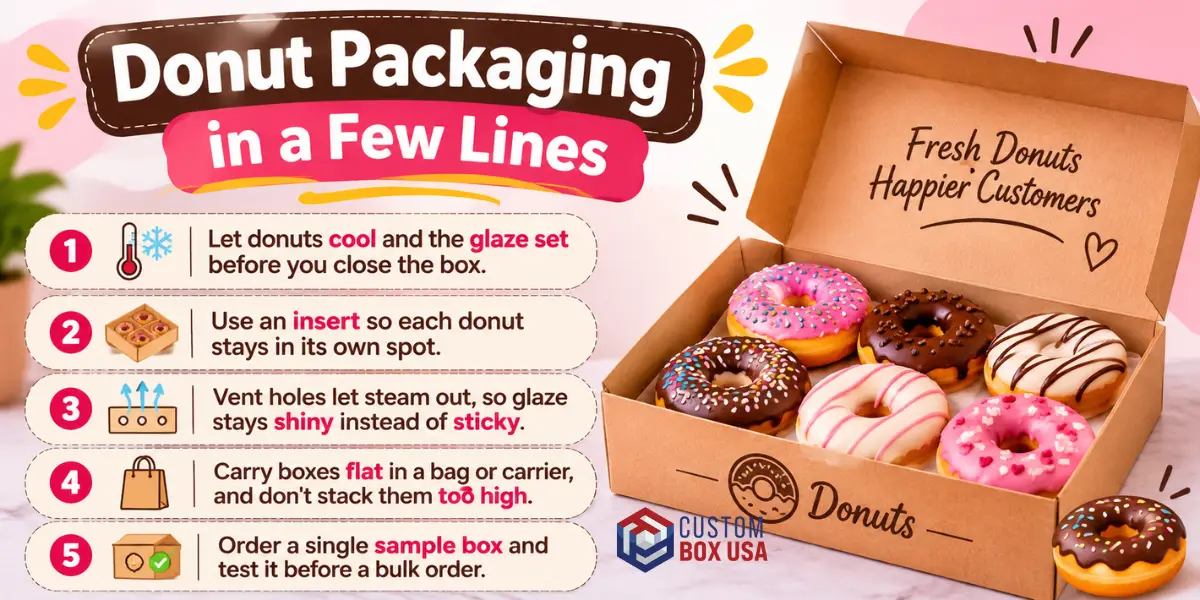
Donut Packaging in a Few Lines
What to look for in a donut box
A good donut box does five jobs: it fits, it holds, it breathes, it resists grease and it carries well. Check each one before you buy.
Size and lid clearance
Lid clearance is the space between the top of the donut and the lid. Measure your tallest donut with its toppings, not just the plain dough, because sprinkles, crumble and piped cream all add height. A box that's too tall lets donuts tip over, and one that's too short squashes the frosting.
An insert that holds each donut
An insert is a cardboard tray or divider with cut-outs that grip each donut. It works like an egg carton: every piece gets its own seat, so nothing bumps its neighbor. Without one, donuts slide every time the car brakes.
Vent holes
Die-cut vent holes are small holes cut into the box when it's made. They let steam out so the glaze stays shiny. A few small holes on the sides or lid are usually enough, because you want air to move gently, not a cold draft rushing in.
Grease resistance
Fried dough leaves oil behind, and plain paperboard soaks it up like a paper towel. A grease-resistant coating or liner is a layer that stops oil from seeping through and staining the box. Some older grease-proof paper used PFAS, man-made chemicals that repel grease. The FDA says PFAS grease-proofing agents are no longer sold for paper and paperboard food packaging in the US, as of February 2024 (FDA: Authorized Uses of PFAS in Food Contact Applications). Even so, ask your supplier which coating or liner they use, and get the answer in writing.
Window or solid lid
A window box has a clear panel so people can see the donuts. It sells well on a counter and makes a mixed dozen look like a treat. A solid lid gives you more room to print your brand. For delivery, either one works as long as the box has an insert.
Board type: kraft, white or corrugated
Kraft is strong brown paperboard with a natural look, and it's often recyclable. White board makes bright colors and photos stand out. Corrugated board has a wavy paper layer inside, like a tiny row of arches, which makes it stiff and good for stacking. Light board is plenty for a single donut, but corrugated is the safer pick for catering stacks or mail.
Handles and carry style
A gable box has a roof-shaped top with a built-in handle. It suits half-dozens and kids' party orders because people can carry it with one hand. A clamshell box has a hinged lid that snaps shut, like a clam. A sleeve is a paper wrap that slides over a tray to hold it closed and show off your brand.
Which box fits which donut?
Match the box to the donut's weak spot. A powdered donut and a cream-filled donut fail in very different ways.
| Donut type | Main problem | Best box style | Insert and venting | Delivery add-on |
|---|---|---|---|---|
| Glazed | Glaze sticks to lid or neighbors | Window or solid box with good height | Insert with gaps between donuts; side vents | Carry flat in a box bag |
| Sprinkled or topped | Toppings crushed or scattered | Taller box with extra lid clearance | Snug insert; light venting | Sticker seal so the lid stays put |
| Cream or custard filled | Leaks and food-safety time limits | Box with insert and liner | Insert that holds donuts upright; liner under each | Cooler bag for longer trips |
| Powdered sugar | Sugar dusts every other donut | Separate box or divided section | Full dividers, not just cut-outs | Keep it level so sugar stays put |
| Mini donuts | Tiny pieces roll around | Custom small box, cone or tray with sleeve | Small-cell insert; lined board | Seal well for bags with other items |
| Jumbo or specialty | Won't fit standard boxes | Custom size box | Single-cavity insert | Handle or carrier for weight |
| Mixed dozen | Different heights and toppings | Dozen box sized for the tallest donut | Insert with full dividers | Outer bag and seal |
Mini and jumbo donuts need custom sizes
Standard boxes are made for standard donuts. Minis rattle around inside them, and jumbos get squeezed. A custom size with an insert built around your real donut fixes both problems. It also looks more polished, because the box clearly was made for what's inside.
Donut box options by budget and use
Simpler boxes cost less per unit, while windows, inserts and handles add cost. Pay for the extras that solve a real problem in your orders.
| Option | Best for | Why it works | Budget level |
|---|---|---|---|
| Single-donut sleeve or small box | Grab-and-go, cafes | Fast to pack, little waste | Lower |
| Kraft or white box, no insert | Short takeout trips | Simple, easy to print your logo | Lower |
| Window box with insert | Counter sales, mixed dozens | Shows the donuts and stops sliding | Mid |
| Gable box with handle | Half-dozens, parties, walk-out orders | Easy one-hand carry | Mid |
| Sleeve and tray | Gift sets, premium boxes | Strong brand look, easy to open | Mid to higher |
| Corrugated box with insert | Catering stacks, mail orders | Stiff, stacks without crushing | Higher |
One money tip: keep your box sizes few. For example, a single dozen box with an insert that takes swappable dividers can cover glazed, filled and mixed orders. Fewer sizes means simpler reorders and tidier shelves.
How do you transport donuts without ruining them?
Keep the box sealed, flat and supported from below. Most trip damage comes from tilting and stacking, not from the box itself.
Seal the box
A sticker seal, a strip of tape or a sleeve keeps the lid from popping open. A tamper seal sticker also shows the customer that nobody opened the box on the way, and that small detail builds trust with delivery orders.
Outer bag, carrier and stacking
For delivery, put the box in a flat-bottom bag or carrier, since a thin retail box may need that extra layer to survive handling. Stack only as high as the bottom box can take without its lid bending. If a lid starts to buckle, the box under it isn't strong enough for that stack.
Keep it flat in the car
Car seats slope backward, so donuts slide to the back of the box. Set boxes on the floor or in the trunk on a flat surface. A "keep flat" note on the box or bag helps drivers who are in a hurry.
Hot and cold weather
Summer cars heat up fast, and heat softens glaze and icing, so keep boxes out of direct sun and use an insulated bag on longer trips. In winter, a box moving from a cold car into a warm room can collect extra condensation. On humid days, glaze stays tacky longer, so give donuts more time to set before you close the lid.
Filled and cream donuts: time and temperature
Cream and custard fillings are perishable, which means they can spoil and make people sick if they stay warm too long. They need more care than a plain glazed ring.
The USDA calls 40°F to 140°F the Danger Zone, because bacteria grow fastest in that range. Its general guidance says perishable food shouldn't stay out of the fridge more than 2 hours, or 1 hour if the air is above 90°F (USDA Food Safety and Inspection Service: How Temperatures Affect Food). That's food-safety guidance, not a promise about any box.
For long deliveries or hot days, put a cooler bag or ice pack outside the donut box. Keep ice from touching the box, because wet board goes soft. And tell customers to refrigerate cream-filled donuts if they won't eat them soon.
Can you ship donuts by mail?
Yes, but only with careful packing and fast shipping. Donuts are soft and go stale quickly, so mail is much harder than local delivery.
Airtight inner pack, snug outer box
Wrap or bag the donuts so air can't dry them out. Place that inner pack in a sturdy corrugated outer box, then fill the gaps so nothing rattles when you shake it. Filled donuts may also need ice packs and an insulated liner.
Can you reuse an old box, like a hot chocolate box?
A thin retail box, like a hot chocolate box, is built for a store shelf, not a delivery truck. It can work as an inner layer inside a shipping box. On its own, it may crush or pop open on the way.
Perishable label and PO boxes
Mark the outside "perishable" and choose the fastest service you can. Some customers ask about sending donuts to a PO box. Rules depend on the carrier, so check with yours first. Even when it's allowed, the package may sit at the post office until someone picks it up, so a street address is the safer choice for food.
Red flags: 7 common donut packaging mistakes
Most donut packaging problems come from a handful of habits, and each one has a simple fix.
- Boxing warm donuts. Steam turns to water. Fix: let the glaze set first.
- Sealing tight with no vents. Tops go sticky. Fix: choose a box with vent holes.
- Using a box that's too big. Donuts slide and crash. Fix: size to your count and add an insert.
- No lid clearance. Frosting ends up on the lid. Fix: measure with toppings on.
- Mixing powdered with glazed. Sugar sticks to the glaze. Fix: use full dividers or a separate box.
- Stacking heavy boxes too high. Lids buckle. Fix: use stiffer board or shorter stacks.
- Loose boxes in a delivery bag. They tilt and slide. Fix: use a flat-bottom bag or carrier.
Donut box ideas that also sell your brand
Your box travels to offices, homes and parties, so it works as a silent salesman. A little design thought helps you turn every delivery into a branded moment.
Logo, color and window ideas
Print your logo on the lid and your social handle on the side. A QR code that links to your menu or ordering page makes reorders easy. A window shaped like a donut is a fun touch, and bright inside printing gives people a small surprise when they open the lid. A thank-you card tucked under the seal costs little and feels personal.
Donut PR packages for local creators
A box PR package is a gift box you send to influencers or local media to show off a new flavor. For donuts, keep it simple: a branded box, a short note about the flavor and a sticker seal. Deliver it fresh and local, because donuts don't wait well.
Seasonal, holiday and corporate orders
Seasonal sleeves and stickers refresh plain boxes without a full redesign. For bigger runs, our holiday gift boxes work well for donut gift sets. Office orders often come in big batches, so a handle box or sturdy dozen box with your client's logo makes a strong impression. With December close, now is a good time to plan your holiday boxes.
Questions to ask your box supplier
A few direct questions can save you from a bad bulk order. Ask these before you pay.
- Which coating or liner do you use for grease resistance?
- Which materials do you suggest for direct contact with donuts?
- Can you add vent holes and a custom insert?
- Can I order one sample box before a full run?
- Will I see a digital proof before printing?
- What is the turnaround, and is there a rush option?
- Do you offer kraft or recyclable board?
The FDA regulates the substances used in food packaging, which it calls food contact substances (FDA: Regulatory Status of Food Contact Material Components). A good supplier should answer your material questions plainly.
Test before you order: a simple checklist
Pack one real box with real donuts and treat it a bit roughly. If it survives your test, it will usually survive your customers.
- Measure your tallest donut with toppings.
- Pack a sample box with a full, mixed order.
- Close and seal it, then give it a gentle shake.
- Tilt it slightly, like someone carrying it under one arm.
- Take it on a short drive with a few turns and stops.
- Open it and check the lid, glaze, toppings and any grease spots.
If something fails, change one thing at a time, the way you'd adjust one ingredient in a recipe. Try more lid clearance, a firmer insert or extra vents, then test again.
Our recommendation by situation
Pick the simplest box that solves your real problem. Here's where we'd start.
- Small cafe, mostly singles: a single-donut sleeve or small kraft box.
- Bakery counter with mixed dozens: a window box with a divided insert.
- Delivery apps: a dozen box with an insert, a sticker seal and a flat-bottom bag.
- Office and catering: corrugated boxes or handle boxes that stack well.
- Filled donut specialists: an upright insert, liners and a cooler bag for long trips.
- Eco-minded brands: kraft boxes made from recyclable stock.
Custom donut boxes from Custom Box USA
Custom Box USA makes custom donut boxes in the size, style, material and finish you choose. That means you shape the box around your donuts, instead of squeezing donuts into a stock box.
- Your size and style: window, solid, gable, sleeve, tuck-end and more, with cardboard or die-cut inserts.
- Your materials: corrugated, paperboard, kraft and recyclable stock.
- Your print and finish: CMYK (standard four-ink, full-color printing) or PMS (Pantone colors mixed to an exact shade), printed inside, outside or both, with a gloss or matte finish.
- Free design support: upload artwork or just share your logo, and our team helps with the rest.
- No die and plate charges: a die is the cutting tool shaped like your box, and a plate carries your design to the press. You don't pay extra for either.
- Free shipping across the USA.
- Low minimum: orders start at 1 unit, so you can test a sample before a bulk run.
- Timing: standard turnaround is 8 to 10 business days, and rush orders take 4 to 6 days. Timing can vary with order size and location.
Ordering is simple. You configure your box and get a quote, work on the design, pay after you approve the digital file, and then we handle production and delivery. New customers get 20% off their first purchase. For other treats, our bakery boxes follow the same steps.
Frequently Asked Questions
How do you box donuts?
Let them cool, place each donut in its own spot in an insert, then close and seal the lid. Choose a box sized for your count, with room above the toppings and a few vent holes.
How do you transport donuts?
Carry the box flat and sealed, in a flat-bottom bag or carrier. Keep it off sloped car seats and out of direct sun, and don't stack boxes so high that the lids bend.
Do donut boxes need vent holes?
Yes, a few small vents help a lot. They let steam escape, so glaze stays shiny instead of turning sticky.
What is the best box for a dozen donuts?
A dozen box with a divided insert and enough lid clearance for your tallest donut works best. For catering or stacking, choose corrugated board.
Can I send a package to a PO box?
It depends on the carrier, so check with yours first. For donuts, a street address is better, because a package at the post office can wait until someone picks it up.
Can I use a hot chocolate box to ship a package?
Only as an inner box. Thin retail boxes aren't built for shipping, so put it inside a sturdy corrugated box and fill the gaps.
Are your donut boxes recyclable?
We offer kraft and recyclable stock options. Ask our team which material suits your donuts and your recycling goals.
Next step: get your donut boxes quoted
Your donuts should reach the table looking the way they left your counter. Tell us your donut sizes, your counts and how you deliver, and our team will suggest a box, insert and finish that fit. Design help and USA shipping are free, and you can start with a single sample box.
Get a Free Quote for your custom donut boxes today.