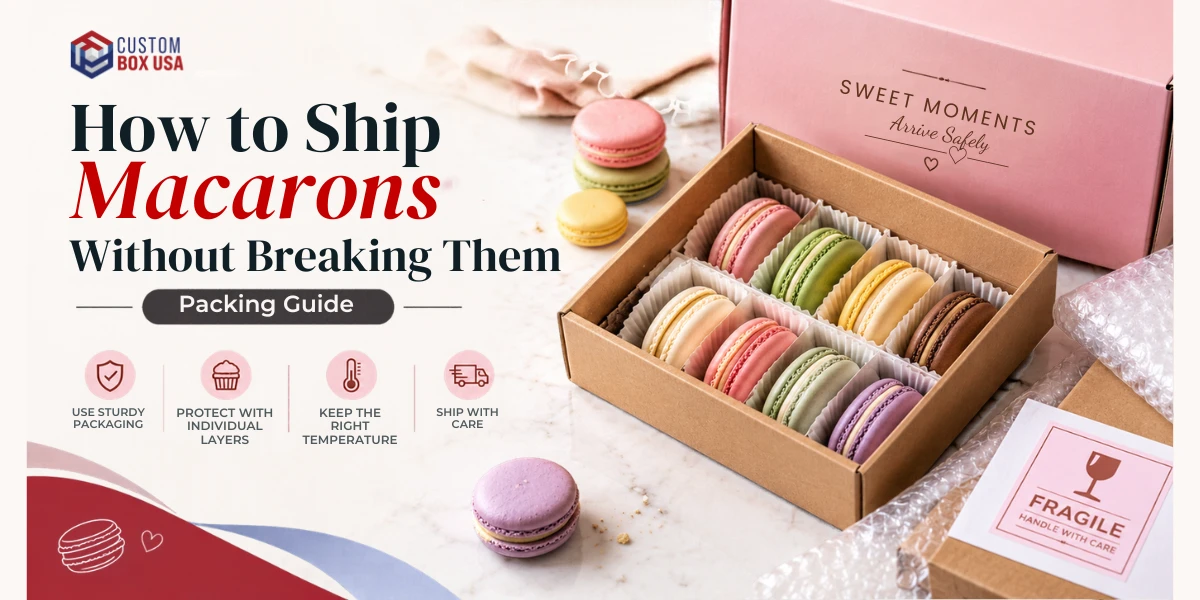
How do you ship macarons without breaking them? Hold each cookie still in an insert, put that box inside a bigger padded shipping carton, add a cold pack when the filling needs it, and pick a fast service early in the week. That's how to ship macarons so they arrive whole.
Macarons don't forgive much. A few bumps, a warm truck or one empty corner can turn a pretty box into crumbs. The reassuring part is that most damage comes from a short list of packing mistakes, and you can fix each one before the box leaves your kitchen.
Quick answer: how to ship macarons safely
Safe macaron shipping uses five parts that work as a team. If you skip one, the other four have to work much harder.
The 5-part setup
- Insert: a tray with small cups that holds each macaron in its own spot.
- Inner box: a macaron box that fits the insert closely, with no room to slide.
- Outer carton: a corrugated shipping box. Corrugated means strong cardboard with a wavy layer inside that soaks up bumps.
- Cold pack: a sealed gel pack that keeps soft fillings cool, used when the filling or the weather calls for it.
- Fast shipping: an overnight or 2-day service, sent early in the week.
Why macarons break so easily
A macaron shell is thin and dry on top, with a soft, airy inside. That makes it light, but a small knock can crack the top or crush the shell. The filling is a second weak point. Ganache (chocolate mixed with cream) and buttercream both soften in heat, so a warm box can push filling out the sides.
Humidity softens shells too, but movement does the most harm. When cookies slide, they hit each other, the walls and the lid. The result is usually cracked tops, crushed shells or smeared filling.
What should you look for in a macaron shipping box?
The best box for macarons holds each cookie still, fits your count exactly and stays shut on its own. It also needs to sit inside a sturdy outer carton with room for padding and a cold pack.
A macaron box with insert cups
This is the choice that matters most. Loose macarons in a plain box will touch and rub, even when packed tightly. An insert gives every cookie its own seat. It also keeps flavors apart, so a strong flavor like lemon or coffee doesn't rub onto a delicate one.
The right size for your count
Your insert cups should match the number of cookies you sell per box and the width of your cookies. A cup that's too wide lets the macaron rock, and a cup that's too tight squeezes the filling. Measure a few finished cookies from your own recipe, because sizes vary from baker to baker. If standard sizes don't fit, custom macaron boxes can be made to your exact cookie size and count.
A closure that stays shut
Many macaron boxes use a slider lid, also called a sleeve box. The cover slides on and off like a matchbox. It looks lovely, but it can slide open in transit. A small strip of tape or a sticker seal on each end solves that.
Strong outer board
Your printed macaron box isn't a shipping box on its own. It goes inside a corrugated carton. A common style is the RSC (regular slotted container), a standard shipping box with flaps that meet in the middle. Pick one big enough for padding on every side, but not so big that you need a mountain of fill.
Food contact and sealing
Macarons dry out and pick up smells in open air. Many bakers put the insert inside an airtight bag or container before it goes into the box. If you're unsure which board and inks suit food contact, ask our team which materials work for your product.
Supplies checklist
| Item | What it does | Needed? |
|---|---|---|
| Macaron insert (cup tray or clamshell) | Keeps each cookie in its own spot | Yes |
| Inner macaron box | Holds the insert and shows your brand | Yes |
| Airtight bag or container | Keeps out air and smells | Recommended |
| Corrugated outer carton | Takes the bumps of the trip | Yes |
| Loose fill, crinkle paper or air pillows | Fills empty space so nothing slides | Yes |
| Gel packs and insulated liner | Slows heat from getting in | For soft fillings or warm weather |
| Packing tape | Seals the lid and the carton seams | Yes |
| Fragile, This Side Up and Perishable labels | Tell handlers to be gentle and keep it upright | Yes |
| Care card for the buyer | Explains how to open and store the cookies | Recommended |
Which macaron insert should you use?
| Insert type | What it is | Best for | Cost level |
|---|---|---|---|
| Cup tray | A tray with a round cup for each cookie | Shipping and everyday retail | Low to medium |
| Clear clamshell | A plastic tray in two halves that closes over the cookies like a shell | Shipping, since the top half stops cookies from lifting | Medium |
| Divider grid | Cardboard walls that split the box into slots | Larger treats and local pickup | Low |
| Die-cut cardboard insert | A card piece cut to the exact shape of your cookies | Gift boxes and branded sets, often with a window | Medium, depends on design |
Our honest take: for mail orders, a cup tray or clamshell is the safe pick. Divider grids are fine at the counter, but cookies can still slide inside a slot on a bumpy truck.
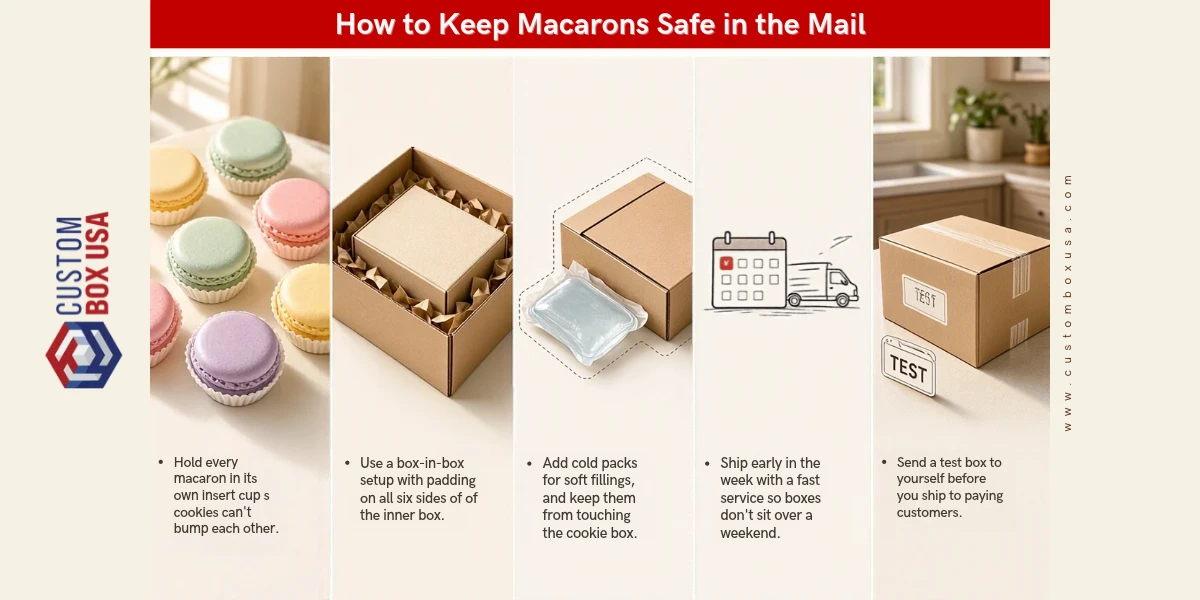
What keeps macarons safe in the mail
Step-by-step: how to package macarons for mailing
The order matters here. Each step protects the one before it.
Step 1: Let shells and filling settle and chill
Freshly filled macarons are at their softest. Let them set and chill in the fridge before you pack, because firm filling holds its shape much better on the road. Follow your own recipe's timing.
Step 2: Seat each macaron in the insert
Place each cookie upright in its cup and press gently so it sits flat, without forcing it. Group the same flavors together, or give very strong flavors their own insert.
Step 3: Close, tape and use a snug inner box
Put the insert in its airtight bag or container, then into the macaron box. Close the lid, and if it's a slider lid, tape both ends. Now do the shake test: hold the box and shake it gently. If you hear or feel movement, add a thin layer of tissue on top of the insert until it stops.
Step 4: Box-in-box with padding on all sides
Box-in-box, also called double boxing, means a small box inside a bigger one with padding between them. Here's how:
- Lay loose fill or air pillows on the bottom of the outer carton.
- Set the macaron box in the center, right side up.
- Fill the four sides until the inner box can't move.
- Add a top layer of fill so all six sides are padded.
- Close the carton and tape every seam, not just the middle.
Then shake it again. If it rattles, it needs more fill.
Step 5: Add a cold pack if your filling needs it
For soft fillings or warm routes, line the outer carton with an insulated liner (a layer that slows heat from getting in) or use a foam cooler. Place gel packs along the sides of the inner box, each sealed in its own plastic bag. Packs sweat as they warm up, and that moisture can make a paper box soggy. Keep a layer of liner or bubble wrap between the packs and the macaron box.
Step 6: Label the package
Mark the outside with Fragile, This Side Up and Perishable labels, plus your return address. For gifts, keep order details and the gift message inside, not on the outer label. Tuck a small care card on top of the inner box. For example: "Open on arrival, refrigerate, and serve at room temperature." Add storage times based on your own recipe.
Do macarons need to stay cold in transit?
Macarons with dairy-based fillings should stay cold, because food safety agencies warn against leaving perishable food warm for long. Jam or sugar-based fillings handle short trips better, though heat still softens the shells.
What the USDA says about the Danger Zone
The USDA calls 40 °F to 140 °F the "Danger Zone," the range where bacteria grow fastest in perishable food. It advises not leaving such food out of the fridge for more than 2 hours, or 1 hour when it's above 90 °F. You can read the full USDA Danger Zone guidance. The FDA gives the same 2-hour rule and says cold perishable food should stay at 40 °F or below, as its FDA safe food handling tips explain. A delivery truck isn't a fridge, so cold packs, insulation and speed all matter for cream fillings.
Chilled, frozen or room temperature?
| Filling type | Short trip, cool season | Long trip or hot season |
|---|---|---|
| Buttercream, ganache, cream cheese | Chilled, with gel packs and a liner | Frozen or well chilled, foam cooler, gel packs, overnight service |
| Jam, caramel, sugar-based | Room temperature may be fine; chilled is safer | Chilled, with gel packs and a liner |
| Fresh fruit or whipped fillings | Not a good fit for mail | Not a good fit for mail |
Sources don't agree on how long macarons last chilled or frozen, and there's no official number to point to. Set your own shelf-life rules based on your recipe, your own trials and your local food rules.
Hot-weather and humid-climate tips
A box going from California to New York spends far longer on the road than one going across town. Long routes need more cooling and the fastest service. Summer orders to hot states like Texas or Arizona need the most care, and pausing shipments during a heat wave is a sensible call. Midwest winters are easier on fillings, but a box can sit on a cold porch, so ask buyers to bring it in quickly. In humid places, airtight sealing helps keep shells crisp.
Which carrier and shipping day work best for macarons?
The best way to ship macarons is the fastest service you can afford, sent on a Monday or Tuesday. Less time on the road means fewer bumps and less heat.
Fast services to consider
USPS, UPS and FedEx all offer overnight and 2-day services worth comparing. Prices, service names and cutoff times change, so check each carrier's site before you set your shipping rates.
Ship Monday or Tuesday
A box sent on Thursday or Friday can get stuck in a warehouse over the weekend. That's a long wait for buttercream. Many macaron sellers ship only early in the week for this reason. Watch for holidays too, when carriers may not deliver.
What USPS says about perishable mail
USPS says perishable items are mailed at the sender's own risk, so if a box spoils or arrives late, the loss is usually yours. Items must be packed as required and reach the buyer before they go bad, as USPS Publication 52 on perishable matter explains. Food that can't reach its destination without spoiling can't be mailed at all, according to the USPS rules for fresh foods and perishables. That's one more reason to skip slow services for cream-filled cookies.
Can you ship packages to a PO box?
Yes, USPS delivers to PO boxes, but other carriers may not, so check before you pick a service. For macarons, a PO box adds another risk: the package waits until the buyer comes to collect it. Ask for a street address when you can. Our post on sending packages to a PO box covers the details.
Red flags: common mistakes that crack macarons
Most broken macarons come from a few avoidable mistakes, and extra space in the box tops the list. Check your setup against these before you ship.
- Oversized box: empty space lets the inner box slide and hit the walls.
- No insert: cookies rub and crack even when packed tight.
- Flavors touching: strong flavors and soft fillings mix.
- Thursday or Friday shipping: boxes sit over the weekend.
- Ice pack touching the box: moisture softens the paperboard.
- No "This Side Up" mark: the box gets flipped and cookies fall out of their cups.
- Untaped slider lid: the lid slides open inside the carton.
- No note to the buyer: the box sits unopened in a warm room.
- No test shipment: you find the weak spot on a paying order.
Before you launch, ship a test box to yourself or a friend in a faraway state. Open it and look for cracks, smears and soft spots. It's the cheapest way to learn what your setup needs. No packaging can stop every break under very rough handling, but a good insert and a padded carton make breaks far less likely.
Think of the cost this way. A proper box and insert cost something up front. One ruined order costs the cookies, the shipping, a refund or remake, and maybe a customer.
Questions to ask your packaging supplier
A good supplier should answer these clearly before you pay. If the answers are vague, keep looking.
- Can you make the insert cups fit my exact cookie size and count?
- Can I order one sample box before a bulk order?
- Which materials suit food like mine?
- Will I see a digital proof before printing?
- Do you offer kraft or recyclable board?
- Are there die or plate charges?
- How long do production and delivery take, and is there a rush option?
Our recommendation by situation
Match your setup to how far the box travels and how it needs to look.
| Your situation | Recommended setup |
|---|---|
| Local pickup or same-day delivery | Printed macaron box with a cup tray or divider, no outer carton |
| Same-state shipping, cool weather | Insert, sealed inner box, corrugated carton with fill, 2-day service |
| Cross-country or summer shipping | Clamshell insert, airtight bag, insulated liner or foam cooler, gel packs, overnight service |
| Holiday or corporate gifts | Custom printed box with a window and die-cut insert, double boxed for shipping |
Make the box part of your brand
Your macaron box is the first thing a customer sees. It should keep the cookies safe and look like you. Turn every delivery into a branded moment.
Custom macaron boxes with logo, window and finish
You choose the size, style, insert, colors and finish. You can print outside, inside or both, add a clear window so buyers see the cookies, and pick gloss or matte coating, spot UV (a shiny coat on just one part, like your logo) or foil. Our box print and ship process is simple. You share your logo or artwork, our team helps with the design for free, and the finished boxes ship free across the USA.
Kraft and recyclable board options
Brown kraft boxes give a natural, earthy look. Recyclable paperboard and boxes made from recycled materials are also available for brands that want to cut waste.
Gift and holiday macaron boxes
Valentine's Day, Easter, Mother's Day and Christmas are popular times for macaron gifts. Design and proof approval come before production, and standard turnaround is 8 to 10 business days, so give yourself room. If you're reading this at the end of October, now is the time to order Christmas boxes and start planning for Valentine's Day. Browse holiday gift boxes for seasonal ideas.
Frequently Asked Questions
How do you ship macarons safely?
Ship them chilled in an insert, inside a padded corrugated carton, using a fast service sent early in the week. Add gel packs and insulation for soft fillings or warm routes.
How do you package macarons?
Seat each cookie in its own insert cup, then seal the insert in an airtight bag or container inside a snug box. Tape the lid so it can't slide open.
How do you mail macarons through USPS?
Pick the fastest USPS service that fits your route, and pack the box so it arrives before anything spoils. USPS says perishables are mailed at the sender's own risk, so packing and speed are on you.
Do macarons need ice packs when shipped?
Macarons with dairy fillings like buttercream or ganache usually do. Seal each pack in a bag and keep it from touching the paper box.
Should I freeze macarons before shipping?
Freezing can help on long or hot routes because it firms the filling. Tell buyers to thaw them in the fridge in the closed box, and follow your own shelf-life guidance.
What is the best box for shipping macarons?
The best box for macarons is a snug box with a cup tray or clamshell insert, placed inside a corrugated outer carton. The insert keeps cookies apart, and the carton takes the bumps.
Can you ship cupcakes?
Yes. The same ideas apply: an insert that holds each cupcake, a snug box and fast delivery. See our guide on packaging cupcakes for delivery.
Get custom macaron boxes with inserts
A well-fitted box and insert is the simplest way to stop broken macarons before they happen. Custom Box USA makes macaron boxes with inserts in the size, material, finish and print you choose.
- Free design support. Upload artwork or just send your logo.
- Free shipping across the USA.
- Minimum order as low as 1 unit, so you can test one sample box first.
- No die and plate charges.
- Standard turnaround of 8 to 10 business days, or rush in 4 to 6 days. Timing may vary with order size and location.
- 20% off your first order.
Tell us your cookie size, count and style, and we'll reply within 2 hours. Get a free quote and give your macarons a box that keeps them whole all the way to your customer's door.