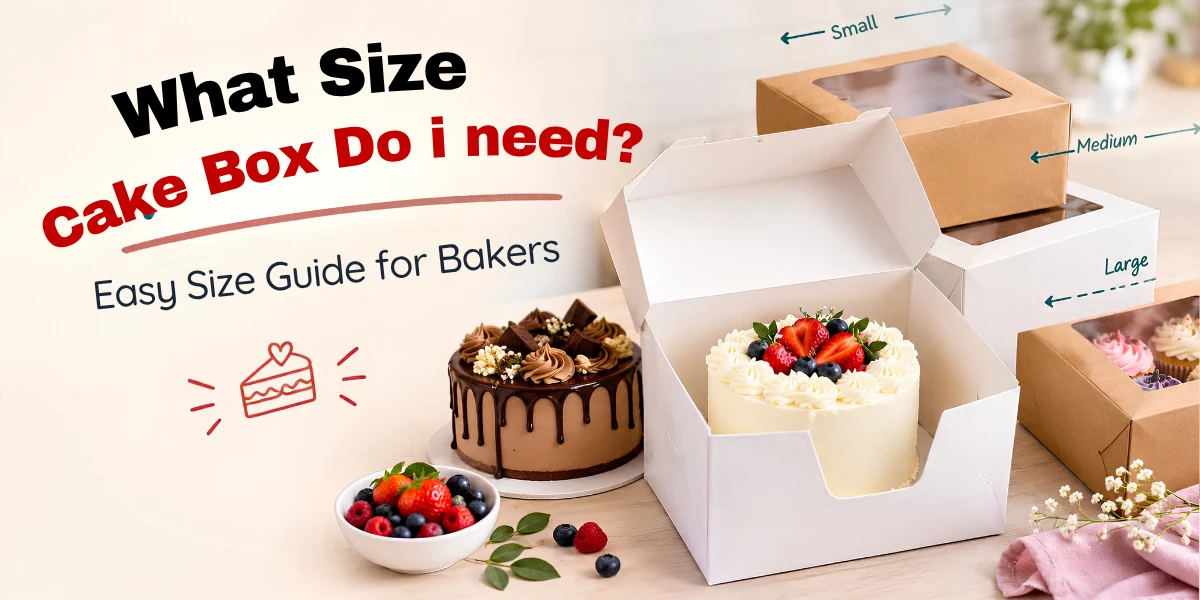
Most people pick a cake box by the pan size. You baked in an 8-inch pan, so you buy an 8-inch box, right? Not quite. To answer "what size cake box do I need," match the box to your cake board, not your cake. The board should be about 1 to 2 inches wider than the frosted cake. The box height should clear the tallest decoration with room to spare.
For example, an 8-inch cake usually sits on a 10-inch board and goes in a 10x10 box. The height depends on your layers and topper. This one rule prevents most crushed rosettes and cakes that slide into the box wall. Below you'll find a size chart, a simple way to measure, and help for tall and tiered cakes.
What size cake box do I need? The quick answers
The box footprint should equal your board size. The box height should be the full cake height plus clearance, which is the empty space between the cake and the lid or walls. The table sums up the most common answers.
| Question | Short answer |
|---|---|
| How wide should the box be? | The same as your cake board. |
| How wide should the board be? | About 1 to 2 inches wider than the frosted cake. |
| How tall should the box be? | Board bottom to tallest decoration, plus about 1.5 to 2 inches for tall cakes. |
| 8-inch cake? | 10-inch board in a 10x10 box, 4 to 5 inches tall, more with a topper. |
| Quarter sheet (9x13) cake? | About a 10x14 box. |
| Not sure between two sizes? | Go taller, not wider. |
| Before a big order? | Test-fit one box with your real board. |
How much bigger should a cake box be than the cake?
About 1 to 2 inches wider than the cake, because that's the extra width of the board. The box then holds the board snugly. Sources don't agree on the exact gap, and the margins they suggest range from 1/4 inch to 2 inches. Our view: a snug board fit matters more than any single number. A board that can't move keeps the frosting off the walls.
Should I measure the cake or the cake board?
Measure both, but buy the box to fit the board. A cake board is the flat, stiff card the cake sits on. When it's extra thick, people often call it a cake drum. You lift the board, not the cake, and it's the widest flat part, so it's what has to fit inside the box.
How do you measure a cake for a box?
Measure the frosted cake, then the board, then the full height to the tallest decoration. Then add clearance. All you need is a ruler or tape measure, and you should do it after the cake is fully decorated.
- Measure the frosted cake. Go across the widest point, including frosting and any piped border.
- Measure the board. Go edge to edge. This gives you the box width and length.
- Measure the height. Start at the bottom of the board and stop at the top of the tallest topper. A topper is a decoration on top, such as a figurine, a sign or fresh flowers.
- Add clearance and write it down. Note the size as L x W x H (length, width and height) in inches.
Why is the frosted cake wider than the pan?
Frosting adds width on every side. An 8-inch pan makes an 8-inch sponge, but once you add buttercream and a piped border, the cake is wider than 8 inches. That's why buying by pan size so often goes wrong.
Where do I measure the height from?
Start at the very bottom of the board, not the bottom of the cake. Boards have thickness, and a thick drum adds more height than you'd expect. Measure up to the highest point, whether that's a candle, a sugar flower or a topper sign.
Can you show a worked example?
Sure. Say you have an 8-inch cake that stands 5 inches tall with its topper:
- Cake: 8 inches wide once frosted
- Board: 10 inches, so the footprint is 10 x 10
- Height to top of topper: 5 inches
- Clearance: about 1.5 to 2 inches
- Box: 10 x 10 x about 7 inches
A shallow 10x10x4 box would press the lid right into that topper. For more help with box measurements in general, our guide on how to measure length, width and height walks through it step by step.
What if my sizes are in centimeters?
One inch equals 2.54 centimeters. Multiply inches by 2.54 to get centimeters, or divide centimeters by 2.54 to get inches. For example, a 10 x 10 in box is about 25 x 25 cm. US box sizes are usually listed in inches, so convert before you order.
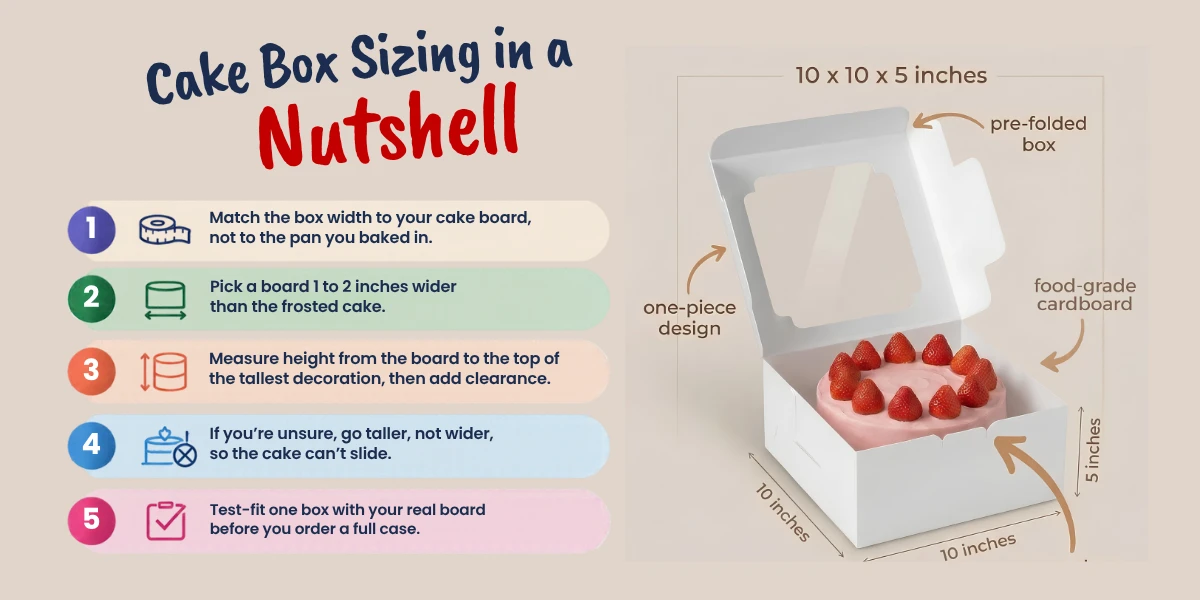
Cake Box Sizing in a Nutshell
Cake box size chart: which box fits which cake?
Most round and square cakes follow the same pattern. Add about 2 inches to the cake to get the board, then match the box to the board. The cake box dimensions below are common supplier guidance, not a fixed standard, so always check the inside measurements of any box you buy.
| Cake size | Board | Box footprint | Typical height | Good box style |
|---|---|---|---|---|
| 6-inch round or square | 8 inch | 8 x 8 | 4 to 5 in | Window or kraft box |
| 8-inch round or square | 10 inch | 10 x 10 | 4 to 5 in (taller with topper) | Window or front-loading box |
| 10-inch round or square | 12 inch | 12 x 12 | 4 to 6 in | Front-loading box |
| 12-inch round or square | 14 inch | 14 x 14 | 4 to 6 in | Corrugated box |
| 3 to 4 layer or flower-topped cake | Cake + 2 in | Match board | About 8 to 10 in | Tall front-loading box |
| Any cake with a topper | Cake + 2 in | Match board | Topper top + 1.5 to 2 in | Tall box |
The typical heights above suit single-layer cakes. Many celebration cakes are taller, so treat height as something you measure, never something you guess.
What box fits a sheet cake?
A quarter sheet cake fits a box of about 10x14 inches. A half sheet needs about 14x19, and a full sheet about 19x27 or 20x28. Sheet cakes are rectangle cakes named after their pan, and a quarter sheet is about 9x13 inches. Sheet box sizes vary from one supplier to the next, so test-fit one box before you order a case.
What about cupcakes, cookies and mini cakes?
These need shallow boxes with inserts, not standard cake boxes. An insert is a piece inside the box that holds each item still. A common size for four cupcakes is about 6 x 6 x 3 inches, and about 9 x 6 x 3 inches for six, each with a fitted insert. Cookies do better in even shallower boxes. Our post on packaging cupcakes for delivery covers inserts in more detail.
Is a 10x10 cake box the right size?
A 10x10 cake box is the right footprint for an 8-inch cake on a 10-inch board. Height is where people slip up. Some 10x10 boxes are only 4 inches tall, which is too short for many frosted layer cakes.
What does a 10x10 box fit?
It fits a 10-inch board, which usually holds an 8-inch cake. If you mostly sell 8-inch cakes, this footprint will probably be your main box.
When is a 10x10 box too short?
It's too short when your cake plus decoration comes close to the box height or goes past it. A two-layer cake with a piped top, candles or a topper can easily pass 4 inches. So when you order, ask for the height too, not just "10x10."
When should I move up to 12x12?
Move up when your board is wider than 10 inches, such as a 10-inch cake on a 12-inch board. A cake that looks tight under the lid is a height problem, not a width problem. In that case, choose a taller 10x10, because a bigger footprint gives the board room to slide.
One note on 10-inch boards: most sources say a 10-inch board fits a 10x10 box, but one says it needs a 12-inch box. Real boxes can differ by a fraction of an inch. The safe move is to test one box with your actual board before you buy many.
What cake box sizes work for tall cakes?
Tall cakes need tall boxes. Plan on about 8 to 10 inches for 3 to 4 layer or flower-topped cakes, and about 12 to 14 inches for larger tiered cakes. Always measure to the tallest point and add about 1.5 to 2 inches.
How tall should the box be for layered cakes or toppers?
Take the full height, from board bottom to tallest decoration, and add 1.5 to 2 inches. A single-layer cake usually fits a box 4 to 6 inches tall. A 3 or 4-layer cake, or one with flowers on top, often needs 8 to 10 inches. Measure after the final topper goes on.
What box do I need for a 2-tier or 3-tier cake?
A two-tier cake usually needs a box about 10 to 12 inches tall, and bigger tiered cakes often need 12 to 14 inches. A tiered cake is two or more cakes stacked, small on top of big. Dowels (support sticks) and thin boards between tiers carry the weight. The box footprint still matches the bottom board.
Which box styles work best for tall or heavy cakes?
Front-loading and corrugated boxes are the safest picks for tall or heavy cakes. Here's how the main styles compare:
- Front-loading box: The front wall folds down, so you slide the cake in instead of lowering it from above. This is much safer for tall cakes.
- Corrugated box: Corrugated cardboard has a wavy layer between two flat sheets, which makes it strong. It suits heavy cakes. See our custom corrugated boxes.
- Paperboard box: Thin, smooth and light. It works well for standard single cakes and slices.
- Window box: A clear cutout lets buyers see the cake. It looks great on display, but tall window boxes can have weaker sides.
- Gable or handle box: This box has a carry handle shaped like a small house roof. It's good for slices and small cakes, not big tiers.
Torn between a window and a solid lid? Our comparison of window vs solid bakery boxes can help you decide.
Which sizing mistakes cost bakers the most?
Four mistakes cause most of the damage: measuring too early, buying by pan size, choosing a box that's too wide, and using a weak box for a heavy cake. The good news is that each one is easy to avoid once you know it.
Why is measuring before the topper a problem?
The topper is often the tallest point, and a short lid will crush it. Measure the finished cake every time.
Why not just buy by pan size?
Frosting makes the cake wider than the pan, and the board is wider again. An 8-inch box for an 8-inch cake won't fit the board.
Is a bigger box safer?
No. Extra width lets the board slide, and the frosting ends up on the walls. Size up in height, never in width.
What happens with a weak box?
A thin box can bow or sag under a heavy cake, and tall window sides can bend into tall piping. For heavy or tall cakes, ask our team about corrugated board or a stronger paperboard.
How do I keep the cake safe on the way?
Use a board that fits snugly, put a non-slip mat under the box, and keep cream cakes cold. The right size does half the work, and careful handling on the trip does the rest.
How do I stop my cake sliding in the box?
Choose a board that fits the box with almost no gap. Then add a non-slip mat under the board and another under the box. These small steps help too:
- Chill the cake before boxing so the frosting is firm.
- Place the box on a flat, level surface in the car, like the floor or a flat trunk. Seats often slope.
- Don't stack cake boxes on top of each other.
- Store empty boxes flat and dry so they keep their shape.
How long can a cream cake stay out of the fridge?
Perishable food should not sit out for more than 2 hours, or 1 hour if it's above 90°F. Cold foods should stay at 40°F or below, according to USDA guidance on take-out and delivered food. The FDA tips for keeping cold food cold explain that bacteria grow fast between 40°F and 140°F, the "danger zone." This matters most for cakes with whipped cream, custard or cream cheese frosting, so use a cooler or a cold car for those deliveries.
Which materials can touch my cake?
Ask your box supplier which materials suit your cake, because materials that touch food are regulated in the US. The FDA food contact substances guidance explains how those materials are reviewed. When you order with us, our team can talk you through material choices for your cakes.
Should a bakery stock standard sizes or order custom cake boxes?
Most bakeries do well with a small set of core sizes, plus custom boxes for cakes that don't fit. Custom boxes also let you add your logo and turn every pickup into a branded moment.
How many sizes should I stock?
Keep it small and based on real sales. Look at last month's orders and stock boxes for the cake sizes you sell most, such as your 6, 8 and 10-inch cakes. Then add one tall box for layered and topper cakes.
When does a custom box make sense?
Go custom when your cakes are unusual or when you want your brand on the box. Tall cakes, heart shapes, mini cakes and odd board sizes often fit stock boxes poorly. A box made to your exact L x W x H holds the board snugly. Add your print, and the box becomes a silent salesman on every counter and car seat.
What can Custom Box USA make for you?
We make custom cake boxes in the size, style, material and finish you choose. Here's what you get:
- Any custom size, including tall, front-loading and window styles
- Corrugated, paperboard, kraft and recyclable materials (see our kraft boxes if you like a natural brown look)
- Free graphic design support: upload your artwork or just share your logo
- No die and plate charges (a die is the cutting tool that shapes a custom box)
- A low minimum order, so you can order a sample box and test-fit it first
- Free shipping across the USA
- 20% off your first purchase
Planning for Thanksgiving or Christmas cake orders? Start early so you have time to check a sample. Our team can share current production times when you ask for a quote.
Frequently Asked Questions
What size cake box do I need for a 6-inch cake?
Use an 8x8 box with an 8-inch board. A typical height is 4 to 5 inches, but a tall 6-inch cake with extra layers or a topper needs more. Measure to the tallest point and add clearance.
What size cake box do I need for an 8-inch cake?
Use a 10x10 box with a 10-inch board. Check the height, because some 10x10 boxes are only 4 inches tall. Frosted layer cakes often need more, and cakes with toppers need more again.
What size cake box do I need for a 9-inch cake?
Use a box that matches your board. Following the board rule, a 9-inch cake usually sits on a 10 or 11-inch board. If stock sizes don't line up, a custom box can match your board exactly.
What size cake box do I need for a 9x13 cake?
A 9x13 quarter sheet cake usually fits a box of about 10x14 inches. Sheet box sizes vary between suppliers, so test one box with your board first.
What size cake box do I need for a bundt cake?
Measure the bundt at its widest point and put it on a board about 1 to 2 inches wider. Then match a square box to that board. Bundt cakes are often tall, so measure the height and add clearance before you choose.
What size cake box do I need for a pound cake?
Use a long rectangle box sized to the loaf. Measure the length, width and height of the baked loaf, then add a small margin on each side. A snug fit stops the loaf from sliding end to end.
What size cake box do I need for 24 cupcakes?
It depends on your cupcake size, so measure one cupcake and choose a box with a fitted insert for 24. You might also split a big order into two smaller boxes, which are easier to carry. Share your cupcake size with our team, and we can suggest a fit.
Get your cake box size right: next step
Measure the finished cake, match the box to the board, and go taller, not wider. That simple habit protects your cakes and your reputation. If your cakes don't fit stock sizes, or you want your logo on every box, we can make boxes to your exact measurements with free design support and free USA shipping.
Get a free quote and tell us your cake, board and height. Prefer to talk? Call +1 (424) 447-6206 or email sales@customboxusa.com.