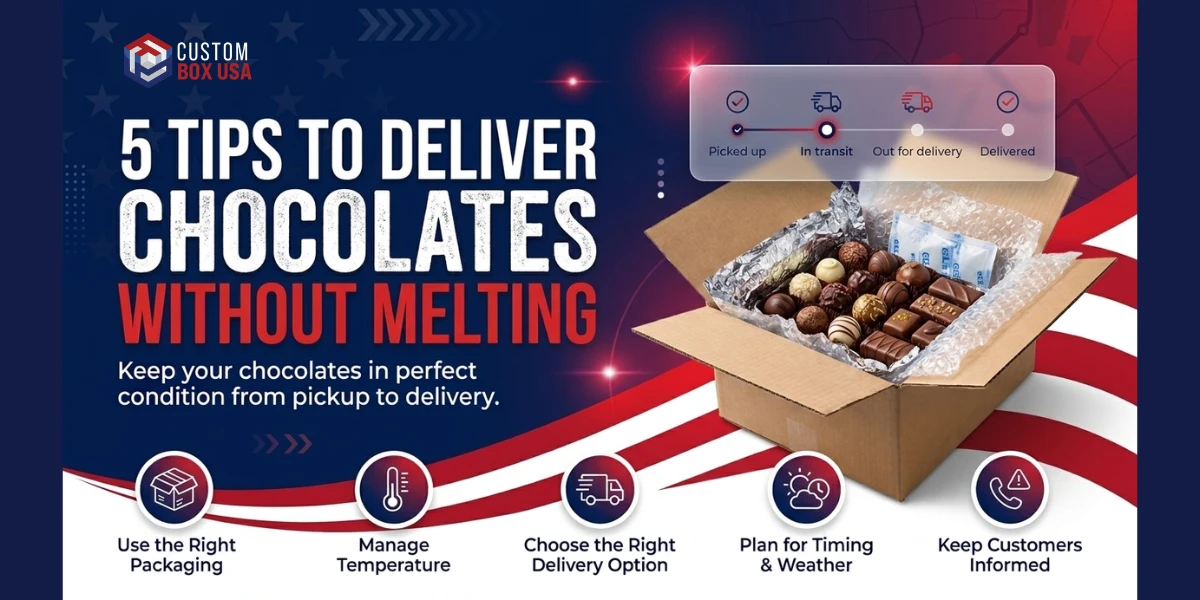
To ship chocolate without melting, cool it first and pack it snug in an insulated box with wrapped gel packs. Then send it by a fast service early in the week. Miss one step and your customer may open soft, streaky chocolate instead of a gift.
Use this checklist for a single gift, a holiday rush or weekly online orders. It's grouped by stage, so you can print it and work through it at the packing table.
Quick answer: how to ship chocolate without melting
Keep heat out and keep transit short. Five things decide whether your chocolate arrives firm.
The 5-part formula
- Cool chocolate: pack it at a cool, steady room temperature, never warm.
- Insulation: a liner inside a strong outer box slows heat from outside.
- Coolant: wrapped gel packs in warm weather, and often none in cold weather.
- Speed: fewer days in a hot truck means less risk.
- Timing: ship early in the week and check the weather where the box is going.
No single part works alone. A great liner won't save chocolate that sits in a warehouse over a hot weekend.
Why does chocolate melt in the mail?
Chocolate's main fat, cocoa butter, melts at about 93-100°F (34-38°C). That's close to body temperature. A parked delivery truck or a sunny porch can get hotter than that on a summer day.
Cocoa butter and the low melting point
Cocoa butter's low melting point (the temperature where a solid turns liquid) is why chocolate melts so nicely in your mouth. It's also why it goes soft in a hot van.
Good chocolate is also tempered. Tempering is a careful heating and cooling step that gives chocolate its shine and clean snap. If chocolate melts and sets again on its own, it loses that temper. It turns dull and can feel soft or crumbly.
Melting vs bloom: two kinds of white marks
Chocolate doesn't have to turn liquid to be ruined. Watch for bloom:
- Fat bloom: white or gray streaks. Heat pushes cocoa butter to the surface, where it sets in a cloudy layer.
- Sugar bloom: tiny white, dusty spots. Moisture dissolves sugar on the surface, then dries and leaves the sugar behind.
Fat bloom points to heat. Sugar bloom points to water, often from condensation. Condensation is the water drops that form when something cold meets warm, damp air.
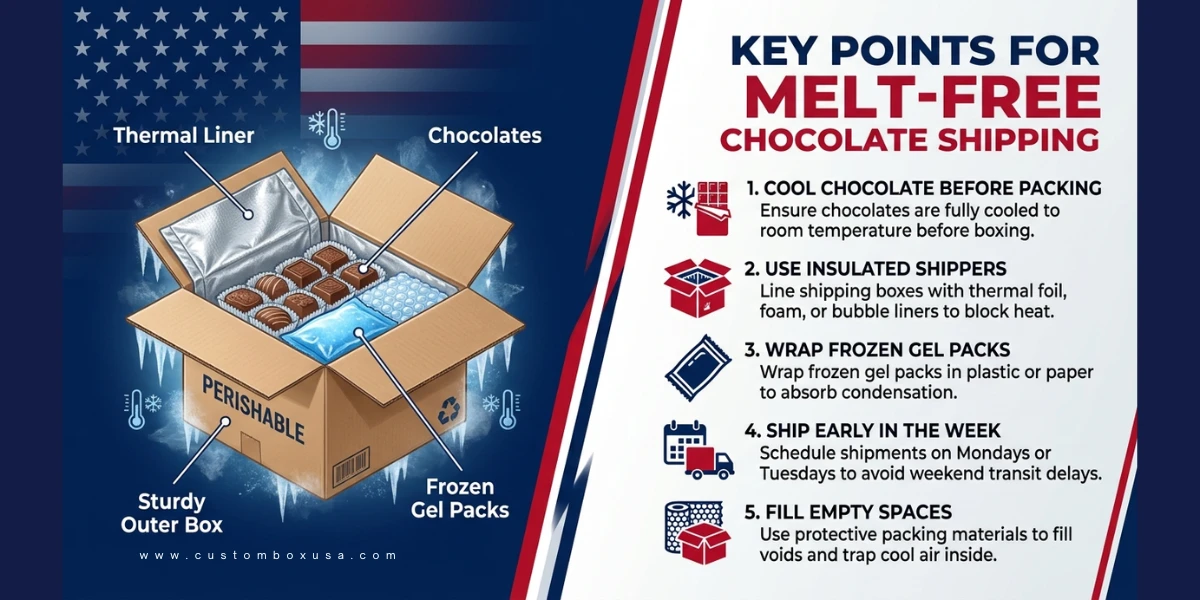
Key Points for Melt-Free Chocolate Shipping
Before you pack: the planning checklist
Most melted shipments go wrong before the tape comes out. Run these checks first.
Check the weather and the route
- Check the forecast where the box is going, not just where you are. A box from Oregon to Florida faces far more heat than one going to Maine.
- Think about the whole route. A package can pass through warm hubs even when both ends are cool.
- Hold the shipment if a heat wave is coming. A short wait beats a melted gift.
Pick the speed and the day
- Choose the shortest transit time you can. Transit time is the number of days the box spends traveling. Ground costs less but takes longer, while 2-day or overnight means less time in the heat.
- Ship Monday to Wednesday. Packaging supplier PAC suggests shipping before Thursday so boxes don't sit in a warehouse over the weekend. PAC also says chocolate usually doesn't hold up beyond 3 days in transit, and that overnight is best for destinations above 70°F.
- Tell the recipient which day to expect it.
Gather your supplies
- A snug inner chocolate box, with dividers or individually wrapped pieces
- An outer shipping box made of corrugated cardboard (strong board with a wavy layer in the middle)
- An insulated liner or foam cooler that fits inside the outer box
- Frozen gel packs, plus plastic bags to wrap them
- Paper or other void fill (padding that fills empty space)
- Packing tape and "Perishable" or "Keep cool" labels
How do you package chocolate for shipping?
Work from the inside out: cool chocolate, inner box, liner, wrapped cold packs, padding, then a sealed outer box.
Step 1: Pre-cool the chocolate
Keep the chocolate in a cool, steady spot before packing. One chocolate maker suggests a stable 65-68°F for storage, though sources vary. Gel packs hold a temperature, but they can't bring warm chocolate down. Don't go straight from fridge to box, either. Fridge-cold chocolate can sweat in warm air, and that leads to sugar bloom.
Step 2: Use a snug inner chocolate box
Put the chocolate in a box that fits it closely. Dividers or wrappers stop truffles and bonbons from rubbing and scuffing. A fitted custom chocolate box with inserts also makes a far nicer unboxing than loose pieces in a bag.
Step 3: Choose an outer box with room
The outer box needs space for insulation and cold packs. Pelton Shepherd's chocolate shipping tips suggest an insulated container about 2 to 3 times the size of the chocolate box. Don't go much bigger. Extra air moves heat around and melts cold packs faster.
Step 4: Add an insulated liner
An insulated liner is a layer inside the box that slows incoming heat. It can be foam, fiber or a reflective film. Line every side, including the top and bottom.
Step 5: Add cold packs and keep them off the chocolate
If the chocolate may face temperatures above 70°F in transit, Pelton Shepherd suggests a gel pack or two at the bottom of the container. Seal each pack in a plastic bag in case it leaks. Then add a layer of paper or cardboard between the packs and the chocolate box. Direct contact causes condensation, and that water marks the chocolate.
Step 6: Fill gaps, seal and tape
Fill empty space with void fill so nothing slides. Close the liner lid, then tape every seam of the outer box to keep warm air out.
Step 7: Label it and tell the recipient
Add a "Perishable" label (a sticker that warns handlers the contents are sensitive) and "This side up" if needed. Send the tracking number with a short note, for example: "Chocolate inside. Please bring it in as soon as it arrives."
Insulated chocolate packaging and cold packs: what to choose
Use insulation in almost every season. Add cold packs only when the route is warm. Insulation slows heat change, but it isn't a fridge.
Liner options in plain words
- Foam coolers or foam panels: strong insulation and easy to find. They're bulky, though, and many customers dislike throwing them away.
- Metalized bubble wrap (reflective liner): bubble wrap with a shiny, metal-look layer that reflects heat. It's light and suits shorter trips.
- Cotton fiber or paper-based liners: an option for brands that want to avoid foam. Test them on your route before you rely on them.
Why the outer box still matters
The liner handles heat. The outer box handles bumps, drops and stacking, and a weak one can crush the liner. If you want to cut waste, kraft boxes and other recyclable stock work well as outer or inner boxes.
Gel packs: how many and where
A gel pack is a sealed pouch of frozen gel that soaks up heat inside the box for a while. Frozen water-based gel packs can ship with USPS, UPS and FedEx, including air services. How many you need depends on box size, weather and transit time.
Start with one or two at the bottom for warm routes, then adjust after a test shipment. Don't overdo it. Too many packs can chill the box close to freezing, which brings its own condensation and cracking problems.
Why dry ice is usually the wrong choice
Dry ice is frozen carbon dioxide. It's far too cold for most chocolate and can freeze and crack it. It also comes with hazardous material rules. USPS guidance on keeping mailed items cold limits dry ice to 5 pounds per package for domestic air transport. The box must be vented, not airtight, and dry ice is not allowed in international mail.
Air shipments also need the UN1845 marking and a Class 9 label, under USPS Packaging Instruction 9A (dry ice). For chocolate, gel packs are simpler and safer.
Decision table: what to do by season and weather
Plan for the warmest point on the route. The 70°F line comes from industry guidance, not an official rule, so treat it as a rule of thumb.
| Conditions on the route | Shipping speed | Cold packs | Liner |
|---|---|---|---|
| Cold or freezing (deep winter, northern states) | Ground can work for nearby trips | Usually none | Yes, to guard against freezing and sudden warm-ups |
| Cool, below 70°F the whole way | Ground for short trips, 2-day for longer | Often none, or one for long routes | Yes |
| Warm, above 70°F at some point | 2-day or overnight | One or two, wrapped, at the bottom | Yes, all sides |
| Hot or heat wave (summer in Florida, Texas or Arizona) | Overnight only | Yes, sized to the trip | Thick foam or similar |
| Extreme heat plus a long trip | Hold the shipment | Not enough on their own | Not enough on their own |
Pay attention to that last row. No packaging beats extreme heat on a long trip, and sometimes the honest answer is to wait.
Shipping chocolate in winter
Shipping chocolate in winter is easier, but cold brings its own risks.
When you can skip cold packs
If the whole route is cool and the trip is short, insulation alone may be enough. Keep the liner anyway. It softens big swings, like a box moving from a freezing truck into a heated office.
Condensation and cracking
A very cold box that warms up fast can collect water drops, which leads to sugar bloom. Very cold chocolate can also crack. Ask recipients to leave the box closed for a while indoors so the chocolate warms up slowly.
Don't leave boxes outside
A box on a frozen porch all day is a problem, and so is one left near a heater. Pick a delivery time when someone is home, or ship to a workplace.
After you ship: the delivery checklist
Your job isn't done when the label prints. Carriers move boxes, but they don't keep them cold.
- Send tracking and the expected delivery day to the recipient.
- Watch tracking for delays. If a box gets stuck, warn the recipient so they know what to check.
- Ask the recipient to bring the box inside right away, out of the sun.
- Ask for honest feedback: was the chocolate firm, glossy and free of white marks?
Know the carrier limits too. USPS doesn't offer refrigeration and won't pay insurance claims for spoiled perishables, even if the box arrived on time. Its rulebook, USPS Publication 52, fresh foods and perishables, also says food that can't reach its destination without spoiling is not mailable. Your packaging has to carry the load.
What to check, why it matters, and the red flags
Run through this table before each batch goes out. Each red flag is a common reason chocolate arrives soft or spotted.
| What to check | Why it matters | Red flag |
|---|---|---|
| Chocolate temperature at packing | Cold packs can't cool warm chocolate | Chocolate feels soft or warm to the touch |
| Gel pack placement | Direct contact causes condensation | Packs touching the chocolate box, or not bagged |
| Number of gel packs | Too many can chill the box near freezing | Packs on every side for a short, mild trip |
| Empty space | Moving air melts packs faster, and items shift | Box rattles when you tilt it |
| Ship day | Weekend stops mean extra days in a warehouse | Shipping on Thursday or Friday |
| Destination forecast | Heat at the end of the route still melts chocolate | Heat wave in the forecast and you ship anyway |
| Coolant type | Dry ice is too cold and comes with hazmat rules | Dry ice packed with chocolate bars |
| Seams and labels | Gaps let warm air in, and handlers need warnings | Untaped seams, no "Perishable" label |
Which chocolates ship best?
Plain bars and individually wrapped pieces travel best. Delicate, filled or fresh items are much harder.
- Easier: solid dark chocolate bars, wrapped squares, chocolate-covered nuts.
- Harder: soft-center truffles, filled bonbons and anything with a thin, decorated shell. These need dividers, padding and fast shipping.
- Hardest: chocolate-covered strawberries and other fresh fruit. They're perishable on two counts, so use overnight shipping.
Selling a mix? Pack for the most delicate item in the box.
Test before you ship in bulk
Send a trial box first. It's the cheapest way to catch problems before a big holiday or corporate gift run.
How to run a simple test
- Pack one box exactly as you plan to pack the real orders.
- Ship it to yourself or a friend, ideally in a warmer state.
- Open it right away and check for softness, streaks, white spots, cracks and water.
- Change one thing at a time: gel pack count, liner, box size or service.
For bigger programs, add a data logger. It's a small device that records the temperature inside the box during the trip.
Start with a single sample box
Custom Box USA's minimum order is as low as 1 unit. Order one sample box, test-ship it, then place your bulk order once you know it works.
Custom chocolate boxes that protect and look great
A well-fitted inner box keeps pieces still and turns a plain cold shipper into a gift. The outer box protects. The inner box is your silent salesman.
With Custom Box USA, you choose the size, style, material and finish. Pick from paperboard, corrugated, kraft and recyclable stock. Add inserts such as cardboard dividers or die-cut trays (trays cut to the exact shape of your pieces), plus windows. Print on the outside, inside or both, with gloss or matte, spot UV, foil stamping, embossing or debossing. You can even print "Keep cool" or "Perishable" right on your shipping box. Not sure which material suits your chocolate? Ask our team.
Design support is free: upload your artwork or just share your logo. Shipping is free across the USA, with no die or plate charges. Standard turnaround is 8 to 10 business days, and rush orders take 4 to 6 days. Timing may vary with order volume and location. Planning ahead for Christmas or Valentine's Day? See our holiday gift boxes and order early.
Printable summary checklist
Keep this list by your packing table.
- ☐ Checked destination forecast and route
- ☐ No heat wave expected (or shipment held)
- ☐ Shipping Monday to Wednesday
- ☐ Fastest sensible service chosen
- ☐ Chocolate cool and steady, not warm, not fridge-cold
- ☐ Snug inner box with dividers or wrapped pieces
- ☐ Outer box about 2 to 3 times the inner box size
- ☐ Liner on all sides
- ☐ Gel packs bagged, at the bottom, not touching chocolate (warm routes only)
- ☐ No dry ice
- ☐ Gaps filled, nothing moves
- ☐ All seams taped
- ☐ "Perishable" label on
- ☐ Recipient told the delivery day
Frequently Asked Questions
How do you mail chocolate without melting?
Pack cool chocolate in an insulated box with wrapped gel packs, and ship it fast, early in the week. Check the weather at the destination, and wait if a heat wave is coming.
How do you ship chocolate without melting with USPS?
Use a fast service, an insulated liner and gel packs, because USPS doesn't refrigerate packages. USPS also won't pay claims for spoiled perishables, so pack for the hottest part of the trip.
How do you ship chocolate bars without melting?
Bars are the easiest to ship. Wrap them, pack them flat in a snug box and add insulation. In warm weather, add a gel pack or two at the bottom, kept off the bars with a layer of paper.
Can I ship chocolate with ground shipping?
Yes, when the weather is cool and the trip is short. In warm months or on long routes, pick a faster service, since every extra day adds heat risk.
How do you transport chocolate without melting?
Keep it in a cooler bag or insulated box, out of direct sun. In a car, keep it in the cabin with the air on, not in a hot trunk.
How do you ship chocolate overseas without melting?
It's much harder. Trips are longer, and USPS doesn't allow dry ice in international mail. Choose the fastest service, insulate well, use gel packs, and check the destination country's food rules first.
Why did my chocolate turn white?
White marks are usually bloom. White or gray streaks point to heat (fat bloom). Dusty white spots point to moisture (sugar bloom), often from condensation.
Next step: Get a free quote
Melt-free chocolate comes down to cool product, good insulation, fast shipping and smart timing. The right box holds it all together and turns every delivery into a branded moment.
Tell us about your chocolate, the size and the style you want, and we'll help with the design for free. Shipping across the USA is free too. Get a free quote and hear back within 2 hours.