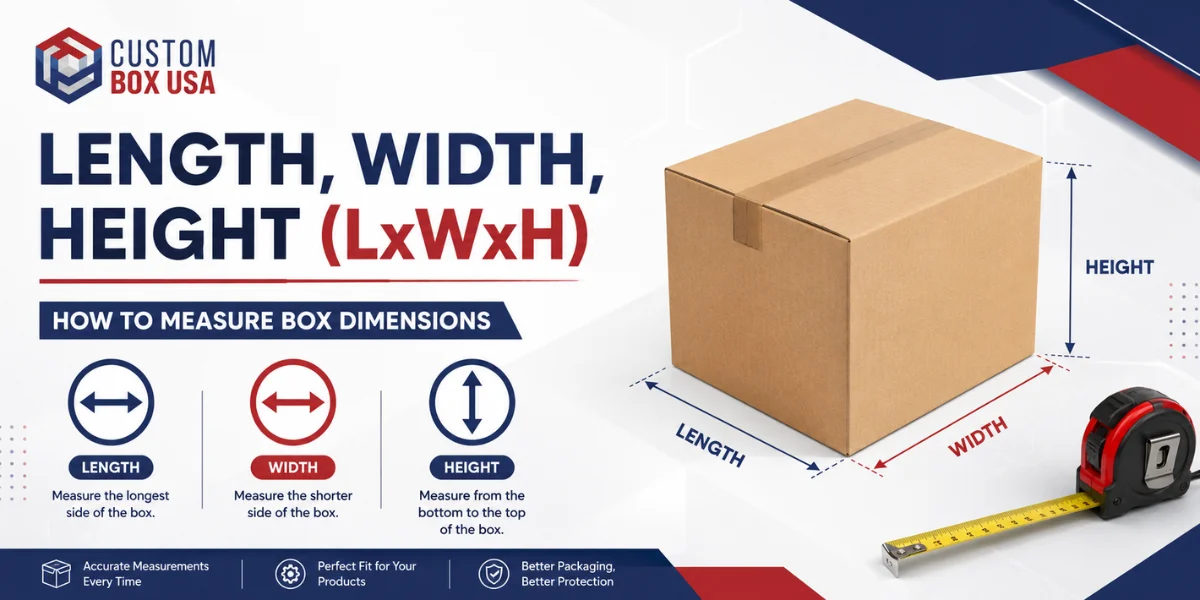
Length, Width, Height (L x W x H): How to Measure Box Dimensions the Right Way
Few things in business are more frustrating than opening a shipment of newly manufactured custom boxes only to realize your product does not fit inside. You push down on the lid, but the cardboard bulges. You try turning the product sideways, but the flaps refuse to close. Or maybe the opposite happens: your product sits inside a massive, empty cavern of cardboard, rolling around during transit while your shipping carrier charges you double for all the empty space you are paying to transport.
When packaging errors happen, they rarely stem from complex engineering failures. More often than not, they trace back to a simple mix-up with three basic numbers: length, width, and height.
In the world of packaging, manufacturing, and logistics, the specific order of your measurements is vital. Writing numbers in the wrong order can turn a shallow presentation tray into a tall, narrow tube. Assuming inside measurements are the same as outside measurements can ruin a product launch. Relying on guesses instead of exact calculations leads to damaged goods, inflated shipping bills, and wasted warehouse space.
This detailed guide explains everything you need to know about box dimensions. You will learn how to measure length, width, height correctly every time, how to handle different box styles, how to calculate volume and surface area, and how to avoid the costly mistakes that trap many businesses.
Why the L x W x H Measurement Order Matters
It is easy to think that math is math and order does not matter. After all, if you multiply 20 by 10 by 5, you get 1,000 cubic inches regardless of the order you choose. But while volume stays the same, physical structure changes completely when you swap these dimensions.
A box that measures 20 inches long, 10 inches wide, and 5 inches high is a wide, shallow, gift-style box. If you accidentally write those same numbers as 5 inches long, 10 inches wide, and 20 inches high, you end up with a tall, narrow tower. If a custom box manufacturer builds packaging based on mixed-up numbers, your product will not fit, your artwork will print upside down or sideways, and your structural design will fail.
The packaging industry relies on a universal standard to keep everyone on the same page:
$$\text{Length (L)} \times \text{Width (W)} \times \text{Height (H)}$$
This sequence remains consistent across structural designers, print operators, warehouse teams, and logistics carriers worldwide. When every party interprets the sequence in the exact same way, the transition from initial design to final delivery runs smoothly.
How Miscommunication Disrupts Supply Chains
Consider what happens when a product team creates a spec sheet using an unconventional format like Width x Length x Height. They send these numbers to a box manufacturer without specifying the format. The manufacturer assumes standard length, width, height order and builds the tooling.
By the time the finished boxes arrive at your facility, thousands of dollars have gone into paperboard, corrugated fluting, cutting dies, and ink plates. If the opening of the box is rotated ninety degrees, your automated packing line jams, or your custom protective foam inserts fall right through.
Verifying the measurement order with your packaging provider before production begins costs nothing. Fixing a production run built on incorrect dimensions costs thousands of dollars and weeks of lost time.
Defining the Terms: Length, Width, and Height
To measure a box accurately, you must understand what each specific term represents from a structural standpoint. Open the box or set it up on a flat table as if you were about to place an item inside it. Look down at the box from above.
Length: The Longest Horizontal Side of the Base
Length is always the longest horizontal measurement of the box's opening or base. When looking straight down into the box, identify the longest side running left to right or front to back along the bottom plane. That edge is your length. It is listed first in the measurement sequence, which is why professionals refer to it as the lead dimension.
Even if a box is extraordinarily tall—like a poster tube or a golf bag shipper—the length is still determined by looking at the base plane. However, for standard rectangular packaging, identifying the longest side of the open face gives you your length.
Width: The Shorter Horizontal Side of the Base
Width is the shorter horizontal measurement of the base plane. It runs perpendicular to the length at a ninety-degree angle. If length represents the side-to-side distance across the main face, width represents the front-to-back distance.
Together, length and width define the floor footprint of the box. Knowing the exact footprint helps you determine if your item will slide horizontally into the opening without catching on the side walls.
Height: The Vertical Dimension
Height is the distance measured vertically from the very bottom of the box to the top rim or upper flap closure.
Different industries use different terms for this vertical plane. Retailers, shelf-space planners, and e-commerce merchants often refer to this dimension as "depth." Packaging engineers, box manufacturers, and freight carriers almost always refer to it as "height." Both terms refer to the vertical space between the base of the container and its opening at the top.
Internal vs. External Box Dimensions
One of the most frequent mistakes businesses make when ordering custom boxes is confusing internal measurements with external measurements. A box that measures 12 inches by 10 inches by 8 inches on the outside does not offer 12 inches by 10 inches by 8 inches of usable space on the inside.
Internal Dimensions (ID): Built for Product Fit
Internal dimensions measure the usable space inside the box. When you are trying to figure out if your product, along with its tissue paper, bubble wrap, or custom foam inserts, will fit into a container, you must measure the internal space.
Box manufacturers use internal dimensions as their baseline when engineering custom packaging. When you tell a manufacturer that you need a box with a specific length, width, height, they will build the structural dieline to match those internal clearance points so your product slides in comfortably.
External Dimensions (OD): Built for Freight and Logistics
External dimensions measure the total space the box takes up in the real world, measured from outer edge to outer edge. Shipping carriers, logistics companies, and warehouse teams rely exclusively on external measurements.
When a carrier places your box on a sorting belt or stacks it inside a delivery truck, they do not care how much room is inside the container. They care about how much physical space the outside of the box occupies.
The Wall Thickness Variable
The gap between internal and external measurements depends directly on the thickness of the material used to make the box.
- Paperboard Folding Cartons: Thin paperboard cartons (like cereal boxes or cosmetic boxes) have thin walls. The difference between inside and outside measurements might be less than one-sixteenth of an inch.
- Single-Wall Corrugated Cardboard: Standard shipping boxes made of E-flute or B-flute cardboard add roughly one-eighth to three-sixteenths of an inch to overall external dimensions.
- Double-Wall and Triple-Wall Corrugated: Heavy-duty shipping boxes built for heavy industrial goods or fragile electronics have thick walls. Double-wall cardboard can add up to half an inch or more to the outside dimensions.
If you measure the outside of a heavy-duty corrugated box and order a new batch based on those outer numbers, your new boxes will arrive with internal space that is half an inch too small on every side. Your product will not fit inside. Always clarify whether your numbers represent internal space or external footprint.
Dimensional Weight (DIM Weight) and Shipping Costs
Measuring length, width, height accurately is not just about making sure your product fits. It directly controls how much money you spend on freight and parcel delivery.
In the past, shipping carriers priced packages based purely on actual weight. If a box weighed five pounds, you paid the five-pound rate regardless of whether the box was the size of a toaster or the size of a refrigerator.
That system changed with the introduction of Dimensional Weight (DIM Weight) pricing. Major parcel carriers (including UPS, FedEx, DHL, and national postal services) calculate charges using a formula that compares actual physical weight against the total volumetric size of the box.
How Dimensional Weight is Calculated
Carriers calculate dimensional weight by multiplying the external length, width, height of your package to find its total volume in cubic inches, then dividing that volume by a standardized number called a DIM Divisor.
$$\text{Dimensional Weight} = \frac{\text{Length} \times \text{Width} \times \text{Height}}{\text{DIM Divisor}}$$
For commercial domestic shipping in many regions, the standard divisor is typically 139 (though this varies by carrier and contract terms).
Consider a business shipping a lightweight cotton jacket that weighs only 3 pounds.
- If the business packs the jacket into an oversized box measuring 18 inches x 15 inches x 12 inches, the total volume equals 3,240 cubic inches.
- Dividing 3,240 by a standard divisor of 139 gives a dimensional weight of 23.3 pounds.
- The carrier rounds this up and bills the business for 24 pounds, even though the box only weighs 3 pounds on a scale.
By accurately measuring the jacket and switching to a snug mailer box measuring 14 inches x 11 inches x 3 inches (total volume of 462 cubic inches), the dimensional weight drops to 3.3 pounds. The carrier then bills the business for just 4 pounds.
Trimming unneeded inches off your length, width, height can save your business thousands of dollars in freight expenses over the course of a year.
Measuring Unique Box Styles
While the basic standard of length, width, height applies to all rectangular containers, different styles of boxes require slight adjustments when taking measurements.
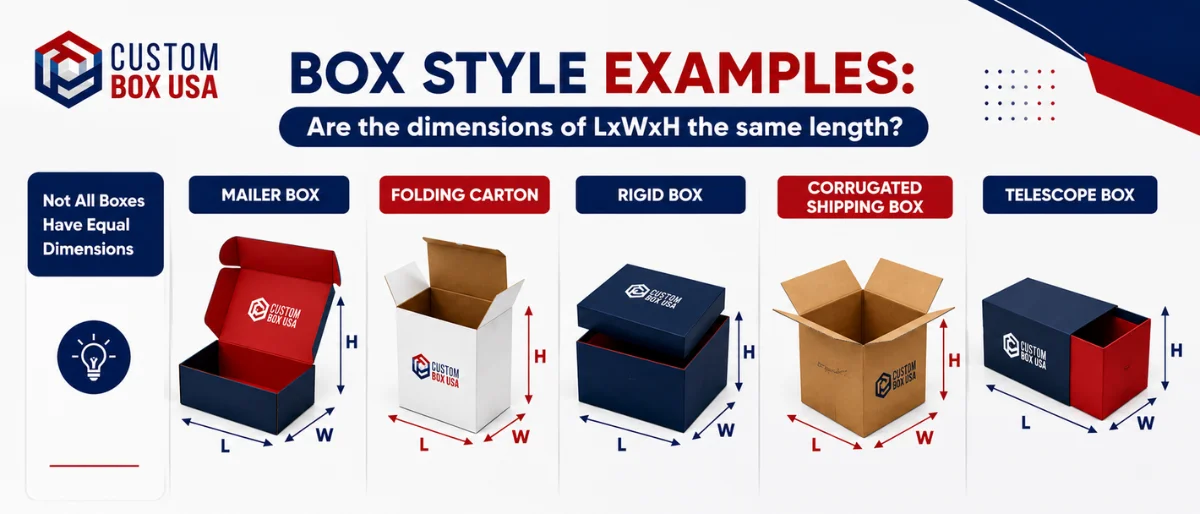
Mailer Boxes
Mailer boxes are popular for direct-to-consumer e-commerce brands, subscription boxes, and retail kits. They feature a hinged lid with side flaps that tuck securely into the front wall of the box.
When measuring a mailer box, assemble the box completely. Lay it flat on a table with the front opening facing you. Measure the horizontal front edge for length, the side edge going toward the back hinge for width, and the vertical wall for height.
In mailer boxes, height is almost always the smallest of the three dimensions. Pay close attention to internal clearances: the side flaps that tuck inward take up internal space, so leave a slight buffer when sizing items to fit inside.
Folding Cartons
Folding cartons are crafted from paperboard sheets and are used for lightweight retail items like cosmetics, vitamins, software, and packaged foods. They ship flat to your facility, where they are popped open, filled, and sealed along top and bottom flaps.
Always measure a folding carton when it is fully assembled, popped open, and closed—never while flat. Measuring a flat paperboard blank will give you raw sheet dimensions, not structural box dimensions. Specify whether your measurements represent the assembled internal space or the flat die-cut blank so the structural designer builds the fold lines in the right places.
Rigid Boxes
Rigid boxes (often called set-up boxes) are constructed from thick, solid chipboard wrapped in premium paper. Examples include iPhone packaging, luxury jewelry boxes, and high-end board game boxes.
Because rigid box walls are firm and do not bend or compress like corrugated board, internal dimensions and external dimensions stay close to each other. However, because these boxes often include custom internal trays, vacuum-formed inserts, or foam cutouts, exact internal length, width, height measurements are critical. A fraction of a millimeter off can prevent an internal tray from resting flush inside the base.
Corrugated Shipping Boxes
Standard corrugated shipping containers (often called Regular Slotted Containers or RSCs) feature top and bottom flaps that meet in the middle to be sealed with tape.
Because corrugated fluting contains air channels sandwiched between paper liners, material thickness plays a massive role here. A single-wall C-flute box has a wall thickness of roughly three-sixteenths of an inch. When all flaps overlap, the outer height increases. Always measure the interior from fold-line to fold-line to confirm product fit, and measure outer extreme points to calculate freight space.
Telescope Boxes
Telescope boxes consist of two separate pieces: a base that holds the product and a top lid that slides down over the base (like a shoe box or a board game box).
The lid must have a slightly larger length and width than the base so it can slide over it smoothly without tearing. When measuring a telescope box:
- Measure the base for your primary internal length, width, height.
- Measure the lid's height separately. Partial-telescope boxes have lids that cover only part of the vertical wall, while full-telescope boxes have lids that extend all the way down to the bottom edge.
Step-by-Step Guide: How to Measure a Box Accurately
To ensure you get exact measurements every time, follow this systematic process before ordering custom packaging or booking freight shipping.
Tools You Will Need
- A firm, flat measuring surface (such as a large table or concrete floor).
- A rigid steel tape measure or a flat metal ruler (avoid soft fabric measuring tapes used for clothing, as they stretch and create inaccuracies).
- A notebook or digital spreadsheet to record numbers immediately.
Step 1: Set Up the Box
Assemble the box completely. Close all bottom flaps and top lids as if the package were fully sealed and ready for shipment. Place the box on your flat work surface.
Step 2: Measure the Length
Look down at the base opening of the box. Identify the longest horizontal edge. Place your steel tape measure along the inside bottom panel (for internal space) or along the outer edge (for external footprint). Measure from inner wall to inner wall. Write this number down as your Length (L).
Step 3: Measure the Width
Turn your ruler ninety degrees to measure the shorter horizontal edge of the base plane. Measure from front to back across the bottom floor of the box. Write this number down as your Width (W).
Step 4: Measure the Height
Place the tape measure vertically along an inside corner of the box. Measure straight up from the bottom surface to the top rim or score line where the top flap folds down. Do not include the flap itself in the height measurement—only measure up to the fold line where the flap hinges. Write this number down as your Height (H).
Step 5: Format Your Results
Combine your three measurements using the standard sequence:
$$\text{Length} \times \text{Width} \times \text{Height}$$
If your length is 14 inches, width is 10 inches, and height is 4 inches, write the final specification as 14" x 10" x 4".
Essential Mathematical Formulas for Packaging
Once you have established your exact length, width, height, you can use these core geometric formulas to plan storage capacity, material usage, and protective packing needs.
Calculating Box Volume
Volume represents the total three-dimensional space enclosed inside a box. Calculating volume helps you verify whether an item will fit, how much void-fill material (such as packing peanuts or crinkle paper) you will need, and what the space capacity is.
$$\text{Volume} = \text{Length} \times \text{Width} \times \text{Height}$$
Real-World Example:
If you have a box with internal dimensions of 12 inches long, 8 inches wide, and 6 inches high:
$$\text{Volume} = 12 \times 8 \times 6 = 576 \text{ cubic inches}$$
If your item has a total volume of 450 cubic inches, you know that this box will comfortably house the product while leaving roughly 126 cubic inches of space for protective wrapping.
Calculating Surface Area
Surface area represents the combined total area of all six exterior faces of a rectangular box. Knowing the surface area helps structural engineers calculate how much corrugated board or paper sheet material is needed to manufacture the box, and helps printing teams calculate ink coverage.
$$\text{Surface Area} = 2 \times [(\text{Length} \times \text{Width}) + (\text{Length} \times \text{Height}) + (\text{Width} \times \text{Height})]$$
Real-World Example:
Using the same box measuring 12" x 8" x 6":
$$\text{Top and Bottom Panels} = 12 \times 8 = 96 \text{ sq in}$$
$$\text{Front and Back Panels} = 12 \times 6 = 72 \text{ sq in}$$
$$\text{Left and Right Panels} = 8 \times 6 = 48 \text{ sq in}$$
$$\text{Sum of Three Sides} = 96 + 72 + 48 = 216 \text{ sq in}$$
$$\text{Total Surface Area} = 216 \times 2 = 432 \text{ square inches}$$
Measuring Irregular, Round, or Bulging Containers
Not every product or box fits neatly into a rigid rectangular shape. Odd shapes require special measuring strategies to ensure your items are properly protected and carrier compliant.
The Bounding Box Method for Irregular Shapes
If you are packing an irregular item—such as a sculpture, an ergonomic office chair component, or an asymmetrical tool—you must use the bounding box method.
Imagine placing the irregular item inside an invisible rectangular glass cage. Measure the extreme outer points of the item along three perpendicular axes:
- Max Length: The distance between the two furthest points running horizontally.
- Max Width: The distance between the two furthest points running across depth.
- Max Height: The distance from the absolute lowest point to the absolute highest point.
These three maximum values form your required internal length, width, height. Once you have these baseline numbers, add your standard clearance margin for protective cushioning.
Measuring Cylinders and Round Tubes
Cylindrical packaging—such as mailing tubes, candle canisters, and cosmetic bottles—does not have traditional sides. Instead, it is measured using Diameter and Height.
- Diameter: Measure straight across the center circle from one outer edge to the opposite outer edge.
- Height: Measure vertically from the flat base to the top rim or cap.
When placing a cylindrical item into a rectangular shipping box, remember that the box's internal length and width must both be equal to or greater than the cylinder's outer diameter. A candle canister with a 4-inch diameter requires a box with an internal length of at least 4 inches and an internal width of at least 4 inches.
Handling Bulging or Overstuffed Boxes
If a box is packed so tightly that its cardboard side walls bow or bulge outward, parcel carriers will calculate shipping costs based on the widest bulge point—not the original flat panel edge.
To measure a bulging box accurately:
- Place the box flat against a wall.
- Hold a straight ruler flush against the outermost point of the bulge.
- Measure the total distance from the wall to that ruler.
Always design your packaging with sufficient internal clearance so sides remain flat. Bowed box walls lower structural integrity, making the box far more likely to collapse when stacked on pallets in freight trucks.
Common Sizing Mistakes and How to Avoid Them
Even experienced supply chain managers occasionally slip up when ordering boxes. Review this checklist of frequent mistakes to protect your budget and operations.
|
Common Mistake |
Why It Causes Problems |
How to Avoid It |
|
Swapping Measurement Order |
Leads to incorrect structural manufacturing, misaligned printing, and boxes that do not fit automated packing lines. |
Always list dimensions as Length x Width x Height (L x W x H). |
|
Confusing Internal and External Sizes |
Results in boxes that are either too small inside for the product or larger than expected on shipping belts. |
Use internal numbers for product fit; use external numbers for freight calculation. |
|
Ignoring Cushioning Space |
Leaves no room for bubble wrap, foam, or paper void fill, causing product damage during transit. |
Add 0.5" to 2" of padding clearance to your product's core dimensions. |
|
Measuring Flat Sheets |
Creates inaccurate dimensions that do not reflect the true folded structure of the box. |
Always measure fully assembled boxes set up on a flat surface. |
|
Mixing Units of Measure |
Causes major sizing conversions errors when working with global suppliers. |
Stick exclusively to inches or centimeters across the entire spec sheet. |
|
Forgetting Board Thickness |
Fails to account for corrugated fluting wall thickness, resulting in cramped internal space. |
Account for fluting walls (E, B, C, or double-wall fluting) when calculating dimensions. |
Industry Reference Guidelines
Different industries rely on standardized box dimensions for everyday packaging needs. While you should always measure your specific product instead of relying on averages, this reference table illustrates common length, width, height ranges across common applications.
|
Product Category |
Typical Box Style |
Common Dimensions (L x W x H) |
Primary Purpose |
|
Standard Small Shipper |
Corrugated RSC |
9" x 6" x 4" |
Small retail goods, books, electronics |
|
Medium Freight Box |
Corrugated RSC |
12" x 10" x 8" |
Apparel sets, home decor, multi-item orders |
|
Large Master Carton |
Double-Wall Corrugated |
18" x 14" x 12" |
Bulk items, heavy goods, master storage |
|
E-Commerce Apparel |
Tuck-Top Mailer |
11" x 8" x 3" |
Shirts, folded pants, lightweight soft goods |
|
Footwear |
Two-Piece Telescope |
13" x 8" x 5" |
Standard shoes, sneakers, ankle boots |
|
Fresh Pizza |
Roll-End Corrugated |
12" x 12" x 2" |
Flat food delivery, hot bakery pies |
|
Cosmetics & Skincare |
Folding Paperboard |
4" x 2" x 2" |
Serums, lotions, cream jars |
|
Poured Scented Candle |
Rigid Chipboard |
4" x 4" x 5" |
Glass candle jars, fragile ceramic gifts |
International Unit Conversion Reference
When working with overseas suppliers or global shipping networks, you will often need to convert dimensions between imperial (inches) and metric (centimeters) systems.
To convert inches to centimeters: multiply by 2.54.
To convert centimeters to inches: divide by 2.54.
Quick Conversion Reference Table
|
Inches (in) |
Centimeters (cm) |
Millimeters (mm) |
|
1" |
2.54 cm |
25.4 mm |
|
2" |
5.08 cm |
50.8 mm |
|
4" |
10.16 cm |
101.6 mm |
|
6" |
15.24 cm |
152.4 mm |
|
8" |
20.32 cm |
203.2 mm |
|
10" |
25.40 cm |
254.0 mm |
|
12" |
30.48 cm |
304.8 mm |
|
15" |
38.10 cm |
381.0 mm |
|
18" |
45.72 cm |
457.2 mm |
|
24" |
60.96 cm |
609.6 mm |
Tip: Always round metric conversions to the nearest whole millimeter (0.1 cm) when sending dielines to box manufacturers to avoid tiny rounding discrepancies during laser cutting.
Industry Testing Standards and Structural Compliance
Accurate measurements are vital for ensuring that your packaging passes rigorous physical testing before entering commercial supply chains. Leading international bodies establish testing procedures to evaluate how box dimensions impact product protection:
- ISTA (International Safe Transit Association): Protocols like ISTA 3A simulate parcel delivery environment hazards (drops, vibration, compression). If your internal length, width, height measurements leave too much empty space, the box walls will fail compression tests under heavy load.
- Amazon Packaging Compliance (ISTA 6-Amazon): Amazon requires vendor packaging to pass strict Ships-In-Own-Container (SIOC) tests. Boxes that are oversized relative to the product inside face financial penalties and require extra prep fees.
- ASTM International (ASTM D4169): Standard practice for performance testing of shipping containers and systems. Proper dimensional clearance ensures that internal inserts support stress points during transit.
When you start with accurate measurements, your packaging passes transit tests far more easily, keeping products safe from factory floor to customer doorstep.
Real-World Case Study: Sizing a Multi-Pack Box
To see how these concepts work in practice, let us walk through a real-world sizing scenario.
Imagine you manufacture glass jar candles. Each candle jar measures 3.5 inches in diameter and 4 inches in height. You want to design a custom retail box that holds two candles side-by-side.
1. Calculate Core Product Footprint
- Length: Two candles placed side-by-side equal 3.5"+3.5"=7.0".
- Width: The front-to-back distance of one candle equals 3.5".
- Height: The vertical height of the candle equals 4.0".
The raw product footprint is 7" x 3.5" x 4".
2. Factor in Clearance and Protective Inserts
If you place raw glass jars directly next to each other, they will clink together and break during shipping. You must add a corrugated divider partition between the jars (1/16" thick) and leave clearance around the outer walls for protective foam padding (0.5" on each side).
- New Internal Length: 7.0"+1.0" (side padding)+0.0625" (divider)=8.0625" (round up to 8.125").
- New Internal Width: 3.5"+1.0" (front/back padding)=4.5".
- New Internal Height: 4.0"+0.5" (top/bottom padding)=4.5".
3. Final Box Order Specification
You submit your structural order to your box manufacturer using the standard format:
Required Internal Dimensions: 8.125"×4.5"×4.5" (L × W × H)
By carefully measuring the raw product, adding buffer space for protective inserts, and writing the final numbers in the correct length, width, height sequence, your candles arrive safely, the box looks great on retail shelves, and shipping costs stay under control.
Final Checklist Before Placing Your Box Order
Before approving a production proof or submitting a custom packaging order, complete this quick final review:
- Are all dimensions written in strict Length x Width x Height order?
- [Did you measure an assembled, fully setup box rather than a flat piece of board?
- [Have you clearly specified whether your numbers represent internal dimensions or external dimensions?
- Did you add clearance space for bubble wrap, foam inserts, or tissue paper?
- Are all measurements recorded in a single unit of measurement (all inches or all centimeters)?
- Did you verify whether your carrier will bill based on actual weight or dimensional weight?
Taking a moment to measure your boxes accurately using the standard length, width, height sequence eliminates guesswork, prevents expensive manufacturing errors, protects your products in transit, and optimizes your shipping budget.
Frequently Asked Questions About Box Measurements
What is the correct order for box dimensions?
The standard order for box dimensions is always Length x Width x Height (L x W x H). Length is the longest side of the base, width is the shorter side of the base, and height is the vertical distance from bottom to top.
What does W x D x H mean, and how is it different from L x W x H?
W x D x H stands for Width x Depth x Height. Some furniture makers, retail shelf planners, and architectural designers use this format. In packaging, "Depth" corresponds to "Width" (front-to-back distance), while "Height" remains the vertical distance. However, box manufacturers almost always require standard L x W x H. Always double-check definitions with your supplier to prevent confusion.
Are height and depth the exact same measurement?
In packaging design, yes. Height and depth both measure the vertical distance from the bottom base of the box to the top rim opening. Retailers tend to say depth, whereas cardboard manufacturers and shipping carriers say height.
Should I measure the inside or outside of a box?
That depends on your goal. Measure the inside of the box when checking if your product and protective cushioning will fit. Measure the outside of the box when calculating shipping costs, freight space, and warehouse pallet storage.
How do I measure an irregular or round object for a box?
Use the bounding box method. Place the item on a flat surface and measure its maximum outer dimensions across three axes: maximum horizontal length, maximum depth width, and maximum vertical height. Use those three peak numbers as your base internal dimensions.
Conclusion
At Custom Box USA, we know that getting your length, width, and height right is the difference between a smooth product launch and a costly packaging headache. That is why our team works closely with you to review your exact measurements, account for wall thickness and protective padding, and engineer custom boxes that fit your items like a glove. By combining precision structural design with vibrant custom printing and premium materials, we help you eliminate wasted space, cut down on shipping fees, and deliver an outstanding unboxing experience to your customers every single time.