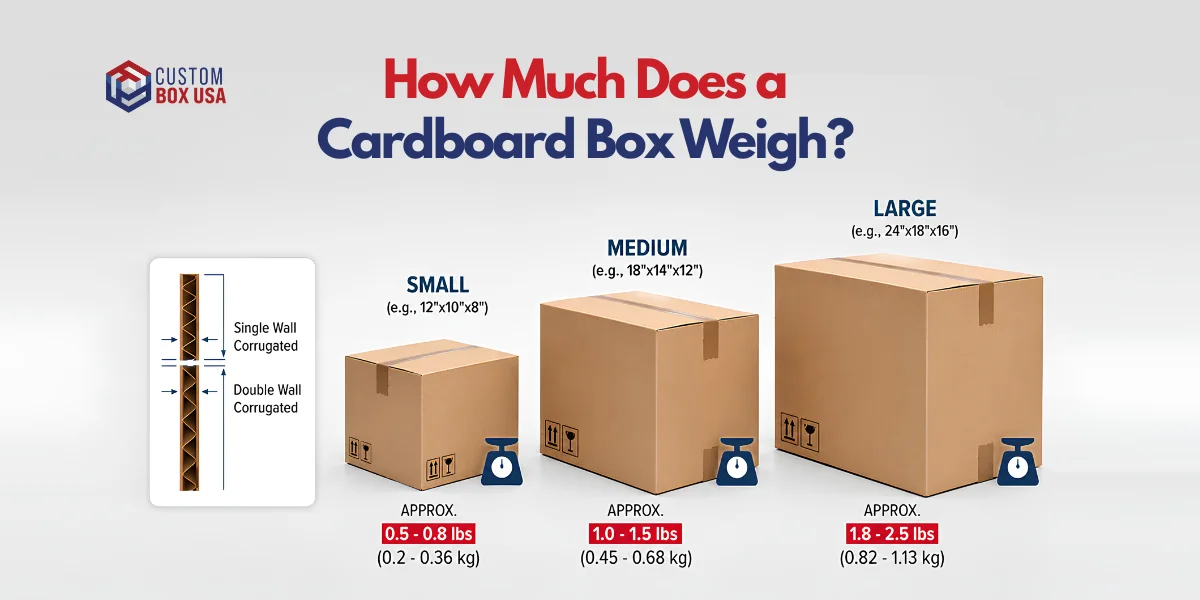
How Much Does a Cardboard Box Weigh?
Want to know what the weight of your cardboard box will be before you ship? Custom Box USA explains the exact formulas to use to determine cardboard box weight in pounds, kilograms, ounces, and grams, the factors that actually determine the weight, and an important distinction most guides overlook; the standard formula determines dimensional weight rather than physical weight of the box. This guide includes the math, the technical standards, and the reference tables that you need for determining freight cost estimates or comparing the strength of single wall vs. double wall.
Dimensional Weight vs. Physical Weight: The Distinction Most Guides Miss
The weight of the cardboard box relies on three factors – size, type of cardboard, and number of layers in the walls. Most guides will have omitted the most important aspect: the standard “divide by 166” formula is used to calculate dimensional weight, which is the number carriers use to bill shipping, and not the actual physical weight of the empty box.
Did you know that nearly every “cardboard box weight” formula you see on the web is actually the dimensional weight (DIM weight) formula that shipping companies use to calculate billable weight and freight, and not the actual weight on a scale? The weight of the DIM is volume-related. The carriers use it because it is low weight but high volume and uses up a lot of cargo space in the truck, and the carrier charges by weight, whichever is higher, between actual weight and dimensional weight.
Which is why it is not uncommon to find wildly varying figures when looking up the weight of a 12x12x12 box. An empty box of that size typically weighs from 0.75 to 1.2 lbs and the weight range will vary according to the cardboard type and density. One point to note: If you are taking numbers from multiple sites, be sure you are comparing apples to apples. Actual weight against actual weight; not one against the other with DIM weight.
Why Cardboard Box Weight Matters
This is not only a figure which you scribble down and forget. It can influence shipping prices, product protection and your team/customer's ease of handling the product.
Shipping Costs: Carriers charge by whichever is greater: by weight or by dimensional weight. That's increased weight and size, increased shipping costs, reweigh fees, or delivery delays due to underweight or miscalculated custom boxes.
Durability and Product Protection: Wall thickness is not the only indicator of strength, the Edge Crush Test (ECT) rate, or “lb test" is the most important measure.
Ease of Handling: It's easier and safer to handle the lighter boxes manually, which is important for workers in the warehouse, delivery drivers and customers.
Cost Management: Preventing over-ordering (wasted material and unnecessary shipping weight) and under-ordering (weak boxes) by making accurate estimates of weight and material.
Regulatory Compliance: There are freight and storage regulations that come into effect at certain weights. If you know how much your box weighs, there's no need to run into compliance problems later.
Factors That Affect Cardboard Box Weight
Not only size, but several factors affect the weight of a cardboard box. The factors are below,
Box Size
The bigger the box, the more material it will need, the more material the box will need the heavier it will be. This is the easiest of the variables.
Cardboard Type
You will find two main materials that you will encounter in cards: cardstock and corrugated. Corrugated box is made with fluted layers between sheet liner and that's the reason it's heavier than plain sheet.
Wall Type (Single, Double, or Triple)
Single wall is your lightest option and is suitable for products that do not require much protection. Double wall – an additional fluted layer for added durability. The heavyweight of the three, triple wall is meant for heavy demands on storage and shipping.
Material Thickness and Moisture Content
The thicker the cardboard the heavier the cardboard, and typically the thicker the cardboard, the better suited it will be for heavier products or higher-end products. Moisture matters too. Cardboard can absorb water and increase in weight especially in warm, humid climates and/or prolonged storage, if numbers are significant.
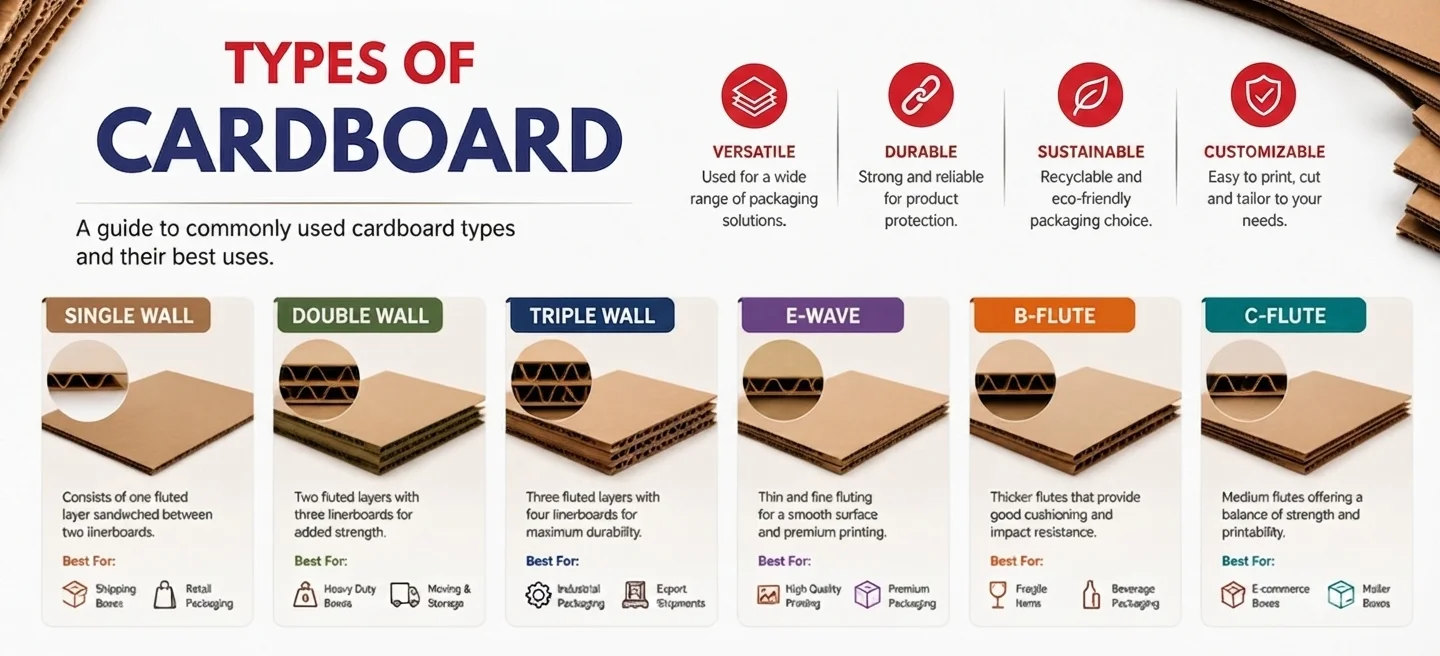
Box Design and Add-Ons
There are so many additional features like handles, dividers, die-cuts, coatings, etc. that add to the weight on top of the base structure.
Why Weight and Strength Are Not the Same Thing
Many people think that the heavier a box is, the more robust it is. It's not an easy thing to do. Two tests are widely used in the industry: The Edge Crush Test (ECT), which is measured in pounds per inch and reflects the ability of the material to withstand crushing under stacking forces, and "lb test" (such as 200 lb test or 275 lb test), an older, but still current test for burst strength. Here's a good reminder about strength: a poorly designed box of 32 ECT won't be as strong as a well-designed box of 32 ECT. Just the number isn't the answer.
How to Calculate Cardboard Box Weight
When it comes to calculating an estimated box weight, regardless of the unit you seek, it is actually an easy procedure. To get a good idea of the amount of work done, follow this sequence:
Step 1: Know Your Box Dimensions – Determine the size of your box. Measure length, width and height in inches or centimetres
Step 2: Determine the Cardboard Thickness —Cardboard Thickness (usually in millimeters or inches).
Step 3: Determine the Cardboard Type – Single, double or triple-wall corrugated or plain cardstock.
Step 4: Apply the Formula for estimates using the dimensional formulas below, for actual physical weight use a scale.
Cardboard Box Weight in Pounds
The box's volume is then divided by an industry standard dimensional weight divisor to determine the box's weight in pounds. The formula used by most shipping calculations in the United States.
Before you begin to compare sources, it's important to become familiar with the distinction between these two numbers. The DIM formula is intended to provide the shipping weight for a 12" x 12" x 12" box which is 10.4 lbs, but that's the shipping weight/ billable weight of the box, not its actual weight when placed on a scale. The empty weight of such a cardboard box is in the range of 0.75 to 1.2 lbs, depending on the cardboard type and thickness of the box. When comparing numbers from different sites be sure to compare the same type of weight: DIM to DIM, actual to actual.
Use this formula to calculate weight (in pounds) out of length × width × height ÷ 166. Take a 12x12x12 inch box as an example: (12 × 12 × 12) ÷ 166 = 1,728 ÷ 166 = 10.4 pounds. Remember, this weight is dimensional/shipping weight, not necessarily a scale weight of an empty box.
Cardboard Box Weight in Ounces
It is helpful to know how to convert to ounces when you need to measure in smaller and lighter packages, since pounds are too large a unit. The conversion involves one multiplication.
Formula: Weight (oz) = Weight (lbs) × 16
Example: 10.4 lbs × 16 = 166.4 ounces
Cardboard Box Weight in Kilograms
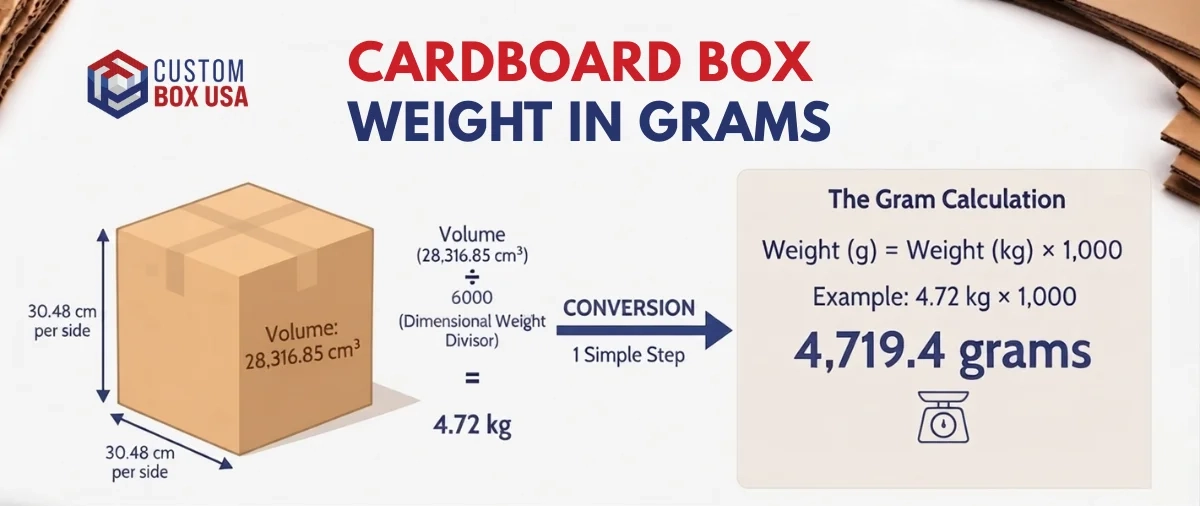
Kilograms are the standard unit of measure for international shipping or brands using the metric system.All dimensions need to be converted to centimetres before you can work in the metric version.
Formula: Weight (kg) = (Length in cm × Width in cm × Height in cm) ÷ 6,000
Example: For a 12x12x12 inch box (30.48 cm per side): 30.48 × 30.48 × 30.48 = 28,316.85 cm³, divided by 6,000 = 4.72 kilograms.
Cardboard Box Weight in Grams
Grams are the unit to use for anything that needs a finer degree of precision. After setting up a figure in kg, converting to grams takes one simple step.
Formula: Weight (g) = Weight (kg) × 1,000
Example: 4.72 kg × 1,000 = 4,719.4 grams.
Same size as a box but metric version. At 30.48 cm per side: 30.48 × 30.48 × 30.48 gives you 28,316.85 cm³, divide that by 6,000, and you get 4.72 kilograms.
Standard Cardboard Box Weight Chart
When you don't need to type in the formula for each box size, reference charts save time. Here are the most popular sizes for White cardboard boxes in retail and shipping.
|
Box Dimensions (inches) |
Est. Physical Weight (lbs) |
Weight (kg) |
Weight (oz) |
Weight (grams) |
|---|---|---|---|---|
|
6x6x6 |
0.2 lbs |
0.09 kg |
3.2 oz |
90.7 g |
|
8x8x8 |
0.3 lbs |
0.14 kg |
4.8 oz |
136.1 g |
|
10x10x10 |
0.5 lbs |
0.23 kg |
8 oz |
226.8 g |
|
12x12x12 (Single-wall) |
0.75 lbs |
0.34 kg |
12 oz |
340.2 g |
|
12x12x12 (Double-wall) |
1.2 lbs |
0.55 kg |
19.2 oz |
544.3 g |
|
14x14x14 |
1.5 lbs |
0.68 kg |
24 oz |
680.4 g |
|
16x16x16 |
2.0 lbs |
0.91 kg |
32 oz |
907.2 g |
|
18x18x18 |
2.5 lbs |
1.13 kg |
40 oz |
1,134.0 g |
|
24x24x24 (Large) |
3.5 lbs |
1.59 kg |
56 oz |
1,587.6 g |
Use a scale for actual empty box weight as real weight can differ in thickness, number of walls, ECT rating, and features added.
Cardboard Material Density Reference
Those who prefer a more technical beginning than the dimensions listed above: A more precise way to calculate weight is by using raw material density.
Corrugated cardboard: approximately 0.69 g/cm³
Non-corrugated chipboard: approximately 0.83 g/cm³
These values are affected by moisture and are subject to change depending on storage conditions and humidity.
Understanding ECT and “Lb Test” Ratings
Weight does not necessarily mean strength, so it is best to become familiar with manufacturers' rating systems. Each of them measures what is shown in the table below.
|
Rating System |
What It Measures |
Common Values |
|---|---|---|
|
Edge Crush Test (ECT) |
Stacking strength, in pounds per inch |
23, 32, 44, 51 ECT |
|
Bursting/Mullen Test (“lb test”) |
Burst resistance |
200 lb, 275 lb test |
For example, a 32 ECT box is a lightweight box (up to 19% lighter than a 200 lb test box), and is suitable for many shipments for standard carrier requirements. The ECT/lb-test rating is a much better indicator of the protection that a box can provide than its weight alone.
Standard Weight Ranges by Box Category
In addition to dimensions, it is also useful to consider it in terms of general size categories when planning storage or estimating the costs of bulk shipping. The table below categorizes the range of cardboard boxes into the bands used most often in the packaging industry.
|
Box Category |
Typical Dimensions |
Approximate Weight Range |
|---|---|---|
|
Small Boxes |
6x6x6 inches |
0.5–1 lb |
|
Medium Boxes |
12x12x12 inches |
0.75–1.2 lbs (single to double-wall) |
|
Large Boxes |
24x24x24 inches |
3–7 lbs |
|
Extra-Large Boxes |
36x36x36 inches |
Varies by wall type and reinforcement |
How Much Does a Pallet of Cardboard Boxes Weigh?
The weight of pallets will depend on the number of boxes, the weight per box and box size. An average pallet carries approximately 60 boxes, and the weight of the boxes (excluding the weight of the pallet itself) is generally in the 30-50 lb range for smaller boxes, and increases dramatically with box size.
Example comparison: 50 medium boxes (10 lbs each) = 500 lbs versus 50 large boxes (15 lbs each) = 750 lbs.
Ideal Box Weight for Shipping
Boxes between 0.5 and 3 pounds are a good choice for most shipments, as they are durable enough to keep shipping costs down. If it is outside of this range, it is best to check details with the shipping partner as actual and dimensional weight may impact cost.
Ordering With Custom Box USA
Knowing what boxes are made of and how to determine the box's weight and strength is just as important as selecting the right custom box for your product. All orders come with the following.
Full Customization: Wall type, ECT rating, thickness, size and finish can be customized to suit your product weight and fragility requirements.
Free Design Support Expert: direction to choose the material and construction not only by actual weight, but also by the strength of the materials.
Durability Matched to Product: Single, double or triple wall construction available, as indicated by real ECT or lb-test ratings and not by weight.
Free US Shipping: No extra shipping charges on custom box order countrywide.
FAQs
What is the mass of a box of mass 12 inches x 12 inches x 12 inches of cardboard?
A single wall 12x12x12 box measures at approximately 0.75 lbs (340 grams) and a double wall box is approximately 1.2 lbs (544 grams). These are estimates of the physical weight of the box, and are not the dimensional (DIM) weight used by shipping companies. To calculate DIM weight, use the formula **(L × W × H) ÷ 166**, which gives 10.4 lbs for the same 12 × 12 × 12-inch box.
Does the weight of a box equal the “divide by 166” formula?
No. The formula for calculating the billable weight of a package, called dimensional (DIM) weight, is (L × W × H) ÷ 166. It does not measure the actual physical weight of the box — for that, use a scale.
Is there a relationship between box weight and box strength?
No. This is not based on weight; strength is measured by ECT (Edge Crush Test) or by lb-test rating and flute profile and precision of construction.
What is a good rating of ECT for regular shipping?
32 ECT is a standard that is lightweight enough for many shipments. The higher value/heavier items will generally require 44 ECT or above, or a “200 lb test” / “275 lb test” rated box.
Does cardboard box weight impact shipping costs?
Yes. Both scale weight and dimensional weight are important in cost estimates, as carriers charge whichever is higher, whichever is the greater of the two.
What is the best place to buy custom cardboard boxes for my product weight and strength requirements?
Single, Double and Triple Wall corrugated boxes are available with various ECT ratings, and Custom Box USA will provide free design advice and ship from throughout the nation to match your actual protection requirements.