When people search custom boxes near me, the most common mistake is picking the closest pin on the map. Many of those pins are shipping stores, sign shops or resellers that never print a box themselves. If you need printed, branded boxes for a small business, an online box maker that ships to your door is usually the safer choice.
A local shop still wins in a few cases. Need five plain boxes by tomorrow, or one box built around a fragile lamp? Go local. For anything with your logo, your colors and a reorder plan, the sections below show how to compare your options, what each one costs you in time and risk, and how to test a box before you spend real money.
Local printer or online box maker? The short answer
Pick a local shop for small, fast, plain jobs and face-to-face help. Pick an online box maker for printed packaging, custom sizes, special finishes and reorders.
Distance matters less than most people expect. Printed boxes often travel by courier anyway, even from a shop in your own town. The real local benefit is a person you can talk to across a counter. That has value, but it rarely outweighs a wider choice of styles and a clear proof process.
Pick local if...
- You need a few boxes this week, and they don't need printing.
- You're shipping one odd item, like a sculpture or a mirror, and need a box built around it.
- You want to hold materials in your hands before you decide, and the shop keeps samples on site.
Pick an online box maker if...
- You want your logo, brand colors or full artwork on the box.
- You need a custom size, a window, an insert or a finish like foil or spot UV.
- You plan to reorder the same box every month or every season.
- There's no true box printer near you, which is common in small towns.
The safe middle route: one sample first, then bulk
The lowest-risk path is simple. Order one sample box online, test it with your product, and only then order in bulk. At Custom Box USA, the minimum order is as low as 1 unit, so you can check fit, strength and color before you commit your budget.
What does "custom boxes near me" actually find?
It finds a mix of businesses, and only some of them make boxes. A search for custom packaging near me often returns shipping stores, print shops, sign makers and even moving companies.
Printer, reseller or shipping store?
These three work very differently, so it helps to know which one you're calling.
- Packaging printer: runs the press and cuts the boxes. If something goes wrong, they can fix it directly.
- Reseller: takes your order and sends it to another company to make. This can work fine, but answers and fixes may take longer.
- Shipping store: sells or builds plain cardboard boxes for moving or shipping. Great for a fragile one-off, but not set up for branded retail packaging.
Questions that tell them apart
- "Do you print and cut the boxes yourself, or send them out?"
- "Who makes the dieline?" A dieline is a flat map of the box that shows every fold, cut and glue line. Your art goes on top of it.
- "Can I see a printed sample of the style and material I want?"
- "Will I get a proof before printing?" A proof is a preview of the final design that you approve first.
- "What happens if the boxes arrive wrong?"
Clear, quick answers are a good sign. Vague ones often point to a reseller or a shop that rarely makes printed boxes.
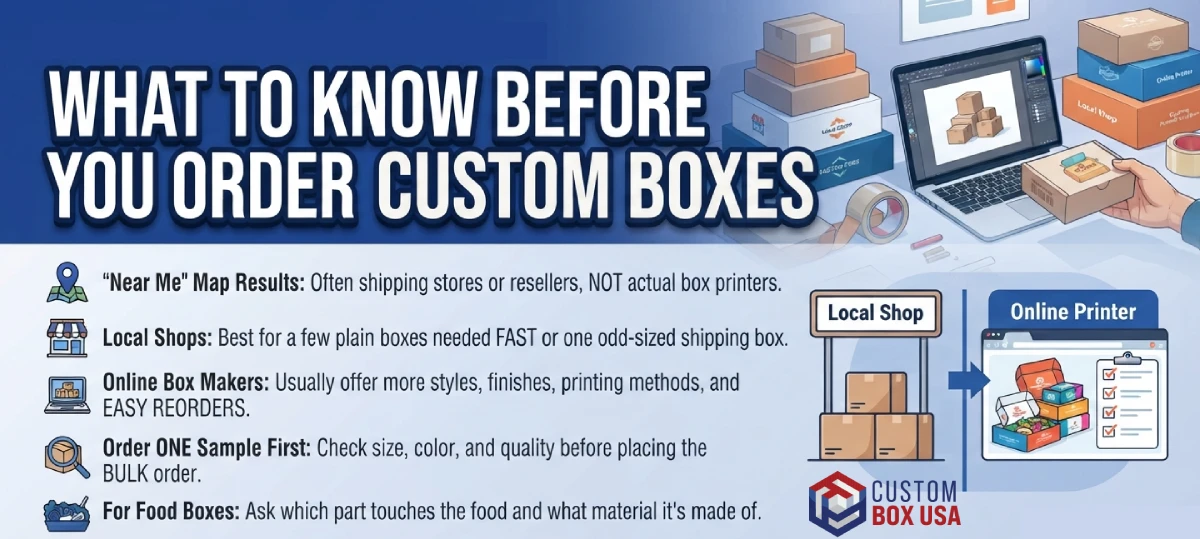
What to know before you order
Local vs online custom packaging: side-by-side
Online box makers usually give you more choice and easier reorders, while local shops give you a face and quick help on simple jobs. Here's how they compare on the points small business owners ask about most.
| Factor | Local shop | Online box maker |
|---|---|---|
| Order size | Good for a few boxes or small printed runs | From one sample up to custom boxes wholesale runs |
| Minimums and setup fees | Varies a lot; printed runs may carry setup fees | Often low; Custom Box USA has no die and plate charges |
| Box styles | Often a short list, mostly plain shipping boxes | Mailer, tuck-end, roll-end, window, sleeve, two-piece and more |
| Materials | Often stock corrugated | Corrugated, paperboard, kraft and recyclable stock |
| Finishes | Often limited | Gloss, matte, spot UV, foil, embossing, debossing |
| Samples and proofs | You may see samples in person | Digital proof first; physical sample on request |
| Delivery | Pickup or courier | Courier to your door |
| Design help | Varies; ask whether there's a fee | Free design support at Custom Box USA |
| Cost per printed box | Depends on setup fees and run size | Depends on setup fees and run size; ask for a quote |
| Best for | Rush plain boxes, one odd shipping box, face-to-face talks | Branded custom printed boxes, custom sizes, reorders |
Order size and minimums
The minimum order quantity (MOQ) is the smallest number of boxes a maker will sell you. Minimums exist because every run needs setup. Someone has to prepare the press, make the cutting tool and run the gluer, whether you order 200 boxes or 2,000, as one printer's guide explains. Those costs are often billed as die and plate charges, the fee for the cutting tool and printing plates.
Box styles, materials and finishes
Many local shops stock corrugated cardboard, which has a wavy layer between two flat sheets and holds up well in shipping. Fewer offer paperboard, the thin, stiff board used for cookie or tea boxes. Online makers usually carry both, plus kraft, inserts and special finishes. For custom cardboard boxes or custom corrugated boxes in an exact size, ordering online gives you more room to choose.
Samples and proofs
This is where a local shop shines, because you can walk in and touch things. Online, you can get close to the same result by asking for a physical sample after you approve your digital proof.
Turnaround and shipping
A local shop may hand over plain boxes quickly. Printed boxes take time anywhere, since printing, drying, cutting and gluing are separate steps. With an online order, the boxes then travel by courier, so build a little extra time into your plan.
Reorders and support
Most online makers keep your size, art and specs on file, which makes reordering simple. Local shops may do the same, but their hours limit when you can reach them. If you're searching "custom boxes near me open now," you're probably on a deadline. Custom Box USA has customer service reps available 24/7, so a question at 9 p.m. still gets an answer.
Local custom box printer: pros and cons
A true local custom box printer is a great partner if you can find one. The catch is that many towns don't have one.
Pros
- You can talk face to face and see samples.
- Quick help for small, plain jobs.
- Local pickup lets you skip freight costs on a printed order.
Cons
- Fewer sizes, styles and finishes.
- Some resell another company's work.
- Setup fees can make small printed runs pricey.
- Shop hours limit when you can get answers.
Ordering custom boxes online: pros and cons
Ordering custom boxes online gives you more choice and simpler reorders. The trade-off is that you can't touch the box until a sample or the order arrives.
Pros
- Quick online quotes and easy artwork upload.
- More materials, styles and printing methods.
- Design help, often free.
- Your specs stay on file for reorders.
Cons
- You can't handle samples in a shop.
- Colors on a screen don't always match ink on board.
- Courier delivery adds time to your plan.
The first two cons get much smaller once you order one sample before the full run.
Is a local custom box printer cheaper than ordering online?
Not necessarily. For printed boxes, price depends more on setup fees, print method and quantity than on how far away the maker is.
The print method changes the math, so here's what each one means:
- Digital printing: prints straight from a computer file with no plates. It suits small runs.
- Offset printing: uses metal plates and ink rollers. Setup costs more, but it suits big runs and exact colors.
- Flexography: uses flexible plates and is common on corrugated shipping boxes.
- Screen printing: pushes ink through a mesh screen and works well for bold single colors.
Colors come in two systems. CMYK mixes four inks (cyan, magenta, yellow and black) to print most photos. PMS, the Pantone Matching System, uses exact numbered colors, so your brand red stays the same red on every order.
When a shop charges for dies and plates, a small printed run adds up fast. That's why it's worth asking about those charges anywhere you shop. Every box is different, so we don't list fixed prices. A free quote with your size, material and quantity gives you the real number.
Which should you choose? Match it to your situation
Let your order, deadline and product decide, not the map. Here are a few common cases.
- Small-town bakery with no box printer nearby: order online. Start with one sample of your custom bakery boxes, test it with your best-selling cake, then order in bulk.
- Handmade gift seller on an online marketplace: order online. A printed mailer box turns every delivery into a branded moment, and reorders stay simple.
- Company sending holiday gifts to staff in several states: order online so every box matches. Our custom gift boxes include styles that work for clients and teams.
- Restaurant that wants its logo on takeout and custom burger boxes: online usually offers more choice and easier reorders. Ask about grease resistance before you order.
- You need three plain boxes to ship a one-off item tomorrow: go local. A shipping store is perfect for this.
Based in Southern California? Our team works from Anaheim, and our post on custom packaging in Los Angeles covers what to look for locally. Wherever you are, shipping across the USA is free.
Food, bakery and gift boxes: what to ask any maker
For food boxes, ask which part of the box touches the food and what it's made of. A good maker will answer plainly, whether they're down the street or online.
Food-contact materials and the FDA rules in plain words
Anything that touches food, like paper, coatings, inks or glue, is called a food contact substance. The FDA (US Food and Drug Administration) sets the rules for these materials. Many are covered by regulations in 21 CFR parts 174 to 179, a section of the federal rule book for food and drugs.
According to the FDA guidance on food contact materials, a component used in line with those regulations needs no further FDA review. Other routes include an effective Food Contact Notification. If your food touches the box directly, ask your maker which route applies, and ask our team which materials suit your product.
Grease, windows and inserts
Buttery pastries and fried food can soak through plain board. A grease barrier is a layer that stops oil from coming through, so ask what it's made of. The FDA has taken action on certain PFAS-based grease-proofing agents in paper food packaging. PFAS are a group of man-made chemicals, and some have been used to help paper resist grease.
Windows let customers see the cake before they open the box. Inserts are pieces inside the box that hold items still, like dividers for cupcakes or macarons. Our food-safe packaging checklist for bakeries and cafes walks through each question in more detail.
Kraft or white?
Kraft is brown paper stock with a natural, rustic look, which suits farm-to-table bakeries and coffee shops. White board makes bright colors and photos stand out, so it works well for bold brand colors and wedding desserts. Neither is wrong; pick the one that looks like your brand.
Honest eco and shipping claims
Only print an eco or delivery claim you can back up. Two FTC rules explain what that means in practice.
Writing "recyclable" the right way
The FTC Green Guides summary says you should qualify a "recyclable" claim if recycling isn't available to at least 60 percent of the consumers or communities where you sell. Claims about partly recycled content should also be qualified, for example by giving the percentage.
Plain, careful wording is the safest choice. At Custom Box USA, we use only "recyclable" or "made from recycled materials" unless a certificate supports more. If sustainability matters to your brand, browse our eco-friendly packaging options, including kraft and recyclable stock.
Fair delivery promises
Under the FTC Mail, Internet, or Telephone Order Rule, online sellers need a reasonable basis to ship within the time they advertise, or within 30 days if they state no time. If they can't, they must get your consent to the delay or refund your payment. Be careful with any box maker who promises an exact date with no allowance for order size or location.
Common mistakes when ordering custom boxes
Most costly box mistakes happen before printing, not after. These are the ones worth guarding against.
Skipping the sample
A box can look perfect on screen and feel flimsy in your hand. One sample costs far less than a full run you can't use.
Ordering holiday boxes too late
It's November 20, 2026, so Christmas is about five weeks away. If you still need Christmas boxes, start this week. For Valentine's Day and Easter 2027, start early so proofs and samples aren't rushed.
Wrong size or no dieline
Measure your product, then add room for any insert or tissue, because the box's inside size is what counts. A dieline from your maker shows exactly where your art will land.
Judging color on screen
Every screen shows color a little differently. If one exact shade matters, ask for PMS colors and check a printed sample.
Forgetting about your files
Your logo and artwork belong to you. Ask any maker how they store files, who can see them, and whether your design could be reused.
How ordering from Custom Box USA works
You set up your box online, get a quote, approve a digital proof, and then we print and ship. You pay only after you approve the file.
- Configure and quote: choose your size, style, material, finish and quantity. Our instant quote form gets a response within 2 hours.
- Design: upload your artwork, or just share your logo. Our free graphic design support places it on the dieline.
- Payment after digital file approval: you check the proof first, then pay.
- Production: digital, screen, flexography or offset printing, with CMYK or PMS colors, on the inside, outside or both.
- Delivery: free shipping across the USA by couriers such as FedEx, Skynet and DHL.
Standard turnaround is 8 to 10 business days, and rush orders take 4 to 6 days. Timing may vary with order volume and location. New customers also get 20% off their first purchase, and you can browse every style on our custom boxes page.
Quick checklist before you choose
Answer these five questions before you contact anyone, local or online.
- Order size: one sample, a small run, or wholesale?
- Deadline: when must the boxes be in your hands, with a few days to spare?
- Product type: food, gift or retail? Does food touch the box?
- Budget: are there die, plate or design fees on top of the box price?
- Files and privacy: do you have a logo file, and how will the maker store it?
Frequently Asked Questions
Is it better to order custom boxes locally or online?
For printed, branded boxes, online is usually the better fit because you get more styles, finishes and easy reorders. Local works best for a few plain boxes you need fast or for one odd-sized shipping box.
How do I find a custom box maker near me?
Search, then call and ask whether they print and cut boxes themselves. Also ask who makes the dieline and whether you'll get a proof. Many map results are shipping stores or resellers, so these questions save you time.
Can I order just one custom box as a sample?
Yes. At Custom Box USA, the minimum order is as low as 1 unit, so you can test fit, strength and color before a bulk order.
How much do custom boxes cost?
It depends on size, material, print method, finish and quantity. Setup fees can add a lot to small runs. We have no die and plate charges, and a free quote shows your real price.
Where can I get custom boxes made?
You can use a local packaging printer if there's one near you, or an online box maker that ships to you. Custom Box USA makes custom printed boxes in Anaheim, CA, and ships free across the USA.
How long does it take to get custom boxes made?
At Custom Box USA, standard turnaround is 8 to 10 business days, and rush orders take 4 to 6 days. Timing may vary with order volume and location, so plan holiday orders early.
Are your boxes recyclable?
We offer kraft and recyclable stock for brands that want to cut waste. Ask our team which material fits your product, and keep your own claims to plain words like "recyclable."
Get a free quote
The closest shop isn't always the safest choice. A maker who prints the boxes, shows you a proof and lets you test one sample usually is. Your box works as a silent salesman for your brand, so give it a fair test before you commit.
Tell us your size, product and quantity, and our team will help with the design for free. Custom sizes, materials, finishes and printing are all available. Get a free quote today, and we'll reply within 2 hours.