The right partner for custom packaging in Los Angeles prints your size and design at a minimum order you can afford. It also shows you a sample or proof first and gets boxes to you on a clear timeline. Pick wrong, and you could end up with a garage full of boxes that don't fit your cakes. Or your holiday order shows up after the holiday.
LA has plenty of box sellers, and many of their pages sound alike. So we've set this out as the questions bakery owners, cafe managers, food startups and gift buyers ask us most. Each one gets a plain answer you can use to compare any maker, including us.
Custom Packaging Los Angeles Basics: What Makes a Good Box Maker?
A good box maker tells you about minimums, fees, timing and materials before you pay. If you have to dig for those answers, that tells you something too.
What is custom packaging, exactly?
Custom packaging is a box made to your size, style, material and print, instead of a plain box off a shelf. Custom box packaging can be as simple as your logo on a kraft cookie box. It can also be a fully printed cake box with a window and an insert that holds each cupcake in place.
Why bother? A box that fits holds your product still, the way a seatbelt holds a passenger. A printed box also does some selling for you. We call it a silent salesman: it tells people who made the treat before anyone says a word.
What should a good box maker always tell you up front?
Five things: the minimum order, any setup fees, how proofs work, the turnaround time and the shipping cost. Together, they decide your real cost and your real deadline. A low price per box means little if a big setup fee or slow shipping comes with it.
Short on time? These are the quick answers to the questions we hear most:
| Question | Short answer |
|---|---|
| Local shop or online maker? | Local helps when you need boxes in days or want to touch materials. Online often wins on custom print, low minimums and free design help. |
| What is an MOQ? | The minimum order quantity: the smallest number of boxes a maker will print in one order. It varies a lot between sellers. |
| Can I test one box first? | Many makers offer samples. At Custom Box USA, the minimum is as low as 1 unit. |
| What drives the price? | Size, material, quantity, print colors, finishes, inserts and shipping. |
| Are food boxes "FDA approved"? | The FDA regulates the materials that touch food, not each finished box. Ask which materials suit your food. |
| Can I print "recyclable" on my box? | Only if it's true where you sell. Federal and California rules limit this claim. |
| When should I order holiday boxes? | Early, well before makers get busy in the fall. |
Should You Use a Local Box Maker or Order Online?
It depends on what matters most to you. Some buyers want speed and face-to-face contact, while others want custom print and low minimums. It's fine to use one source for some boxes and another for the rest.
When is a local Los Angeles shop the better pick?
Go local when you need boxes within days or want to hold the materials before you buy. Say you run a cafe in Downtown Los Angeles and your pastry boxes run out on a Friday. A supplier you can drive to fixes that fast. A visit also lets you feel the board thickness and see colors in real light.
The trade-off: some local shops mostly stock plain boxes with limited printing, or they ask for larger orders on custom print.
When does an online custom box company win?
An online maker usually wins when you want full custom print, design help and a small first order. Many box manufacturers in Los Angeles and across the country now work online, so "local" matters less than it used to. What matters more is whether they'll send a sample, fix your artwork for free and ship without surprise costs.
There's no single best custom packaging company for everyone. The best one is the one whose answers fit your budget, quantity and deadline.
When do plain stock boxes by the pallet make sense?
They make sense when you ship lots of products and the outer box doesn't need branding. A distributor sells standard sizes in big quantities. That suits warehouses and 3PLs, which are third-party logistics companies that store and ship goods for other brands. It's less helpful for a bakery that wants its name on every box.
What's the difference between wholesale and retail custom boxes?
Wholesale custom boxes are ordered in bulk straight from the maker, so each box costs less. It works like buying flour in big sacks instead of small bags at the store. Short-run orders cost more per box, but they don't tie up your cash or storage space. Many brands start small and test the design. Once it's proven, they switch to wholesale custom boxes in Los Angeles or wherever they sell.
| Factor | Local LA shop | Online custom maker | Stock-box distributor |
|---|---|---|---|
| Minimum order | Varies; custom print may need larger runs | Often low; some allow a single sample | Usually case or pallet quantities |
| Design help | Sometimes | Often included | Rarely; boxes are plain |
| Speed | Fast for in-stock boxes | Set production window plus shipping | Fast for standard sizes |
| Shipping | Pickup possible | Varies; some offer free shipping | Freight costs common |
| Proofing | See samples in person | Digital proof, physical sample on request | Little or none |
| Best for | Last-minute needs, hands-on buyers | Branded boxes at low to mid quantities | High-volume plain shipping boxes |
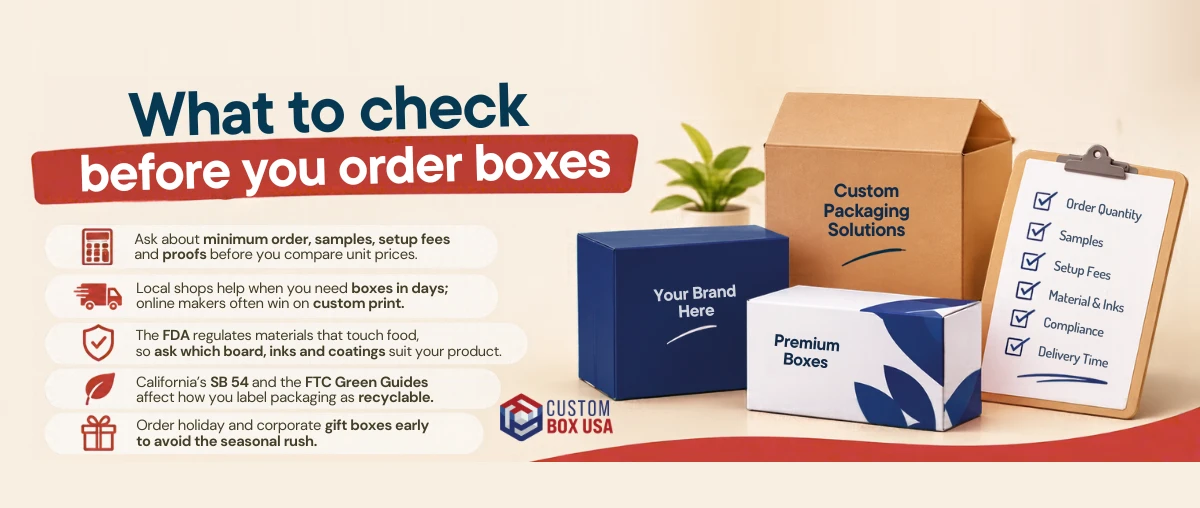
What to check before you order boxes
Which Box Types Fit LA Food, Gift and E-commerce Brands?
Match the box to the product first and the look second. A pretty box that crushes your cake isn't a win.
What works best for custom food packaging in Los Angeles bakeries and cafes?
Most bakery items go in paperboard boxes, also called folding cartons. Paperboard is thin, smooth board that ships flat and folds up in seconds. It works well for cookies, donuts, muffins and slices of cake. Tall cakes need deeper boxes with a sturdy base. Our custom bakery boxes come in many styles, including tuck-end boxes (with flaps that tuck in) and window boxes.
When do you need mailer or corrugated shipping boxes?
You need them when your product travels by courier instead of across a counter. Corrugated cardboard has a wavy layer between two flat sheets. That wavy layer works like a cushion and stops the box from caving in. A mailer box is a corrugated box built to survive the mail and still look good when opened. E-commerce brands use mailers to turn every delivery into a branded moment.
What about gift, corporate and holiday boxes?
Gift boxes are all about the opening moment, so print, finish and inserts matter more. A company sending treats to clients wants a box that looks planned, not thrown together. Browse our custom gift boxes for client, staff and holiday orders. Rigid boxes (thick boxes that don't fold flat) exist for premium gifts. Still, many food gifts look great in folding or corrugated styles at a lower cost.
Should you choose a window, an insert, kraft or white?
Choose a window if your product sells by sight, and an insert if it can slide or tip. An insert is a tray or divider inside the box, a bit like an egg carton for cupcakes. Options include cardboard dividers, die-cut trays and custom foam packaging for fragile items.
Kraft is brown paper stock with a natural, earthy look, while white makes bright colors pop. We compare both in our guide on kraft vs white bakery boxes.
What Should You Ask a Box Maker Before You Order?
Ask every maker the same questions, then put the answers side by side. Here's the checklist we'd use if we were the ones buying:
- What is your minimum order quantity?
- Can I get a sample before the full run?
- Are there die, plate or other setup fees?
- How does proof approval work?
- What file types do you accept?
- What is the standard turnaround, and is rush available?
- What does shipping cost to my address?
- Which materials, inks and coatings will touch my food?
- Which printing method suits my quantity?
- How do you store and use my artwork files?
What's the minimum order, and can I get a sample first?
Minimums vary widely, so always ask. Some LA-area sellers list a few hundred boxes as their minimum, while others say there's no minimum at all. A sample is like a test drive before you buy the car. You find out whether the size fits before you pay for a full run.
Are there setup, die or plate fees?
Some printers charge them, so get the answer in writing. A die is the cutting tool that shapes your box, a bit like a cookie cutter. Plates carry the ink in some printing methods. These fees can make a small order cost far more than the first quote suggested.
How do proofs and print files work?
You approve a digital proof, and sometimes a physical sample, before anything is printed. Your art goes on a dieline, a flat outline of the box showing every fold and cut. It's like a sewing pattern, but for paper.
Next come colors. CMYK mixes four inks to make most colors, while PMS (Pantone) is one exact, pre-mixed brand color. Digital printing suits small runs, and offset suits big runs with sharp color. Screen and flexo (flexography, printing with flexible plates) fit certain jobs. Finishes add the last touch: gloss for shine, matte for a soft flat look, spot UV for shiny spots, foil for a metal look and embossing for raised designs.
How long will production and shipping take?
Ask for both numbers separately, because production time and transit time add up. A maker that quotes only production days can leave you short once shipping adds a few more.
Which materials and inks touch the food?
Ask which board, inks, coatings and glue will sit next to your food, and why they suit it. The rules here are less obvious than most people expect, so the next section explains them.
Are Custom Food Boxes Food-Safe?
Food safety depends on the materials used and how the food touches them. It isn't a stamp on a finished box.
What does the FDA actually regulate?
The FDA regulates food contact substances, meaning materials used to make, pack, ship or hold food. According to this FDA food contact substance overview, the rules focus on the materials, not on approving each finished package. The FDA doesn't inspect every box. That's why you should be wary of any seller calling a box "FDA approved."
Do inks, coatings and glue count?
Yes, if they touch the food or could pass into it. For example, a greasy donut sitting on a printed inside surface is a different case from a cake resting on a paper liner. How long the food stays in the box matters too.
What should you ask your supplier?
Tell them what the food is, whether it's oily, wet or dry, and how long it sits in the box. Then ask which materials suit that use, and ask for the material documents. Our food-safe packaging checklist for bakeries and cafes walks through it step by step. Our team can also tell you which stocks suit your product.
Which California Packaging Rules Should Small Brands Know?
Two sets of rules matter most: California's packaging law SB 54 and the federal rules on green claims. This is general information, not legal advice, so check with a lawyer or the agency about your case.
What is SB 54, and does it apply to me?
California's SB 54 packaging law sets goals for 2032. These include all covered single-use packaging being recyclable or compostable, and a 25% cut in single-use plastic packaging and foodware. The SB 54 regulations now in effect began applying in 2026.
SB 54 is an EPR law, short for extended producer responsibility. That means companies selling packaging help pay for recycling it. CalRecycle, the state recycling agency, keeps a list of which packaging counts. Very small sellers are exempt from most rules based on annual sales, but they still must sell only recyclable or compostable covered packaging by 2032. For a bakery, that's a good reason to lean toward paper-based boxes now.
Can I print "recyclable" or "eco-friendly" on my box?
You can print "recyclable" only if it's true for most of your buyers. The FTC Green Guides (16 CFR Part 260) set the federal rules for green words on packaging. Under the FTC Green Guides 60% rule for recyclable claims, you should qualify the claim if recycling isn't available to at least 60% of the people or communities where you sell. The guides also warn against vague words like "eco-friendly" or "green." A narrow, true claim, such as "box is recyclable," works better.
What about the recycling symbol and PFAS?
Treat the recycling symbol as a claim, and check coatings for PFAS. The chasing-arrows symbol (the three-arrow triangle) can count as saying the box is recyclable. Putting it on a box that isn't recyclable can be seen as misleading, and California has its own limits on its use.
PFAS are "forever chemicals" sometimes used in grease-proof coatings. State rules can go further than federal ones, so a coating that meets FDA rules can still break a state PFAS ban. Ask your maker what's in any grease-resistant coating.
What Mistakes Do LA Brands Make When Ordering Custom Boxes?
Most mistakes come from rushing. A few minutes of checking can save a lot of money.
Why is skipping the sample so risky?
Size is the most common problem, and you only spot it once boxes arrive. A cake box that's a little too short squashes the frosting. A cookie box that's too wide lets cookies slide and break. Measure your product with any decorations on it, then test one box.
Why can unit price fool you?
The price per box leaves out setup fees, shipping and the cost of storing boxes you don't need yet. It's like a cheap plane ticket that grows once bag fees are added. Compare the total landed cost, meaning everything you pay until the boxes reach your door.
When should I order holiday and corporate gift boxes?
Earlier than feels necessary, because makers get busy in the fall. If it's already November, start your Christmas orders now. Thanksgiving pie boxes should already be in motion.
What about printing eco claims you can't back up?
It can mislead buyers and break the rules covered above. Ask your maker which stock is recyclable or made from recycled materials, then print only what's true.
How Does Ordering From Custom Box USA Work for LA Brands?
We're based in Anaheim, in Orange County, right next to LA County. We ship custom boxes to Los Angeles and the rest of the country for free.
Where are you based, and how do boxes reach LA?
Our address is 3921 E La Palma Ave # Q, Anaheim, CA 92807. We offer free shipping across the USA through couriers such as FedEx and DHL. As a custom packaging company serving Los Angeles brands, we run the whole process online, so you never need to visit. You can call us at +1 (424) 447-6206 or email sales@customboxusa.com.
What's included at no extra cost?
You get free graphic design support, free USA shipping and no die or plate charges. Upload finished artwork or just send your logo, and our design team builds the layout. The minimum order is as low as 1 unit, so you can order a single sample before a bulk run.
You can choose custom sizes, materials (corrugated, paperboard, kraft and recyclable stock) and printing on the outside, inside or both. Finishes include spot UV, foil and embossing. Recyclable kraft is a popular pick for brands that care about sustainability.
What are the ordering steps, and how long does it take?
There are five steps, and standard turnaround is 8 to 10 business days.
- Configure and quote: tell us the box style, size, quantity and finish. We reply to quote requests within 2 hours.
- Design: our team places your artwork on the dieline.
- Approval and payment: you pay only after you approve the digital file.
- Production: we print and cut your boxes.
- Delivery: boxes ship free to your US address.
Rush orders take 4 to 6 days, and timing may vary with order volume and location. Over 10 years we've delivered 1500+ orders across the USA, and we're rated 4.9 from 1,159+ reviews. New customers get 20% off their first purchase. See every style on our custom boxes page.
Frequently Asked Questions
How much does custom packaging cost?
It depends on size, material, quantity, print colors, finishes and inserts. Larger orders bring the price per box down, while extras like foil or custom inserts add to it. The fastest way to get a real number is to request a quote with your exact specs.
Where can I find custom box manufacturers in Los Angeles?
Try local search, packaging marketplaces and online makers that ship to LA. Many brands now order custom packaging boxes in the USA online, because sampling and proofing work well from a distance. Compare them with the 10-question checklist above.
What is the minimum order for custom boxes in Los Angeles?
It varies by seller, from a few hundred boxes to no minimum at all. At Custom Box USA, the minimum order is as low as 1 unit.
How long does it take to get custom boxes made?
Most makers quote production time plus shipping time. Our standard turnaround is 8 to 10 business days, with a rush option of 4 to 6 days. Timing may vary with order volume and location.
Can I order just one sample box before a big run?
Yes, with makers that allow it. Our minimum is as low as 1 unit, so you can check fit, color and feel before you commit.
Are your boxes recyclable?
We offer kraft and recyclable stock, and our team can tell you which materials suit your product. Whether a box actually gets recycled also depends on local programs and on any coatings, foils or plastic windows you add.
Ready to Get Your Boxes Started?
Choosing a box maker gets much easier once you ask about minimums, samples, fees, timing and materials. Want to see how we answer those questions for your bakery, cafe, food brand or gift order? Send us your box size and quantity. You'll get free design help, free shipping across the USA and a quick reply.
Get a Free Quote and let's build a box that fits your product and your brand.