Say you just pulled a tray of honey granola out of the oven, and your farmers market booth opens Saturday. The logo is done and the labels are drafted. One question is left: shiny pouch or printed box?
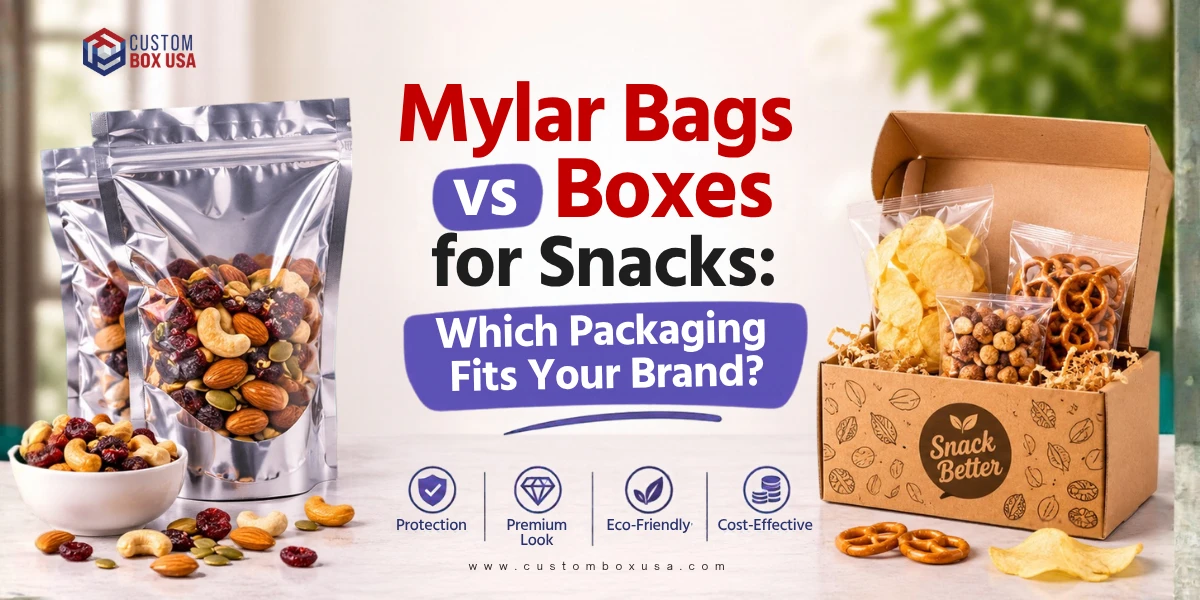
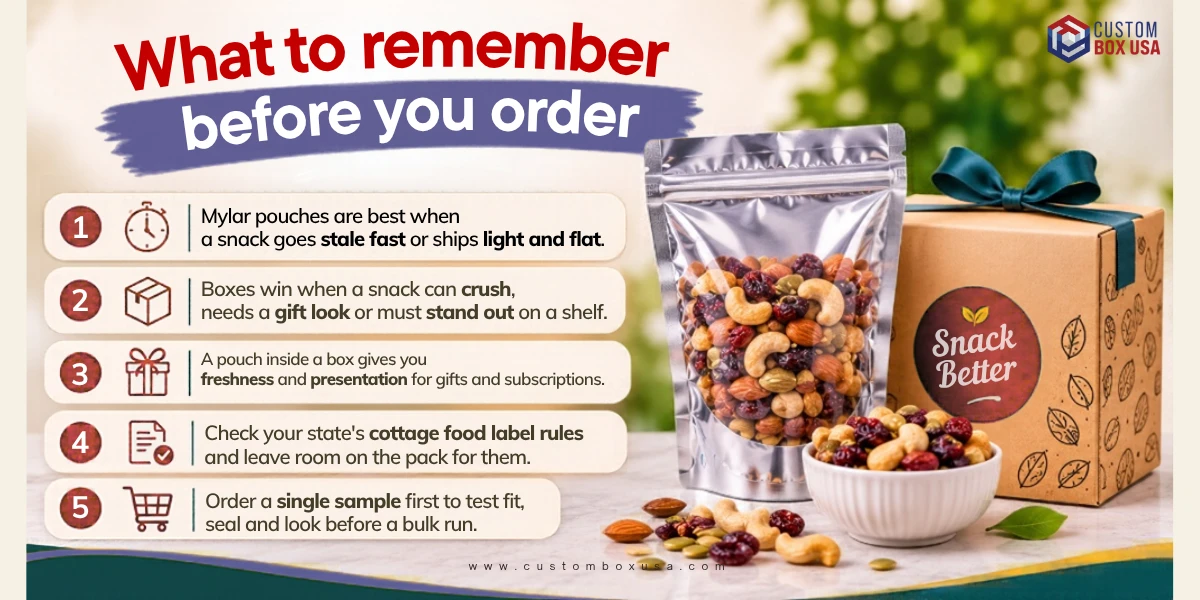
When you compare mylar bags vs boxes for snacks, start with what your snack fears most. If it goes stale fast but doesn't break easily, a mylar pouch is the safer pick. If it can crush, or it needs to look like a gift on a shelf, choose a printed box. For holiday sets, corporate gifts and subscriptions, many brands use both: a sealed pouch inside a branded box.
Quick answer: pouch, box or both?
A pouch handles freshness, a box handles protection and display, and the two together cover both jobs. Three questions settle most cases.
- Does it go stale? If air and humidity ruin it within days, it needs a barrier. That usually means a pouch.
- Can it crush? If it could break in a tote bag or a mail truck, it needs the stiff walls of a box.
- Is it a gift or a shelf item? If it has to look special, a box gives you more print space and a better unboxing experience.
Mylar pouch in one line
A light, sealed bag that keeps out air, moisture and light, and stores flat until you fill it.
Box in one line
A stiff, printed carton that protects what's inside and works as your silent salesman on the shelf.
When to use both
Use both when your snack is crisp and fragile, or when it's a gift. The pouch keeps it fresh, and the box keeps it whole and good-looking.
Mylar bags vs boxes for snacks: side-by-side comparison
"Mylar" is a trade name people use for shiny, thin plastic film. Most mylar bags are made from PET (polyethylene terephthalate), a strong, clear plastic. Many also have a metalized layer, a very thin metal coat inside the film that helps block light, air and water vapor.
| Factor | Mylar pouch | Printed box |
|---|---|---|
| Freshness (barrier) | Strong when heat-sealed; keeps out air, moisture and light | Paperboard alone doesn't stop air or moisture; needs an inner bag or liner for crisp snacks |
| Print space and shelf look | Two big panels (front and back); flat-bottom styles add sides | Six sides to print, plus the inside; stacks neatly on shelves |
| Crush protection | Low; soft sides bend under weight | Higher; stiff walls hold their shape |
| Storage before filling | Stores flat in a small space | Usually ships flat but takes more room once folded |
| Sealing and assembly | Needs a heat sealer for a full seal | Fold and tuck by hand; no special tool |
| Cost drivers | Film layers, zipper, window, print colors, order size | Board type, size, finishes, inserts, order size |
| Recycling | Limited; many-layer films are hard to recycle | Kraft and paperboard boxes are recyclable |
Freshness
Packaging makers rate barrier with two measures. OTR (oxygen transmission rate) shows how much oxygen gets through, and MVTR (moisture vapor transmission rate) shows how much water vapor gets through. Lower is better for both. A sealed metalized pouch usually beats a plain paper box by a wide margin, which is why chips and coffee rarely come in a plain carton.
Thickness
Film thickness is listed in mils or microns. One mil is 0.001 inch. Thicker film stands up better to sharp pretzel ends and nut shells.
Cost drivers (no guesswork)
Pouches are light and flat, so they often cost less to store and ship. A zipper, a window or extra film layers all add to the price. For boxes, the board, the finish (matte, gloss, spot UV or foil) and any inserts matter most. Order size changes the cost per unit for both, so the only fair comparison is a real quote for your exact size.
What to remember before you order
Which snacks fit a pouch, and which fit a box?
Dry, crisp snacks that don't break easily suit pouches. Fragile, sweet or gift snacks suit boxes. Here's how common US snacks line up.
| Snack type | Best pick | Why |
|---|---|---|
| Granola, trail mix, dried fruit | Stand-up pouch with zipper | Goes stale with air; eaten in portions over days |
| Chips and pretzels | Pouch | Needs a strong moisture barrier; light to ship |
| Popcorn | Box or bag | Boxes are great for events and gifts; bags keep it crisp longer |
| Cookies, brownies, bars | Box with a window, inner bag if shipped | Breaks easily; shoppers like to see it |
| Chocolate and truffles | Box | Needs shape, inserts and a gift look |
| Coffee or tea | Pouch inside a box for gifts | Pouch protects aroma; box adds presentation |
| Greasy or oily snacks | Pouch, or box with a liner | Grease can soak into plain paperboard |
Selling something oily, like spiced nuts or kettle corn? Ask our team which board and lining suit it before you settle on plain paperboard. You can browse common styles on our custom snack packaging page.
Three example situations, walked through
These examples are made up, but they match the questions small food brands ask us most. Each one covers the goal, the options and the safer choice.
Situation 1: Homemade granola at a farmers market
The goal: granola that stays crunchy until the last handful, looks good on a table and doesn't cost much in small batches.
The options: a kraft tuck-end box (a folding box with flaps that tuck in at the top and bottom), or a stand-up pouch with a zipper.
The safer choice: the pouch, with a zipper and a tear notch, which is a small cut that lets buyers open the bag by hand. It keeps air out, stands up on your table and closes again at home. A box would look nice, but without an inner bag the granola would slowly lose its crunch.
Situation 2: A small bakery shipping cookies across the country
The goal: cookies that arrive whole and fresh, in a box people want to post online.
The options: cookies in a pouch alone, or a printed cookie box.
The safer choice: a printed box, with each cookie or stack sealed in an inner bag. A pouch alone keeps cookies fresh but does almost nothing against crushing. Our custom cookie boxes with a window hold their shape and let shoppers see the cookies in your store. For the mail, put the retail box inside a corrugated shipper, which is cardboard with a wavy middle layer built for shipping.
Situation 3: A company ordering holiday snack gifts for clients
The goal: a gift that feels special, travels well and stays fresh until the client opens it.
The options: a branded gift box with loose treats, or sealed pouches set inside a gift box.
The safer choice: pouches inside a box. Fill small branded pouches with coffee, trail mix or candied nuts, then hold them in place with an insert. The pouches handle freshness while the box makes the first impression. Our corporate gift boxes can be sized around your pouches.
Decision table: match your situation to a choice
| Your situation | Choose | Main reason |
|---|---|---|
| Crisp snack sold in person | Stand-up pouch | Freshness and low storage space |
| Crisp snack sold on store shelves | Flat-bottom pouch or pouch in a box | More print area and a neat shelf look |
| Fragile baked goods sold in a shop | Box with a window | Protection and visibility |
| Fragile snacks shipped by mail | Sealed inner bag + box + shipper | Freshness and crush protection |
| Holiday or corporate gift | Pouch inside a gift box | Freshness plus presentation |
| Monthly subscription box | Several pouches in one printed box | Light to ship, fun to open |
Stand-up pouch vs box: which suits a small brand starting out?
For most new snack brands, a stand-up pouch is the lower-risk start. A box usually comes in later, when you add gifts or retail shelves. Your snack still has the final say.
How each stands and prints
A stand-up pouch, sometimes called a doypack, has a gusset at the bottom: a fold that opens up so the bag can stand. A flat-bottom pouch adds a flat base and side gussets, so it looks like a small box and gives you more print area. A box has six flat sides, so a long ingredient list, a short brand story and a logo can all fit without crowding.
Resealing and portions
Pouches can have a zipper, a press-to-close strip that lets customers reseal the bag. That suits snacks eaten a handful at a time. A box can't reseal a snack well without an inner bag, so it works better for single servings and gift sets.
Planning for a heat sealer
A heat sealer is a tool that melts the top edge of a bag shut. Even zipper pouches are usually sealed above the zipper, so the bag stays airtight and shows if anyone opened it. Budget for a sealer before you order pouches. Boxes need no tool, which is a quiet advantage for a one- or two-person team.
What is the best packaging for homemade snacks?
Good packaging for homemade snacks is food-grade, fits the snack snugly and leaves clear space for the label your state requires. Many home sellers start with pouches for dry snacks and boxes for baked goods.
Label basics and state rules
Cottage food laws are state rules that let people sell certain homemade foods, and each state sets its own label rules. In Minnesota, labels must show the maker's name and registration or address, the date made, ingredients, allergens and a statement that the food is homemade and not state-inspected. Text must be at least 10-point and in English, according to University of Minnesota Extension cottage food labeling guidance. A QR code can add details there, but it can't replace the required text.
Labels usually have a principal display panel, the front of the pack shoppers see first, and an information panel for the details. Check your own state's rules before you print anything.
Allergens and where to put them
Major allergens such as milk, eggs, fish, shellfish, peanuts, tree nuts, wheat, soy and sesame need to be easy to find. On a pouch, put them on the back panel near the ingredients. On a box, a side panel works well. If your design is busy, leave a plain white area for a printed label, so you can update details without reprinting the whole pack.
Sample first, then scale
Our minimum order goes as low as one unit, so you can test a single sample before a bulk run. Fill it with your real snack, seal it, carry it around for a day and check the label space. That small step catches most sizing mistakes while they're still cheap to fix. Ask our team about the free sample option too.
Are mylar bags food safe and recyclable? What to ask
Mylar bags can be made with materials meant for food contact, but always ask the maker which film and inks suit your snack. Recycling options are more limited for pouches than for paper boxes.
Questions to ask any packaging maker
In the US, the FDA regulates food contact substances: any material that touches food, such as plastics, coatings, inks and glue. The FDA guide to food contact material status says materials used under a listed rule in 21 CFR parts 174 to 179 need no further FDA review. (21 CFR is the part of federal law that holds US food rules.) Other routes are GRAS status, short for "generally recognized as safe," or a Food Contact Notification, which is how a maker tells the FDA about a new food-contact material.
- Which material will touch my snack directly?
- Is the inside layer suited to greasy, salty or acidic foods?
- Where is the ink printed: outside only, or inside too?
- Do I need an inner liner for this product?
Our team can walk you through these answers for your product before you order.
Kraft and recyclable-stock boxes
If your buyers care about sustainability, boxes are the easier story to tell. Our kraft boxes use brown, natural-looking paper and are recyclable. We also offer recyclable stock for printed paperboard boxes.
What to know about pouch recycling
Most curbside bins don't take plastic bags or film. Films marked with resin code #2 or #4 (a small number in a triangle that shows the plastic type) can usually go to store drop-off bins, according to Plastic Film Recycling store drop-off info. Many-layer mylar pouches with metal coats usually don't fit those streams. Pouches made mostly from one plastic type are easier to recycle. Even so, we'd advise against printing "recyclable" on a pouch, since some states have tightened the rules on that word.
5 common mistakes to avoid
Most packaging regrets come from a few small choices made too fast. These are worth a second look.
- A box with no inner barrier for crisp snacks. Paperboard alone lets humidity in, and chips go soft.
- A thin pouch for sharp or heavy snacks. Nut shells and pretzel tips can poke holes in thin film, so ask about a thicker gauge.
- Shipping fragile cookies in a pouch alone. That's how you end up with crumbs and refund requests. Add a box.
- The wrong size, or no label space. A half-empty pouch looks cheap, and a crowded design leaves no room for allergens.
- Calling a pouch "recyclable" without proof. Stick to claims you can back up.
Snack packaging ideas that work in the US
The best snack packaging ideas pair a pouch and a box so each does the job it's good at. Here are four that small brands use often.
- Pouch in a window box: a sealed clear-front pouch inside a box with a window cutout. Shoppers see the snack, and it stays fresh.
- Holiday and corporate gift sets: three or four small pouches in a printed gift box, held in place by an insert.
- Subscription snack boxes: a mix of pouches in one printed box that turns every delivery into a branded moment.
- Kraft sleeve over a pouch: a printed paper sleeve slid over a plain pouch. It looks premium without a separate print run for every flavor.
One caution on windows: they let light in. If your snack fades or turns bitter in light, as coffee and some nuts do, choose a solid pouch and show the product in a photo instead.
How to order custom snack packaging
Ordering takes five steps: configure and quote, design, approve, produce and deliver. You choose every detail, and our team helps with the artwork.
Pick style, size, material and print
Choose a pouch, a box or both. Sizes, materials, finishes and printing are all custom, and boxes can be printed on the outside, the inside or both. See the options on our custom mylar bags for food page.
Free design support
Upload finished artwork, or just send your logo. Our designers place it on a dieline, which is a flat map of your pack showing where it folds and gets cut. There are no die or plate charges.
Order a single sample
Check fit, seal and look with one unit before you commit to a full run.
Quote, approval, production, delivery
You pay only after you approve the digital file. Standard turnaround is 8 to 10 business days, and rush orders take 4 to 6 days, though timing can vary with order volume and location. Shipping is free across the USA. If you searched for custom mylar bags in NYC or custom mylar bags near me, a local shop isn't your only option: we ship from Anaheim, CA to every state.
Frequently Asked Questions
Are mylar bags better than boxes for snacks?
Mylar bags are better for freshness, and boxes are better for protection and presentation. Decide by asking whether your snack mostly fears air or crushing. For gifts, use both.
Do mylar bags keep snacks fresher than paper boxes?
Yes. A heat-sealed mylar bag usually keeps snacks fresher than a paper box on its own. Paperboard doesn't block air or moisture well, so crisp snacks in a box need an inner bag or liner.
Can you ship snacks in mylar bags?
Yes. Sturdy snacks like granola or jerky ship well in mylar bags inside a padded mailer or carton. Fragile snacks such as cookies need a box around the pouch to avoid breakage.
Can you use a mylar bag and a box together?
Yes, and it's one of the most popular setups for gifts and subscriptions. The pouch keeps the snack fresh, while the box protects it and carries your branding.
What is the difference between a stand-up pouch and a flat-bottom pouch?
A stand-up pouch has one folded gusset at the bottom. A flat-bottom pouch has a flat base plus side gussets, so it stands steadier and gives you more print area, much like a small box.
Are mylar bags food safe?
Mylar bags can be made with food-contact materials, but confirm with your maker which film and inks suit your snack. Ask our team, and see the FDA food contact guidance linked above to learn how these materials are regulated.
Next step: Get a Free Quote
If your snack fears air, start with a pouch. If it fears crushing or needs to impress, choose a box, and for gifts, put one inside the other. Still unsure? Tell us your snack and where you sell it, and our team will suggest a setup. You get free design support, free shipping across the USA and 20% off your first purchase, and quotes usually come back within 2 hours.
Get a free quote and order a single sample before you commit.