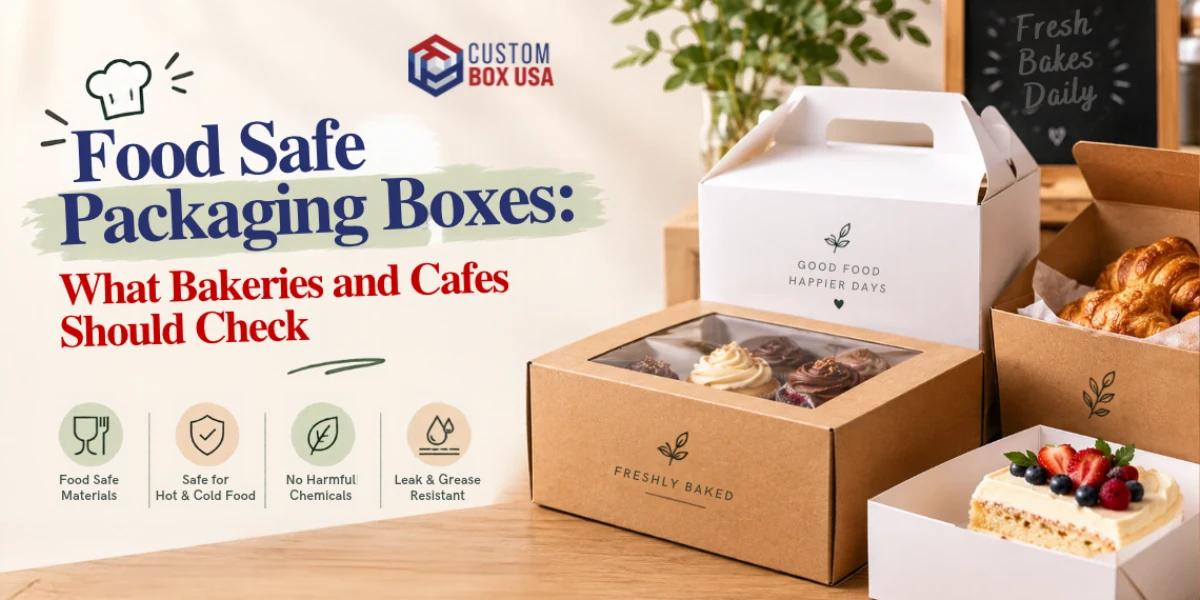
A lot of bakery owners see "food safe" on a product page and stop asking questions. That's a mistake. Real food safe packaging boxes need every part to suit the food inside: the board, the coating, the ink, the glue and the window film. One label can't prove all of that.
Here's a better plan. Sort your menu by food type, check each part of the box, and get a written statement from your supplier before you print. It's mostly a handful of clear questions. The same steps work for a bakery counter in Ohio, a cafe pastry case in Seattle or a farmers market stall in Texas.
| Quick answer | Details |
|---|---|
| What you need | A list of what you pack (dry, buttery, creamy or hot), your box sizes, and a short list of questions for your supplier. |
| Time | One supplier conversation, plus a few days to test a sample box with your own products. |
| Result | Boxes that suit your food, hold up to grease, and look clean when your customer opens them. |
What does "food safe" mean for a bakery box?
It means every material that can touch your food is allowed for that use under US rules. "Food safe" and "food grade" are everyday phrases. On their own, they are not a legal stamp.
Food contact in plain words
The FDA is the US government agency that sets safety rules for food and for anything that touches it. In FDA terms, a food contact substance is any material that touches food or could pass into it. Paper, ink, coating and glue all count.
The main worry is migration. That's when tiny amounts of a chemical move from the box into the food. Food contact packaging rules exist to keep that within safe limits.
Two more terms help. Direct contact means the food sits right on the box surface. Indirect contact means a liner or wrapper sits between the food and the box. Paper and paperboard rules live in 21 CFR Part 176 (Paper and Paperboard Components), part of Title 21 of the Code of Federal Regulations.
Why "FDA approved box" is not quite right
The FDA regulates the parts of a package, such as paper, coatings, inks and glue. It does not approve each printed bakery box one by one. So when a seller writes "FDA approved box," read it as shorthand, not proof.
The FDA guide to the regulatory status of food contact materials explains that a component covered by a rule in 21 CFR Parts 174 to 179 needs no further FDA review. Some materials are GRAS, short for "Generally Recognized as Safe," for their intended use. Newer materials can go through a Food Contact Notification (FCN), a filing a company sends so the FDA can review it.
From your supplier, you want a letter of guarantee or compliance statement. That's a written note saying the material meets FDA rules for certain foods and uses.
Wet, fatty and dry foods: which rule applies
Paper rules split by food type, and it's easy to miss. Section 176.170 covers paper and board that touch aqueous (watery) and fatty (butter or oil) foods, coated or not. Section 176.180 covers paper and board that touch dry food only.
- Fatty or wet: butter croissants, cream cakes, glazed donuts, fruit pies.
- Dry: crisp biscotti, plain hard cookies, dry crackers.
Rule 176.170 also includes an extractives test, a lab check of what can come out of the box surface. If you sell buttery or creamy items, ask whether your board suits fatty foods, not just dry ones.
Are cardboard boxes food safe?
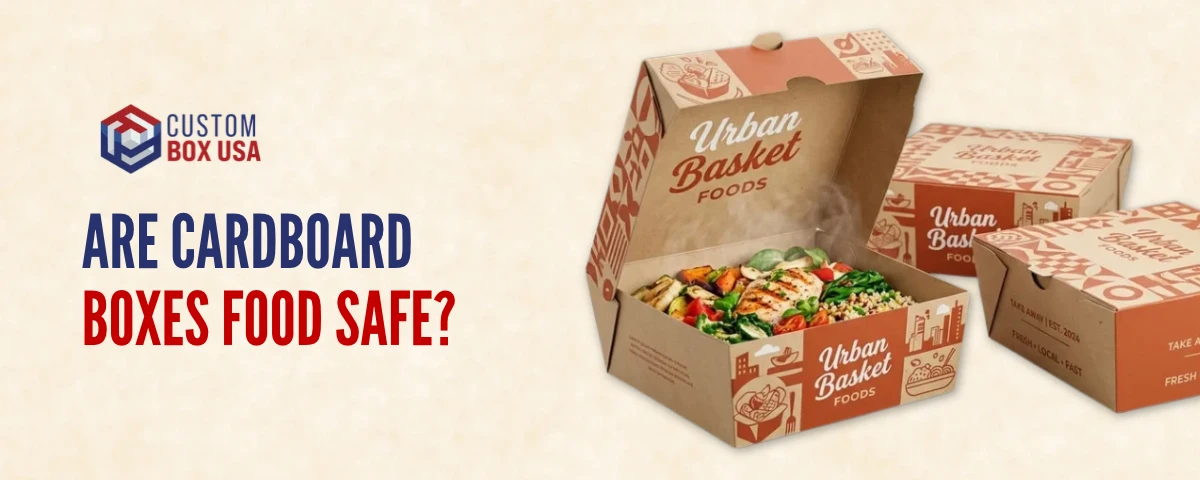
Cardboard can be food safe when it's made for food contact and kept clean and dry. A random shipping box or a reused produce box is a different story.
Paperboard and kraft vs corrugated
"Cardboard" covers a few materials. Here's how they compare in a bakery:
- SBS paperboard: smooth, bright white board (SBS stands for solid bleached sulfate). It's a common pick for printed cake, cookie and pastry boxes.
- Kraft paperboard: strong brown board made from wood pulp. It gives a natural look.
- Corrugated board: board with a wavy layer in the middle, called the flute. It's built for strength and shipping.
Food safe cardboard boxes for direct contact are usually paperboard or kraft made for that use. Food safe corrugated boxes often work best as the outer layer. For example, if you ship cookie tins or boxed pastries, food safe shipping boxes protect the inner packs, while the food sits in its own box or wrap.
When a liner or coating helps
A barrier coating is a thin layer that slows grease and moisture. It's often water-based, which is called an aqueous coating. A glassine or parchment liner is a smooth, greaseproof sheet placed under the food. A liner turns direct contact into indirect contact, so you get an extra layer of protection.
Why you should not reuse boxes that held raw food
Don't reuse old boxes for food. The advice from Michigan State University Extension on cardboard and food storage is clear: only food-grade containers should store food. Cardboard that held raw food can soak up moisture and let bacteria grow. And unlike a hard container, it can't be cleaned and sanitized.
Grease resistant bakery boxes: what to check
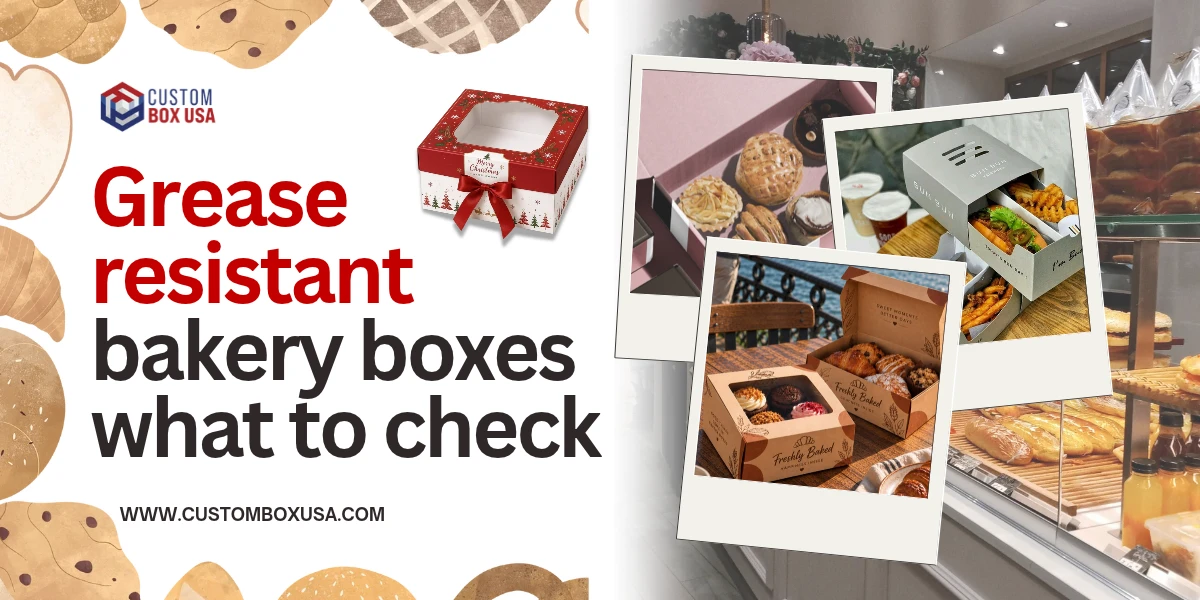
Look for a grease barrier in the board or a liner inside it. Then ask what that barrier is made of. If a supplier can't tell you, keep asking or look elsewhere.
Why butter and oil soak through
Paper is made of fibers with tiny gaps between them. Warm butter and oil creep into those gaps. The result is grease bleed, a dark oily patch that spreads across the box. Your logo ends up next to a stain, which is not the first impression you paid for.
Coatings, liners and glassine
A grease-proofing agent is anything added to paper so oil doesn't soak through. Today that usually means a barrier coating on the inside surface. For very rich items, a glassine or parchment sheet adds a second line of defense. Many bakeries use both: coated board for the box, plus a liner for the stickiest bakes.
PFAS: the short history and what "PFAS-free" means today
PFAS are man-made chemicals often called "forever chemicals." For years, some were used to make paper repel grease in pizza boxes, fast food wrappers and microwave popcorn bags. That history is why so many bakery boxes now say "PFAS-free."
On February 28, 2024, the FDA announced that PFAS grease-proofing agents were no longer being sold for food packaging. In January 2025, the agency found that all remaining authorized uses were no longer effective. It set a June 30, 2025 compliance date to use up old stock. The details are in this FDA document on the PFAS grease-proofing phase-out.
So what should "PFAS-free" mean on a box you buy today? It should mean the grease barrier doesn't use PFAS. Get that in writing from your supplier.
How it works: every part of the box counts
The board is only one part. Ink, varnish, glue, window film and inserts can all touch food or sit close to it, so each one needs to suit food use.
Inks and varnish
Varnish is a clear layer printed over ink for shine or protection. The simplest habit is to keep printing on the outside, away from the food. Want a printed inside for a fun reveal? Ask your supplier which inks and coatings suit that use, or add a liner.
Window film
A window patch is clear film over a cut-out so customers can see the treat. Frosting often presses against it. That makes the film food contact packaging too, so ask what it's made of.
Glue
Glue holds the corners and the window in place. It rarely touches food directly, but it can sit right beside it. Put it on your question list.
Inserts and dividers
Cupcake inserts, cookie dividers and cake boards often touch food directly. Ask about them the same way you ask about the box.
How to check food safe packaging boxes in 7 steps
Work through these steps before you place a print order. Each takes a few minutes and can save you from a stack of boxes that don't fit your menu.
1. Sort your menu by food type
Split your items into four groups: dry, buttery or oily, creamy or wet, and hot. A cafe might have dry biscotti, buttery croissants, cream cheese brownies and warm breakfast pastries. Each group may need a different box setup.
2. Decide on direct or indirect contact
Will the food sit on the board or on a liner? For buttery and creamy items, a liner is a simple way to add protection and keep the box clean.
3. Pick the base board
Choose white SBS for bright, sharp print, kraft for a natural look, or corrugated for shipping strength. Match the choice to the food and to how far it travels.
4. Add grease and moisture protection
For fatty foods, ask for grease resistant board or a coated inner surface. For very rich items, add glassine or parchment too.
5. Check print, window and glue
Keep ink and varnish on the outside. Confirm the window film and glue suit food use, and ask about every insert or divider.
6. Ask for documents in writing
Request a compliance statement that names the food type (dry, fatty or wet) and the use. A one-line "FDA approved" in an email doesn't count.
7. Test a sample with your own product
Put a real croissant or frosted cupcake in a sample box. Leave it for as long as a customer would, then check for stains, soft corners and smudged print. This step catches problems no spec sheet will.
Which box setup fits your baked goods?
Match the box to the food. Dry items need less protection. Buttery, creamy and hot items need a barrier, a liner, or room to breathe.
| Food type | Suggested setup | What to ask the maker |
|---|---|---|
| Dry cookies and biscotti | Paperboard or kraft, printed outside | Is the board suited to dry food contact? |
| Croissants, shortbread and pies | Grease resistant board plus a parchment or glassine liner | Is the board suited to fatty foods? What is the grease barrier made of? |
| Cream cakes and frosted cupcakes | Sturdy board, insert to stop sliding, window film kept off the frosting | Is the window film suited to food contact? Can you add an insert? |
| Donuts and muffins | Coated or grease resistant board, liner for glazed items | How does the inner surface handle glaze and oil? |
| Chocolates and gift assortments | Paperboard with dividers or inserts, foil or embossing outside | Are the inserts and dividers suited to food contact? |
| Hot savory pastries | Box with vent holes, never sealed tight | Will the board stay firm with steam? Is it rated for heat? |
A quick word on heat. A bakery box is made to carry food, not to heat it. If you need microwave safe food packaging boxes, say so at the start and ask what the material is rated for. For everyday counter boxes, browse our custom bakery boxes. For layer cakes and cupcakes, our custom cake boxes come with insert options.
Kraft or white board for a bakery?
Both work well. Pick by the look you want and the food you pack, and check food contact suitability either way.
Look and print quality
White board shows bright colors and fine detail, so it suits detailed logos and colorful designs. Kraft gives a warm, handmade feel that fits artisan bread, cookies and farmers market goods. Darker inks read best on kraft, because the brown base dulls light colors. If that natural look fits your brand, see our custom kraft boxes.
Recyclable and recycled-content wording
Keep eco claims simple and true. Say "recyclable" or "made from recycled materials" when that's accurate for your box. Skip words like "compostable" or "biodegradable" unless you have a certificate for that exact material. For recyclable stock, explore our eco-friendly packaging options.
Common mistakes and fixes
Most box problems come from a few small misses. Here are the usual ones and how to fix each.
| Mistake | Fix |
|---|---|
| Trusting a "food safe" label alone | Ask for a written compliance statement for your food type |
| Checking only the board | Ask about ink, varnish, glue, window film and inserts too |
| Plain kraft for butter-heavy items | Use grease resistant board or add a liner |
| Reusing shipping or produce boxes | Use new boxes made for food |
| Sealing hot items in a closed box | Add vent holes so steam can escape and the board stays firm |
| Storing boxes on the floor of a damp back room | Keep boxes dry, closed and off the floor |
| Skipping the sample | Test one box with your real product before a bulk run |
Pro tips for ordering food boxes
Start small, test with your own bakes, then scale up. Your box is your silent salesman, so it should look as good on day three as on day one.
- Order one sample first. Custom Box USA has a minimum order as low as 1 unit, so you can test a single box before a bulk run.
- Size it to the food. A snug box stops cakes and cookies from sliding. We make custom sizes, materials, finishes and printing, with no die and plate charges.
- Use free design help. Our free graphic design support works from full artwork or just your logo. We can print your logo on food boxes inside, outside or both.
- Ask about materials. Tell our team what you pack and ask which materials suit your product.
- Plan for timing. Standard turnaround is 8 to 10 business days, and rush orders take 4 to 6 days. Timing can vary with order volume and location.
- Book holiday boxes early. Leave time for a sample test before the Thanksgiving and Christmas rush.
Shipping is free across the USA. For takeout, coffee and snack lines, see our full range of food and beverage packaging.
Frequently Asked Questions
What does food grade mean for a box?
It means the materials are made for use with food, but the phrase alone is not a legal stamp. Ask which food types the board suits and get the answer in writing. Food grade boxes for baked goods should suit fatty foods if you sell buttery items.
Do bakery boxes need to be FDA approved?
No, because the FDA doesn't approve individual boxes. It sets rules for the materials used in packaging. What you want is a compliance statement showing the materials meet those rules for your food and use.
Can baked goods touch kraft paper directly?
Yes, if the kraft is made and documented for food contact. For dry cookies, that's often all you need. For buttery or glazed items, add a parchment or glassine liner so grease doesn't soak in.
How do I stop grease soaking through a bakery box?
Use grease resistant board, a liner, or both. Let warm items cool a little before you close the box. Then test a sample with your richest product to see how it holds up.
Are grease-resistant boxes PFAS-free?
New grease resistant boxes sold in the US should not use PFAS grease-proofing agents, since the FDA phase-out had a June 30, 2025 compliance date. Still, ask your supplier to confirm in writing what the grease barrier is made of.
Are Custom Box USA food boxes food safe?
The right answer depends on what you're packing. Tell our team whether your items are dry, buttery, creamy or hot, and ask which materials, coatings and liners suit your product.
Are your boxes recyclable?
We offer kraft and recyclable stock for brands that want greener packaging. Ask our team which options fit your product and your local recycling rules.
Next step: get boxes that suit your food
Safe, good-looking bakery boxes come down to four checks. Match the box to your food, look at every part, ask for documents and test a sample. Then turn every pickup into a branded moment.
Tell us what you bake, the sizes you need and the look you want. Our team replies to quote requests within 2 hours, with free design support and free USA shipping. Get a Free Quote today.