The classic mistake looks like this: a soft, room-temperature cake goes into a loose box with slow shipping on a Thursday. That cake slides, sweats and sits warm in a warehouse all weekend.
Here's how to ship a cake the right way. Chill or freeze it until firm, then fix it to a cake board and set it in a snug cake box. Put that box inside an insulated shipping box with cold packs, and send it overnight early in the week. The steps below cover each part, plus the right boxes, the labels and what changes for cupcakes, cheesecake and tiered cakes.
| Stage | What you need | Time | Result |
|---|---|---|---|
| Prep | Fridge or freezer space | Overnight or longer, until firm | A cold cake that holds its shape |
| Pack | Cake board, non-slip mat, wrap, cake box, insulated outer box, gel packs, void fill, tape, labels | One short packing session once supplies are ready | A cake that can't slide or tip |
| Ship | Overnight or 2-day service | Monday to Wednesday | The cake arrives cold and in one piece |
Can You Ship a Cake in the Mail?
Yes. You can mail a cake within the US, but if it spoils or breaks on the way, that risk is yours. Good packing and fast delivery are what make it work.
What USPS and USDA say about perishable food
A cake with cream, cheese or dairy frosting counts as perishable food, meaning food that can go bad when it gets warm. Under USPS Publication 52, perishable matter rules, you can mail perishables at your own risk. They must be packed properly and delivered fast enough that they don't spoil.
The USDA mail order food safety guidance is more specific. Send perishable food as fast as possible, ideally overnight, and mark the package "Keep Refrigerated." The food should arrive frozen, partly frozen or below 40°F, checked with a food thermometer. The USDA says these rules cover food you mail from home too, not only companies.
Selling cakes? Check your state's cottage food law as well. These are state rules for selling food made in a home kitchen, and they can affect whether you're allowed to ship to buyers in other states.
Which cakes ship best
Dense cakes travel well. Tall, soft and cream-filled cakes are the hardest. Check this table before you promise a customer anything.
| Cake type | Ship whole? | Chill or freeze | Best box and insert | Risk |
|---|---|---|---|---|
| Pound, bundt or king cake | Yes | Freeze works well | Snug cake box or a pan with a lid, inside a shipping box | Low |
| Buttercream layer cake | Yes, with care | Chill or freeze until frosting is hard | Cake box with board, non-slip mat and cake collar | Medium |
| Fondant cake | Yes, with care | Chill; watch for sweating as it warms | Cardboard cake box, tall enough for decorations | Medium to high |
| Cheesecake | Yes | Freeze | Double-boxed, with extra cold packs | High |
| Cupcakes | Yes | Chill | Box with a cupcake insert | Medium |
| Cake slices or cake jars | Yes | Chill or freeze | Small boxes or jars packed tight | Low |
| Tiered cake | Only taken apart | Freeze each tier | One box per tier | Very high |
A king cake is one of the easy ones. It's a bread-like ring cake, so the best way to ship a king cake is the same as a bundt. Freeze it, wrap it tight and pack the sugar topping or icing in a small separate bag.
What Is the Best Box for Shipping a Cake?
Use two boxes: a snug cake box inside a sturdy, insulated corrugated shipping box. The inner box shows off the cake. The outer box protects it.
Box-in-box: inner cake box plus outer shipping box
The inner box holds the cake on its board and keeps its shape. Your customer opens this one, so it's where your logo and colors belong. The outer box takes the knocks from trucks and sorting belts.
For that outer layer, choose corrugated shipping boxes. Corrugated cardboard has a wavy middle layer glued between two flat sheets, which makes it stiff and strong. Double-wall corrugated has two wavy layers, so it's a good pick for heavy or tall cakes. Line it with an insulated liner, a foam or foil layer that slows heat from getting in.
Corrugated, kraft or white? Window or no window?
For the inner cake box, kraft paperboard gives a brown, natural look. White paperboard shows bright, clean print and makes colors pop. Both work, so pick the one that fits your brand.
Windows look great on a bakery counter, but in the mail they're a weak spot that can dent. For shipped cakes, a solid lid is the safer choice. Cardboard has one more advantage: university extension advice on moving cakes notes that cardboard cake boxes "sweat" less than plastic carriers. Less sweating means less water on your frosting.
Custom size, logo and a sample before a bulk order
Fit matters more than most people expect. A box sized to the cake needs less filler and leaves less room to slide. Standard cake box sizes don't always match your pans, though.
With custom cake boxes from Custom Box USA, you choose the size, material, finish and print. That includes cake boxes with logo printing on the outside, inside or both. Not sure what fits? Our cake box size chart shows you how to measure.
With our free design support, you can upload finished artwork or just send your logo. Orders start at 1 unit, so you can test a single sample box with a real cake before you buy cake boxes wholesale or in bulk. Tell our team what you bake and how you ship, and we'll help you pick materials that suit it.
What to Remember Before You Ship
How to Ship a Cake: 7 Packing Steps
Do these in order. Each step guards against a different way a cake can fail: heat, sliding, crushing or rough handling.
1. Chill or freeze the cake
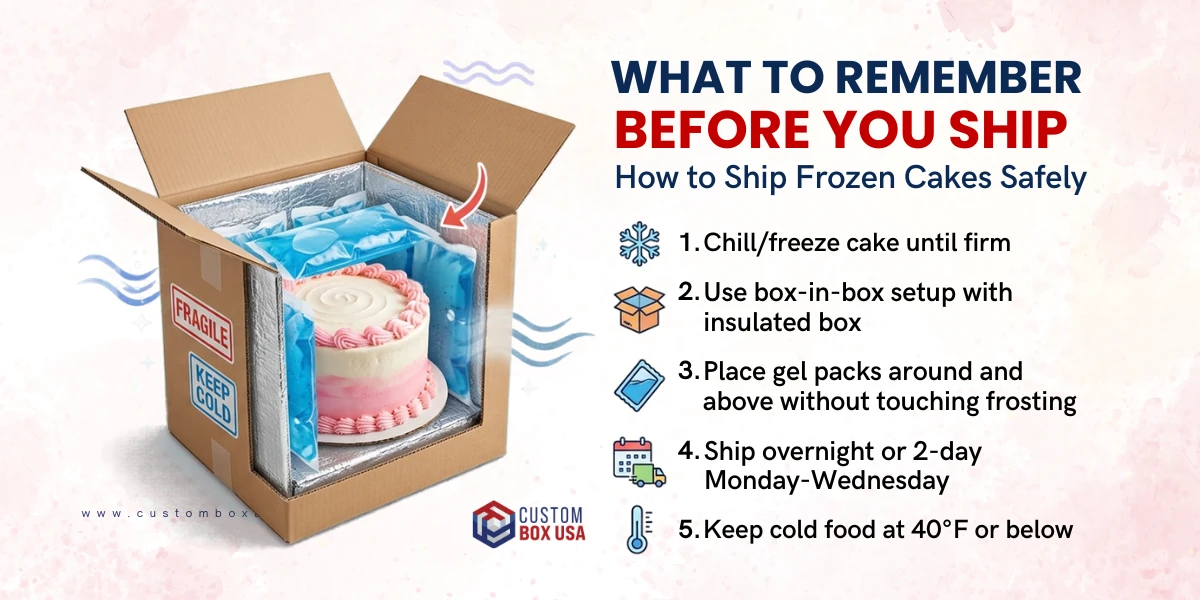
Cold cake is firm cake, and firm cake keeps its shape when the box gets bumped. Chill buttercream cakes until the frosting feels hard to the touch. For longer trips, freeze the cake overnight or longer; common shipping advice suggests about 48 hours. Freeze decorated cakes uncovered first, then wrap them once the frosting is set so the wrap doesn't stick.
2. Fix it to a cake board
A cake board is a stiff cardboard base that keeps the bottom from bending. Match it to the cake size and use a dab of frosting to hold the cake in place. Inside the box, put a non-slip mat (a grippy rubber sheet) under the board. Tall cakes also need dowels, which are rods pushed into the layers to hold them up so they don't sink or lean.
3. Wrap it
Wrap dense, plain cakes tightly in plastic wrap, then foil. For decorated cakes, put a cake collar around the sides first. That's a clear plastic strip that shields the frosting. Then cover the top loosely.
For long trips, the University of Georgia tips for mailing food suggest skipping the frosting and sending a dry frosting mix instead. If the cake has far to go, that's a fair trade.
4. Put it in a snug cake box
Choose a box only slightly larger than the cake on its board, and center the cake inside. Tape the box corners to stiffen them. Close the lid gently so it doesn't press on the decorations.
5. Add the cold source
Line the outer box with foam or an insulated liner and set the cake box inside. Place gel ice packs around and on top of the cake box. These are frozen packs filled with a gel that holds the cold. Cold air sinks, so the packs on top do a lot of the work. Keep every pack outside the cake box, never touching the frosting.
Dry ice is frozen carbon dioxide. It's far colder than gel and gives off gas, so the box must never be airtight. The FedEx dry ice shipping steps call for at least 5–10 pounds of dry ice for every 24 hours in transit. FedEx also says never to seal dry ice in a plastic bag, and not to use foam as the outer box unless FedEx approves it first. Other carriers set their own rules, so check yours before you ship.
6. Fill gaps and seal
Fill every empty space with void fill (also called dunnage), such as crumpled paper, foam or bubble wrap. Close the box and tilt it gently. If you feel anything shift, add more filler. Then tape every seam of the outer box.
7. Label the box
Mark the outer box "Perishable" and "Keep Refrigerated." Add "This Side Up" arrows on every side and a "Fragile" label. Shipping with dry ice? Mark the box "Dry ice" or "Carbon dioxide solid" with the weight in kilograms, and follow your carrier's other dry ice rules. Finish with a clear return address.
How It Works: Why These Steps Keep a Cake Safe
A cake fails in transit for two reasons: it gets warm, or it moves. Every step above fights one or both.
On the heat side, chilling and cold packs keep the cake cold. Insulation keeps outside heat out, and fast shipping limits how long the cold has to last. On the movement side, the board stops bending and the mat stops sliding, while a snug box and filler stop shifting. Labels ask handlers to keep the box upright, but don't count on it. Pack as if the box will get flipped at least once.
How to Ship a Cake Without Damage: Common Mistakes and Fixes
Most damaged cakes come from the same few mistakes. Each one has a simple fix.
| Mistake | Why it causes damage | Fix |
|---|---|---|
| Packing a warm or soft cake | Frosting smears and layers shift at the first bump | Chill or freeze until firm |
| No cake board | The base bends and the cake cracks | Use a stiff board plus a non-slip mat |
| Box too big | The cake slides and hits the walls | Use a box sized to the cake and fill gaps |
| Gel packs touching frosting | Dents, wet spots and smudges | Keep packs outside the cake box |
| Shipping Thursday or Friday | The box can sit warm over the weekend | Ship Monday to Wednesday |
| Sealing dry ice airtight | Gas builds up inside the box | Let gas escape and follow carrier rules |
| No labels | Handlers don't know to keep it upright and cold | Add "This Side Up" and "Keep Refrigerated" |
| Not telling the recipient | The box sits on a porch for hours | Share tracking and the delivery day |
Hot-weather and cold-weather tips
In hot months, use overnight service only, add thicker insulation and pack more cold packs. Frozen cakes on long routes may need dry ice.
In cold months, heat matters less and condensation matters more. Condensation is the water drops that form when a cold item meets warmer air. It can make fondant sticky and boxes soggy. A cardboard cake box and a dry sheet of paper inside the liner help soak up the moisture.
When Should You Ship a Cake?
Ship overnight or 2-day, and send it Monday to Wednesday. That way the cake never spends a weekend sitting in a warehouse.
The 40°F and 2-hour rules in plain words
The USDA 40–140°F Danger Zone and 2-hour rule explain why speed matters. Cold food should stay at 40°F or colder, because bacteria grow fast between 40°F and 140°F. Perishable food shouldn't sit out more than 2 hours, or 1 hour when it's above 90°F. A dairy-frosted cake on a slow, warm truck can pass that limit easily.
Gel packs or dry ice? Pick by weather and distance
| Situation | Cold source | Speed |
|---|---|---|
| Cool weather, short route, chilled cake | Gel packs | Overnight or 2-day |
| Hot weather, any route | More gel packs and thicker insulation | Overnight |
| Cross-country, frozen cake | Dry ice, following carrier rules | Overnight |
| Dense pound or bundt cake, cool weather | Gel packs, often enough | 2-day can work |
For most home bakers on short routes, gel packs and overnight shipping are enough. Dry ice adds rules, handling and cost. Your shipping bill depends mostly on speed, box size, weight and how many cold packs you add, so a snug box can save money too.
Tell the buyer when to expect it
Send the tracking number and the delivery day. Ask the recipient to unpack the cake right away and put it in the fridge. The USDA suggests using a food thermometer to check that perishable food arrived below 40°F.
What Changes for Cupcakes, Cheesecake, Tiered Cakes and Slices
The basic method stays the same. What changes is the insert, how cold the cake needs to be and how many boxes you use.
Cupcakes
Use a cupcake insert, a tray with one hole per cupcake, so each one stays upright and apart. Chill them first so the frosting holds. Our guide on how to package cupcakes for delivery covers inserts in more detail.
Cheesecake
Freeze it solid, double-box it and add extra cold packs. Cheesecake is rich in dairy, so give it the strictest cold treatment of any cake here.
Tiered or decorated cakes
Honestly, we wouldn't mail a stacked tiered cake. Ship each tier frozen in its own box, with dowels ready so the buyer can stack them. Fragile toppers travel better in a small box of their own.
Slices and jars as a safer option
Cake slices and cake jars are far easier to ship. Small portions pack tight, chill fast and break less. If this is your first time shipping cake, start here.
Selling Cakes Online: Branding, Privacy and Planning
When you sell cakes by mail, the box is part of the product. Plan it early and handle customer data with care.
- Make the inner box your silent salesman. Cake box printing with your logo turns every delivery into a branded moment. Print care tips inside the lid, such as "Refrigerate right away."
- Protect customer privacy. Share only tracking and the delivery window. Keep the buyer's full address off the inner box and out of any photos you post.
- Do a practice run. Mail one test cake to a friend before you launch a shipping line. Order a single sample box first so you can check the fit.
- Plan for holiday peaks. Our standard production time is 8 to 10 business days, and rush orders take 4 to 6 days. Timing can vary with order volume and location. With Christmas coming and Valentine's Day right after, order printed cake boxes early.
- Choose recyclable where you can. Kraft boxes and corrugated outer boxes are recyclable. Foam liners and gel packs are often harder to recycle, so ask our team which materials suit your cake.
Frequently Asked Questions
Can you ship cupcakes in the mail?
Yes. Chill the cupcakes and use a box with a cupcake insert, which keeps each one upright and apart. Add cold packs and ship overnight.
How do you ship a cake with icing?
Chill or freeze the iced cake until the frosting is hard, then pack it. Use a cake collar around the sides and keep cold packs away from the icing. For long trips, think about sending the frosting separately.
How do you ship a cake cross country?
Freeze the cake, pack it in an insulated box and ship overnight. On long or hot routes, you may need dry ice. If you use it, follow your carrier's dry ice rules exactly.
How do you ship a cake to another state?
Pack it the same way as for any other trip. Under USPS rules, you mail perishables at your own risk. If you sell cakes, also check your state's cottage food law to see whether it allows sales to buyers in other states.
Can you ship a cake with dry ice?
Yes, but the box must let gas escape and carry dry ice labels. FedEx, for example, requires a "Dry ice" marking with the weight in kilograms and bans sealed plastic bags. Check your carrier's current rules first.
What if the cake arrives warm?
If it arrives above 40°F, don't eat or even taste it. The USDA says bacteria may not change how food tastes, smells or looks. Contact the sender. If you're the seller, have a clear replacement policy ready.
What is the minimum order for custom cake boxes?
At Custom Box USA, you can order as few as 1 unit. That lets you test one sample box with your cake before you place a bulk order.
Next Step: Get a Free Quote
A cake that arrives cold, upright and in a box with your name on it is the kind of order people come back for. Custom Box USA makes cake boxes in your size, material and finish, with free design support and free shipping across the USA. Tell us about your cake and how you ship it. Get a free quote, and our team will get back to you fast.