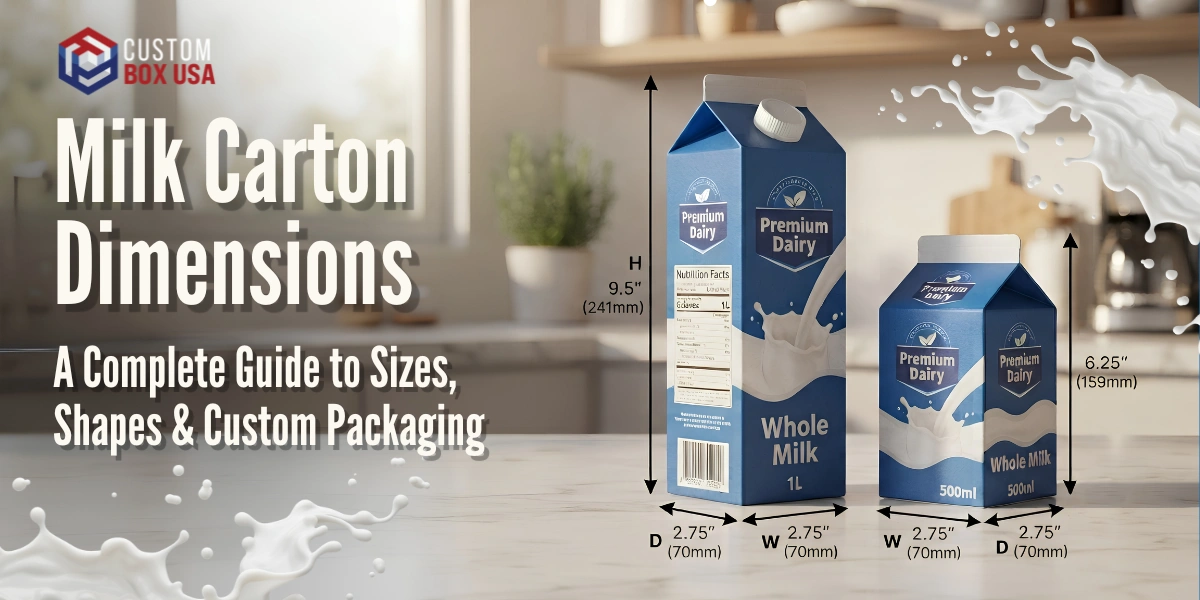
Milk Carton Dimensions: A Complete Guide to Sizes, Shapes & Custom Packaging
Picking the right milk carton size is not just a formality before placing an order, it decides how the carton sits on a shelf, how many fit on a pallet & how a customer experiences your product the moment they open the fridge door. Get the milk carton dimensions wrong & you are either paying for wasted shipping space or watching your cartons wobble on a shelf they were never built to fit.
Custom Box USA works with dairy brands & beverage companies to build custom milk carton packaging. They designed around exact volume, shelf space & branding needs if that is a school ready half pint or a full gallon gable top carton for retail. Before placing an order it helps to actually understand how milk carton size is measured, what the standard dimensions look like in the industry & where custom sizing genuinely makes sense.
The History of Milk Cartons
Milk cartons did not always exist in the way we know them today. Before, the milk used to be transported in glass bottles which were refilled doorstep-to-doorstep. This was until the beginning of the 1900s when the first milk carton made of paperboard appeared in the form of a simple gable-top. Surprisingly enough, that very shape is what we mostly associate with now.
However, by the time of the 1950s refrigeration alone could not satisfy the needs of the dairy industry. This brought about a rise to the development of aseptic packaging technology which protected the milk from light, heat and oxygen thus making it last long without being refrigerated.
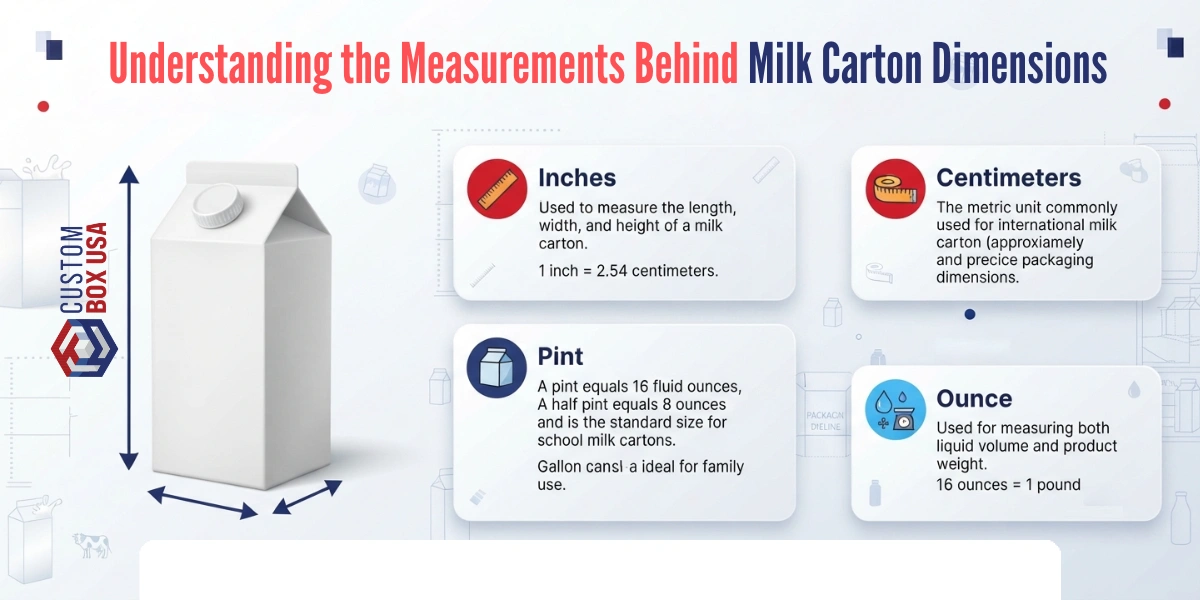
Understanding the Measurements Behind Milk Carton Dimensions
Before getting in exact milk carton box dimensions it helps to know the units involved because milk packaging in the US mixes liquid volume measurements with linear box measurements.
- Inches are used to measure the length, width as well as the height of a carton. One inch equals 2.54 centimeters.
- Centimeters are the metric equivalent that commonly used for international milk carton specifications & exact dimension work.
- Pint is a liquid measurement equal to 16 ounces means a half pint equals 8 oz & is the standard size for school milk carton servings.
- Quart is equal to a quarter of a gallon means roughly 0.94 liters & a common size for individual or specialty dairy items.
- Gallon: the largest standard milk unit in the US holding 128 ounces & the size most families buy for weekly use.
- Ounce used each for liquid volume & carton weight with 16 ounces making up 1 pound.
Knowing these units matters because a milk carton dimensions chart usually mixes them volume in ounces or liters & carton size in inches or centimeters.
Standard Milk Carton Sizes Chart
Here is a breakdown of the most common standard milk carton sizes used in the US dairy & beverage industry
|
Carton Size |
Volume (oz/ml) |
Approximate Dimensions (L x W x H) |
|
Half Pint |
8 oz / 236 ml |
6.9 cm x 5 cm x 9 cm |
|
Pint |
16 oz / 473 ml |
8.5 cm x 6 cm x 11.5 cm |
|
Quart |
32 oz / 946 ml |
12.8 cm x 10 cm x 13 cm |
|
Half Gallon |
64 oz / 1.89 L |
15.5 cm x 9.5 cm x 17.5 cm |
|
Gallon |
128 oz / 3.78 L |
19 cm x 11.4 cm x 20 cm |
These figures represent the commonly used industry range though exact milk carton box dimensions can shift slightly by manufacturer or carton shape. A quart of milk carton & an 8 oz milk carton are two of the most commonly searched sizes largely because they cover the individual servings as well as specialty retail positioning.
- Tip: Always confirm dimensions with your packaging manufacturer before finalising print files just a couple of millimetres of difference in paperboard thickness can shift the final external carton size.
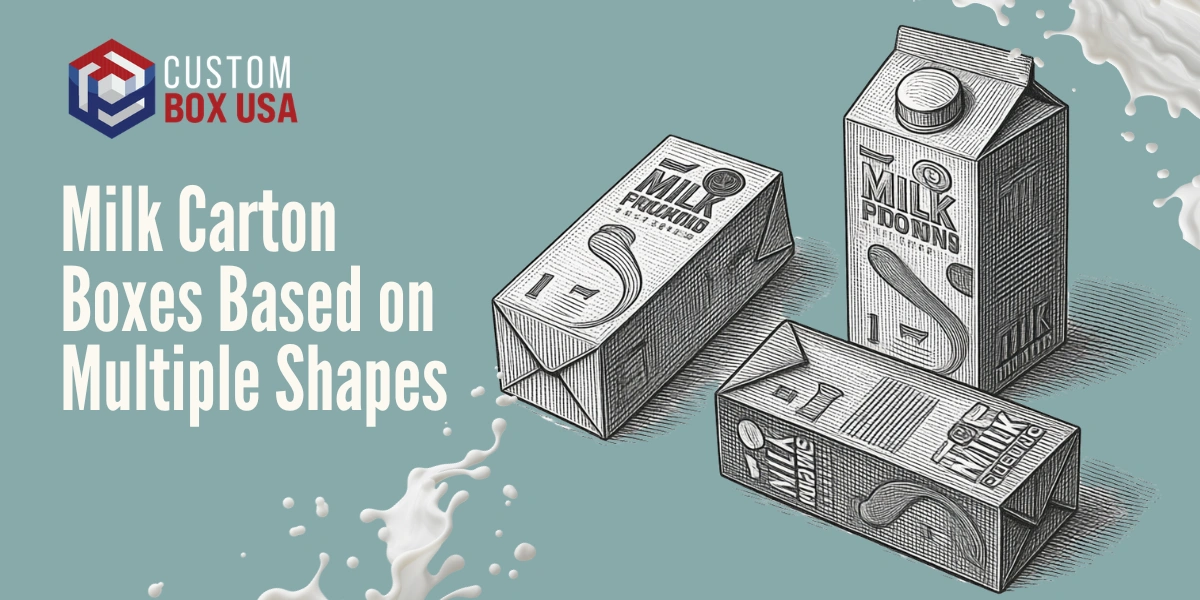
Milk Carton Boxes Based on Multiple Shapes
There are 2 shapes that dominate milk carton boxes in the US & the shape you pick directly affects how you calculate volume.
-
Square Gable Cartons
Square gable cartons are typically used for quart or half pint milk & they feature a square base with a gable-top roof though unlike a true gable boxes they do not include a hold a handle.
Volume formula: V = side × side × side (V = s³)
-
Rectangle Gable Cartons
Rectangular cartons are the go to shape for half gallon & gallon milk packaging. Their sleek & elongated profile fits easily in a fridge door & the gable-top roof structure allows a bit of extra headroom for the liquid inside.
Volume formula: V = Length × Width × Height
How to Measure Milk Carton Dimensions: A Complete Guide
Getting the right milk carton dimension reading is not complicated but it does need consistency in each carton in a batch.
- Measure the height from the base to the top checking all 4 corners for consistency
- Measure the length from the front panel excluding any flaps or spout structures
- Measure the width from the sides again checking all four corners
- Calculate the volume once you have all three measurements using the formula that matches your carton's shape
Tools You Will Needpl
A basic measuring tape or ruler works for most day-to-day checks but for production level accuracy paperboard manufacturers typically use
- Digital calipers for precise length/width/height readings
- Screw gauges specifically for measuring carton wall thickness
- Measuring apps some manufacturers now use the camera on a smartphone app for quick reference checks before a full caliper measurement
How to Measure Dimensions without a Tape Measure?
What to do if you are in a meeting or a field where you need proper tools for carton measurement, but you forgot to take. Don't worry! You can still measure milk carton dimensions with the following:
Standard US Dollar Bill
It has a length of 6.14 inches that you can use to measure the length of the milk box approximately.
Credit Card
A credit card has an approximate width of 3.37 inches, which you keep with you everywhere.
A4 Sheet of Paper
A4 sheet of paper has dimensions 11.7 x 8.3 inches. You can have a rough idea of length and width by comparing the box with an A4 sheet.
Smartphone Apps
In the modern era, it is very easy to have measurements of the carton with the help of smartphone Apps. They give you not exact but close dimensions.
Using these tricks and tools, you can avoid embarrassment and still measure the carton dimensions.
Materials Used in Milk Carton Packaging
The material behind a milk carton not only holds its shape it also protects freshness and resists leaks as well as controls how long the product can safely sit on a shelf. The most common materials are
- Paperboard: A thick, light & sturdy base material that forms the structural core of most gable top cartons. It is the most commonly used option for standard milk carton boxes.
- Cardboard: Light, highly customizable & easy to print on cardboard is popular for retail facing designs where branding & shelf appeal matter as much as function.
- Polyethylene: A thin waterproof coating applied over paperboard or cardboard making the carton leak resistant & perfect for holding liquid with out the material breaking down.
- Aluminum Foil: Used in thin layers in aseptic cartons to block light & oxygen extending shelf life significantly compared to standard refrigerated packaging.
Gable-Top Cartons vs. Aseptic Cartons: The Main Difference
|
Feature |
Gable-Top Carton |
Aseptic Carton (Tetra Pak Style) |
|
Construction |
Paperboard + polyethylene coating |
Six layer construction with aluminum foil |
|
Shelf Life |
2 to 3 weeks/refrigerated |
6 to 12 months/unrefrigerated |
|
Common Use |
Fresh dairy milk/retail & school |
UHT milk, plant-based milk as well as export products |
|
Storage |
Requires cold chain |
Shelf stable |
Standard gable top cartons are built for fresh & refrigerated milk with a short shelf life while aseptic cartons are designed for extended unrefrigerated storage which is why UHT & organic milk brands increasingly favor the aseptic format for huge distribution.
How Milk Carton Sizes Differ Around the World
Milk carton sizing is not universal & this is a gap worth understanding if you are packaging for not just one market.
- US: Predominantly half-gallon (1.89 L) & gallon (3.78 L) sizes for household retail with half pint cartons for school or food service.
- Europe: Commonly uses 1-liter Tetra Pak-style cartons for shelf stable UHT milk.
- UK: Favors HDPE plastic bottles measured in pints with 2 pint & 4 pint being the most common household sizes.
If you are a brand selling in multiple regions this difference affects not just carton dimensions but the whole packaging & shelf stability strategy behind the product.\
Picking the Right Milk Carton Size for Your Brand
If you are not sure which size fits your product here is a simple way to decide
- Half pint or single serve: Best for schools, cafeterias or hotels where portion control & grab and go comfort matter most.
- Pint or quart: Suited to specialty or premium dairy products aimed at individual consumers instead of households.
- Half gallon: The standard option for mainstream US retail that offers strong shelf visibility in a typical refrigerator case.
- Gallon: Perfect for food service, institutional buyers & bulk channels where cost per ounce efficiency drives the decision.
A full gallon of milk weighs approximately 8.6 pounds (3.9 kg) with the carton itself adding only a small fraction of extra weight worth factoring in if shipping cost is part of your packaging decision.
Logistics: Milk Crate & Pallet Dimensions
Carton size is only part of the packaging picture how those cartons move in a supply chain matters just as much. Standard milk crate dimensions typically accommodate multiple gallon or half-gallon milk carton units in a stacked configuration designed for repeated handling with out crushing the cartons inside. When planning milk carton pallet dimensions, brands need to account for the crate footprint as well as the total stack height allowed for safe transit a detail that directly affects how many units ship per truckload & how much that shipment ultimately costs.
Common Mistakes To Avoid During Measurement
Measuring accurate dimensions for a carton of milk is not an easy task and needs focus. Even professionals make mistakes while measuring the length, width, and height of the milk boxes. Here are some common mistakes you should avoid during measurement:
1. Forgot to include the cap while measuring
2. Rounding off values early while converting inches into centimeters.
3. Ignore wall thickness when working on the internal walls of the box.
4. Use a flexible ruler that bends and curves, giving inaccurate values.
Factors That Affect Dimensions
Volume, shape, and material are the factors that affect dimensions. Let’s see how they affect the dimensions of a carton:
Milk Volume
To hold a large amount of milk, we will need large cartons. For a few ounces, we will need small cartons. So the volume affects the carton size in this way.
Shape
Milk packs are most commonly used in rectangular shapes. Now, different shapes can be used for cartons, which changes the measurement pattern.
Material Type
The type of material also affects the dimensions of the carton. Paperboard alone cannot be used for milk packs. A food-grade plastic layer is added inside the carton box that protects the milk from spoiling. Their thickness may vary, which can change the dimensions of the box.
Custom Milk Carton Packaging for Your Brand
Standard sizes work great for most dairy products but plenty of brands particularly emerging plant based milk & premium beverage lines use custom dimension packaging to stand out on a crowded shelf. Custom box USA works directly with brands to build custom sized milk carton boxes that still meet retail shelf requirements & food safety standards while giving your product a distinct shape & presence that standard sizing can not offer.
If you need full color exterior printing, matte or gloss finishing, custom logo placement or FSC-certified sustainable paperboard getting your milk carton dimensions right from the start avoids costly reprints & maintains your production timeline on track.
FAQs
How do you measure a milk carton box?
Measure the height from base to top, the length from the front panel excluding flaps & the width from the sides then multiply for volume.
Do milk carton dimensions include the spout or cap area?
No standard measurements are measured from the main body of the carton & typically exclude the spout or gable top peak.
What is the difference between a Tetra Pak carton & a regular milk carton?
Regular gable top cartons suit refrigerated fresh milk with a 2 to 3 week shelf life while aseptic Tetra Pak-style cartons use foil layers to stay shelf stable for 6 to 12 months unrefrigerated.
Can I customize milk carton dimensions for my brand?
Yes most manufacturers like Custom Box USA offer custom sizing in addition to standard formats as long as the design still meets retail & food safety requirements.
What is the best milk carton size for a small dairy brand launching in retail?
The quart or half-gallon size generally offers the best mix of consumer appeal & shelf presence: half-gallon for mainstream positioning, quart for a slightly premium or specialty product.