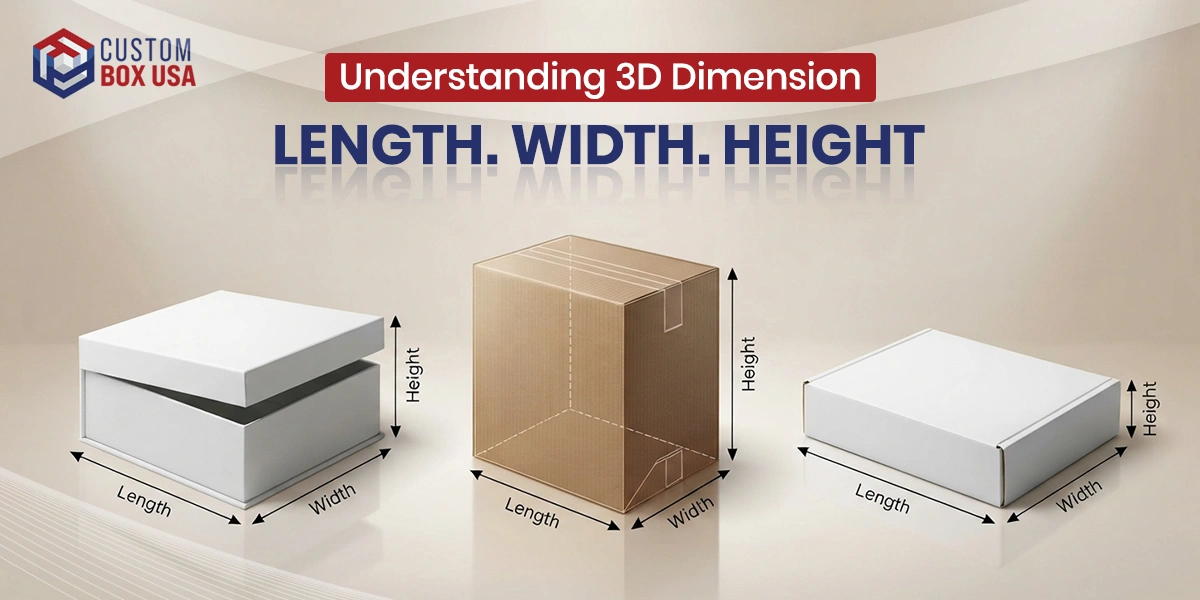
The size and volume of an object are typically measured in terms of length, width and height, where length is the longest side, width is the shortest side perpendicular to length, and height is the distance from the base to the top. If any of these three dimensions are incorrect for a custom box order, it will float around inside on the delivery day or it will simply not fit at all.
If you ask 10 people what 12 x 8 x 5 means in a spec sheet most will be guessing the answer instead of confidently answering it. This guide explains the meaning of each dimension, why it is important to perform calculations in the correct order, how the volume is calculated and what changes according to the box style.
Why Getting Box Dimensions Right Actually Matters
Packaging sizes were once just a rough estimate and extra room for "just in case. That's all been changed with the rising shipping prices and unboxing videos revealing every loose corner. The length, width and height are now quietly determining whether a box will protect a product or cost money to do so.
The right-sized box avoids any empty areas that allow a product to slip or break a corner during shipping. Do it wrong, and it's either over padding a shaky product or trying to fit a product into a box that's not cozy enough. Both are more expensive than getting it right the first time.
The Order of Length, Width, Height
The packaging world uses the dimensions of the boxes read from left to right on the box: L x W x H. It is not a law of physics but the industry agrees that a manufacturer in one state will see the same numbers as a buyer three states away. In a box, length is most important, width second and height is last, unless the box is a different shape. It's occasionally seen as width x length as well, typically on a spec sheet where only the base is relevant.
The industry order isn't random; it is based on ergonomics, specifically, which side of the box your eyes naturally look at first. Once an industry adopts a specific box style, that visual habit becomes the standard layout.
|
Orientation |
Common Order |
Why |
|
Horizontal / lying flat |
Length × Width × Height |
Standard for most shipping and retail boxes |
|
Vertical / standing upright |
Height × Width × Length |
Height is the dimension you see first |
|
Horizontal, viewed from the side |
Length × Height × Width |
Common when reading a side panel |
|
Vertical, viewed front-on |
Height × Length × Width |
Used for tall, narrow packaging |
What Length, Width, and Height Actually Mean
The longest side of the base of the box is called the length and is measured from end to end. The shorter side of the base measured across the front (or "breadth" outside the U.S.) is the width. The distance from the base to the top, generally synonymous with "depth" depending on the supplier.
Imagine a shoe box where length is the long edge in front of you, width is the short edge across the top of the box and height is how tall it is. The only exception is a cube where all three sides are equal, but only when a box becomes rectangular do the three sides start to vary.
The Dimensions of a Box Explained
Each box has a "footprint" (that is, a flat rectangle that you would see looking straight down at the box) and a vertical "rise" or "height. The combined length and width are the footprint, and the height is the vertical rise. The dimensions of a box are a reference to all three combined, or written together as the width and height of a box on a spec sheet.
Length vs Width
Both of these measurements are only of limited value individually. Two boxes with the same volume can be in different shapes, such as 20 x 4 and 12 x 12. Length and width are simply different ways of considering the floor space a product has to work with, before height comes into play.
Width vs Height
If you view a box directly from the front, it's easy to see the width, but the height is not always seen until the box is tilted or viewed from the side. This is the number one mistake that buyers make when they forget to consider this vertical angle.
Height Vs Length
The same procedure applies to length. When you look at a box directly in front of you, it's not the length, but the width. The same trick is performed on height. There is no way to see the relationship between length and height except to turn the box or view a side profile.
Step-by-Step Guide on How to Measure a Box
There is no need to use complicated measuring devices, just a standard tape measure or ruler will work. As long as all three are in the same unit (inches or centimeters).
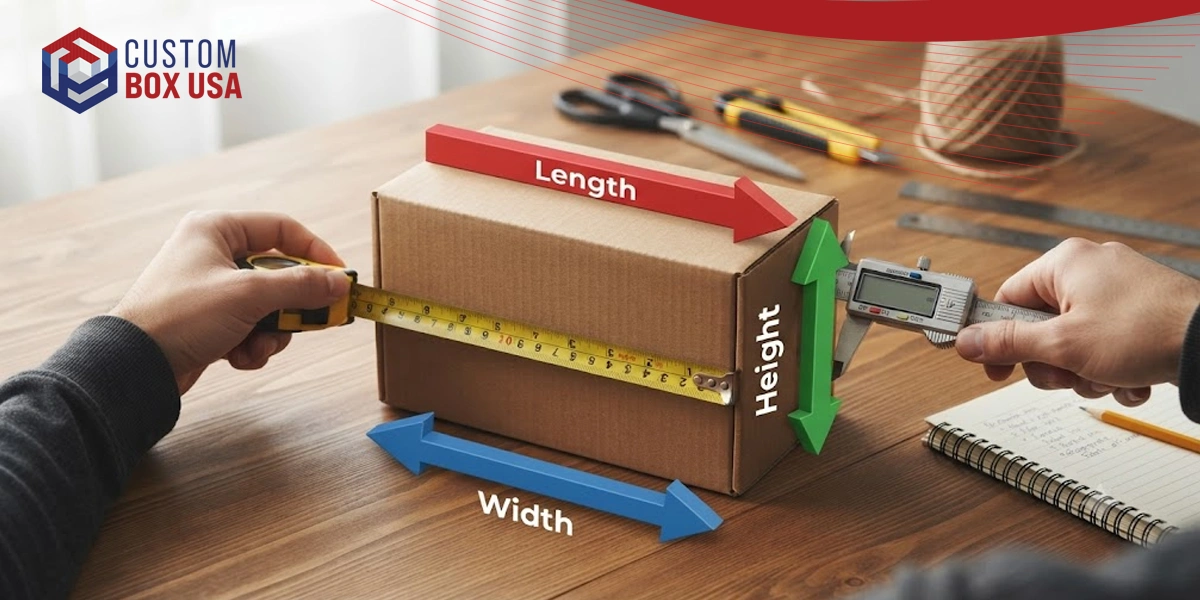
- Step 1: Measure the Length (L): Place the box on a level surface, with the flaps closed. Find the longest side of the bottom. Take a measuring tape and measure it from one end to the other.
- Step 2: Measure the Width (W): Turn the box 90 degrees. Take the measurement of the shorter length of the base.
- Step 3: Measure the Height (H): Measure from the bottom edge of the box to the top edge of the box. (Note: This is sometimes referred to as "depth" by some suppliers).
- Step 4: Check Your Intent: When checking fit of your product boxes, use the internal measurements. For shipping space and/or storage layout, measure the exterior dimensions.
Measure the Length
Place the box with the flaps shut on a level surface so the box can sit flat. Measure the longest side of the bottom and run your measuring tape along the entire side. Keep the number first, it's easy to forget when you are concentrating on the next measurement, the width.
Measuring Box Dimensions the Right Way
The key to measuring dimensions of boxes accurately is consistency – same unit, same surface, same starting point each time. If possible, repeat measurements on each side, as one misread measurement on a spec sheet can ruin an entire production run.
How to Calculate the Volume of a Box
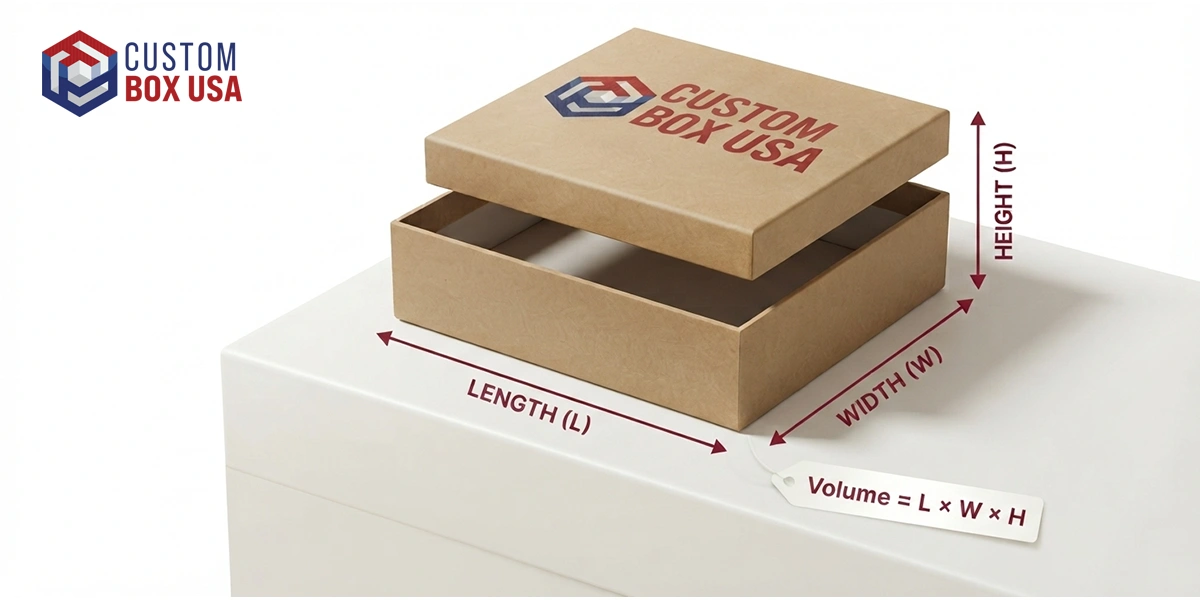
Volume = Length x Width x Height. A 16 x 12 x 10 inch box works out to 1,920 cubic inches. Carriers are charged by dimensional weight (DIM weight), which is the greater of the actual weight or the dimensional weight of your box, which is the volume of the box divided by a carrier-specific divisor.
FedEx and UPS use a divisor of 139 for domestic shipments. Currently, USPS employs 166, but will switch to 139 on July 12, 2026. The oversize surcharge is affected by the size of your box, which is determined by the width and height, measured as “girth” (2 x (width + height)).
The Length x Width x Height Formula
The formula x x y is written as the product of three numbers: length x width x height. The area of the footprint is length x width and the volume is area x height; it's as easy as that.
The Volume of the Box, Explained
When measuring volume, you're getting two pieces of information: how much usable space the box will take up for your product, and how much it will cost you to ship it by dimensional weight. It's important to consider width and height as well as length here because carriers charge based on the volume of space a box takes up, not its weight.
Box Style Changes the Measurement
The formula length x width x height is used for a simple cube or rectangular carton, but it is not used for special shapes.
|
Box Style |
What Changes |
Why It Matters |
|
Pillow Boxes |
Height measured from the center of the curve |
Curved edges don't give a straight vertical line |
|
Mailer Boxes |
Roll-end folds eat into internal space |
Height needs extra allowance or flaps crush the product |
|
Gusseted Boxes |
A separate depth measurement covers the expandable sides |
Usable space changes once it's filled |
|
Rigid Boxes |
Wall thickness is more pronounced |
Internal and external dimensions differ more noticeably |
If you don't know how to measure a specialty box style, send a sample of the product rather than guessing.
Two Dimensions VSThree Dimensions
The majority of products do not require a complete three-measurement spec sheet. A few products have a flat enough size that just one pair of numbers is sufficient to give the packaging supplier all you need to know.
Two-Dimensional Boxes: If you're designing a box that will only be two-dimensional, then length and width are the only dimensions to consider. Again, there is no depth to pack, and things such as photos, canvas art, flat legal documents etc. are typically shipped in a flat, envelope style.
Three-Dimensional Boxes: A three dimensional box has height or depth (also known as length) and that is what provides volume to the box. Cubes or rectangular prisms are solid shapes that require actual space in the interior, as would any other solid shape. Everyday examples of 3-D packages include shoeboxes, cereal boxes and tissue
Internal vs. External Dimensions
Internal dimensions refer to the usable space inside the box. External dimensions account for the thickness of the packaging material itself. For example, rigid gift boxes generally have a thick wall construction between 2mm and 4mm. Getting these numbers right ensures a perfectly snug fit for your product; getting them wrong means your product simply won't fit inside.
The most common beginner's mistake is to confuse which is which. Before production, be clear to your supplier if you are providing internal or external measurements, particularly on more complex boxes such as gusseted boxes.
Measuring Internal Dimensions
Internal dimension is measured by opening the box and measuring between the inside walls, not the outside edges. It's really the number that counts when it comes to product fit, as it does take the thickness of the material.
The Internal Dimensions of a Box
The internal size of a box will always be a little smaller than the external size, either by a few millimetres or by more thicker rigid material. If you're not sure, you can check directly with your supplier to see which set of numbers they are quoting.
Common Standard Box Dimensions
It is always best to have a size designed around the product, but it is nice to know in advance where the standard sizes will fall before asking for a custom quote:
|
Box Type |
Typical Size Range |
|
Small mailer boxes |
4" x 4" x 2" to 8" x 6" x 4" |
|
Standard shipping boxes |
8" x 8" x 8" to 12" x 12" x 6" |
|
Apparel and flat boxes |
Around 12" x 9" x 3" |
|
Flat corrugated boxes |
28" x 28" x 6" internal |
|
Small rigid gift boxes |
4.25" x 4.25" x 12.5" to 6" x 5" x 2.25" |
These are real internal dimensions pulled from current corrugated and rigid box product lines, not arbitrary estimates.
Common Mistakes to Avoid When Measuring
Any inaccuracies in measurement can result in wrongly sized boxes, extra shipping costs and production delays. Do not make these common errors to have the correct and proper size of your box for your product.
- If internal and external measurements do not correspond, the box will not fit the product it is designed for.
- Rounding too early. If the mold is used for die-cutting, a small error of a few millimeters can destroy the mold; if it is used for producing articles, it can cause the articles to fall out of the box.
- Not considering flaps, insert or cushion when measuring internal space.
- Mid-project change of units: inches/cm and all spec sheets will be in that unit.
- We removed the confusing art analogy and replaced it with a real, common mistake that happens when ordering boxes: confusing the top opening of the box with the front of the box.
We also made the warning about the order (Length × Width × Height) punchier. If a customer writes the numbers in the wrong order, the factory will build the box completely wrong (e.g., making it too tall instead of too wide), which wastes thousands of dollars.
The Order Isn't Universal Outside Packaging
The term length x width x height applies to shipping and packaging boxes, but not to all products. If you're thinking of a piece of furniture or a room, you are probably more likely to consider Width x Depth x Height; these are the dimensions used by furniture manufacturers and architectural plans.
3D modeling and computer graphics software takes it one step further, by defining Width x Height x Depth with X, Y, Z coordinate axes, and some European engineering standards prioritize height over width and length. Don't assume that a spec sheet from a furniture vendor or CAD file is in the same sequence as a box supplier will use.
Where to Order Custom Boxes
Looking for a partner that gets L x W x H right the first time? Custom Box USA makes boxes to your specific size and packaging requirements: mailers, rigid boxes and corrugated cartons without any die or plate charges and with free box design assistance.
Minimum orders are 100 boxes and if you are unsure about a size there is no need to order 1,000 boxes to test it. The terms of the offer include Free shipping across the USA and a standard 7 business day production time. Get a quote and save the estimation effort.
Final Thoughts
Understanding how to measure the length, width and height of a box, how to calculate its volume, and how the internal dimensions are just as important as the external. These 3 numbers determine if packaging is going to work or not, either for a single product or a whole production run. Once you're ready, Custom Box USA creates a box to your exact specifications, without any guesswork, without ill-fitting packaging, no sizing up and down just the right size from the start.
FAQ's
What is the correct order to write box dimensions?
Always L x W x H – the lengths, widths and heights always come in that order.
Does width or height come first?
The length is first, the width is second, and the height is last (although for some suppliers, height is first for vertically oriented boxes).
Does depth equal height?
Yes, for the majority of packaging applications. Depending on the supplier, they are used interchangeably.
Should I measure the dimensions inside or outside of my box?
Internal fits for product and external for shipping and storage.
How to find the volume of a box?
Calculate length x width x height. A 16 x 12 x 10 inch box equals 1,920 cubic inches.
How does box size impact shipping cost?
Dimensional (DIM) weight is determined by the “volume” of the box, not the box's actual weight.